The 60-second version
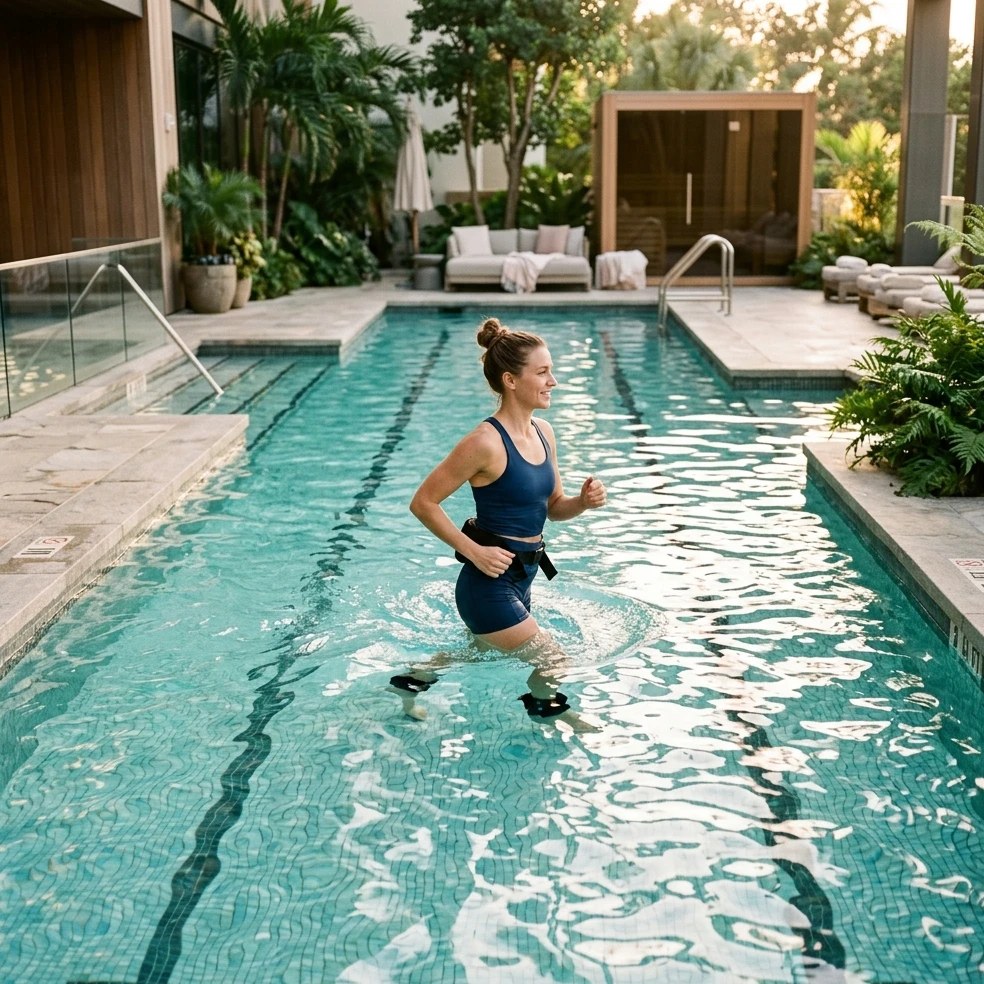
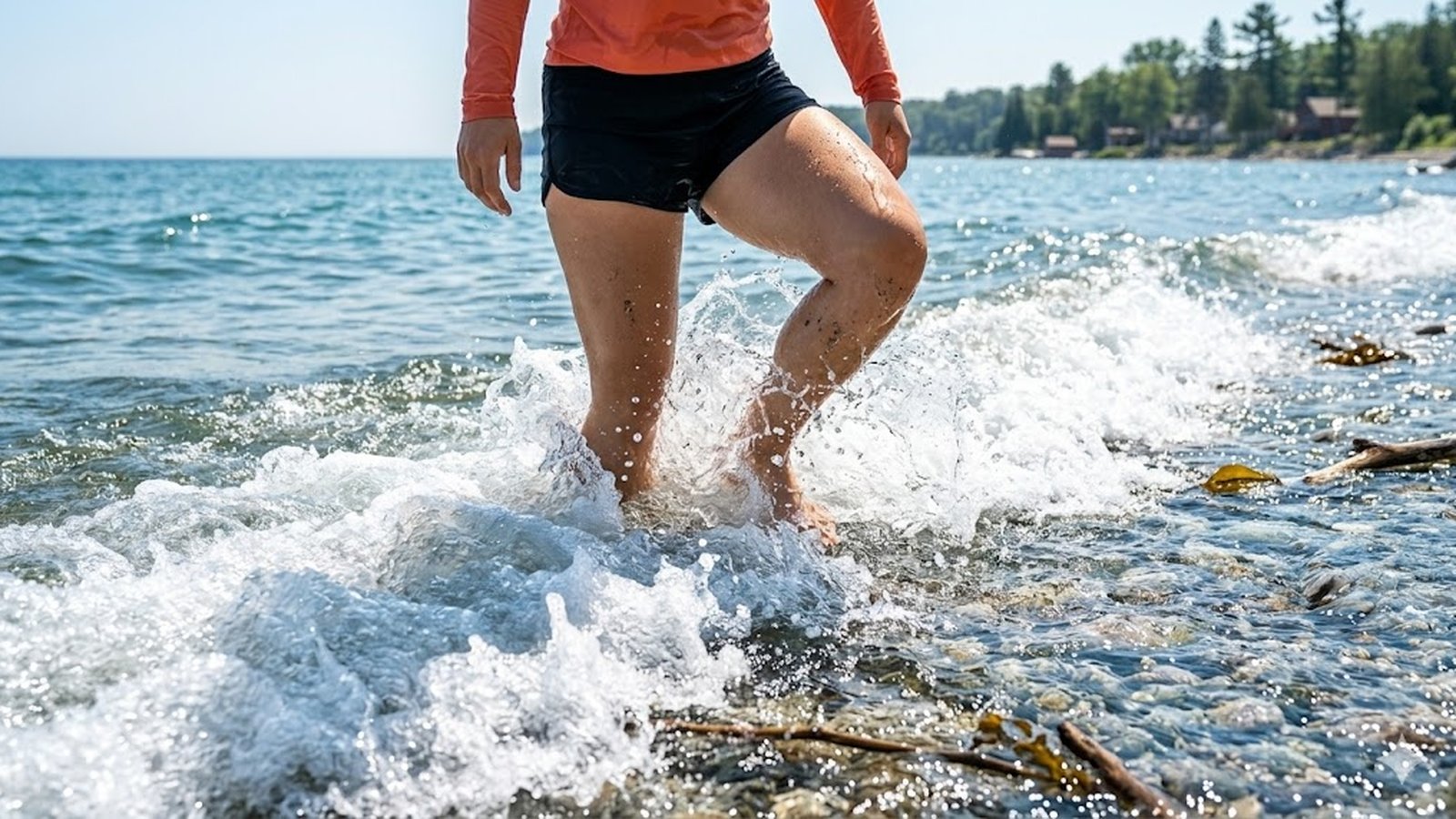
Walking against shallow water flow is a real resistance modality with a well-defined physiology: the drag force scales with velocity squared, so even a 0.5-metre-per-second flow more than doubles the energy cost of equivalent dry-land walking Pohl 2002. The muscle groups recruited are different too — hip abductors and ankle stabilizers fire continuously to maintain alignment against lateral flow forces Becker 2009. For Wasaga readers, walking the lake shallows in moderate wave action is a legitimate lower-body conditioning stimulus, especially for rehabilitation populations who cannot tolerate land-based loading.
What the evidence actually says
Aquatic walking has been studied as both a therapy modality and an athletic conditioning tool. The cleanest physiology paper is Pohl, who measured oxygen consumption and EMG during walking against varying flow rates in a flume tank. At a flow rate of 0.5 m/s — roughly the conditions of mild surf at thigh depth — oxygen consumption rose to 2.3× matched dry-land walking, with corresponding rises in soleus, gluteus medius, and quadriceps activation Pohl 2002.
The therapy-side evidence comes from Becker’s review of aquatic exercise for orthopedic rehabilitation. Wading and shallow-water walking offer 50-70% bodyweight unloading at chest depth while still providing a measurable resistance demand — a combination land-based exercise cannot match Becker 2009. Patients with knee osteoarthritis or post-surgical lower-extremity rehab tolerate aquatic loading at 4-6 weeks post-op when dry-land walking would still be too painful.
How it actually works
Drag force on a body moving through water scales with the square of the relative velocity. Doubling the flow rate quadruples the resistance, which is why walking in calm water feels easy but walking through chest-deep moderate surf feels like a serious workout. The hydrostatic pressure also matters — immersion increases venous return and reduces peripheral edema, which is part of why the rehab benefit is more than just unloading Batterham 2011.
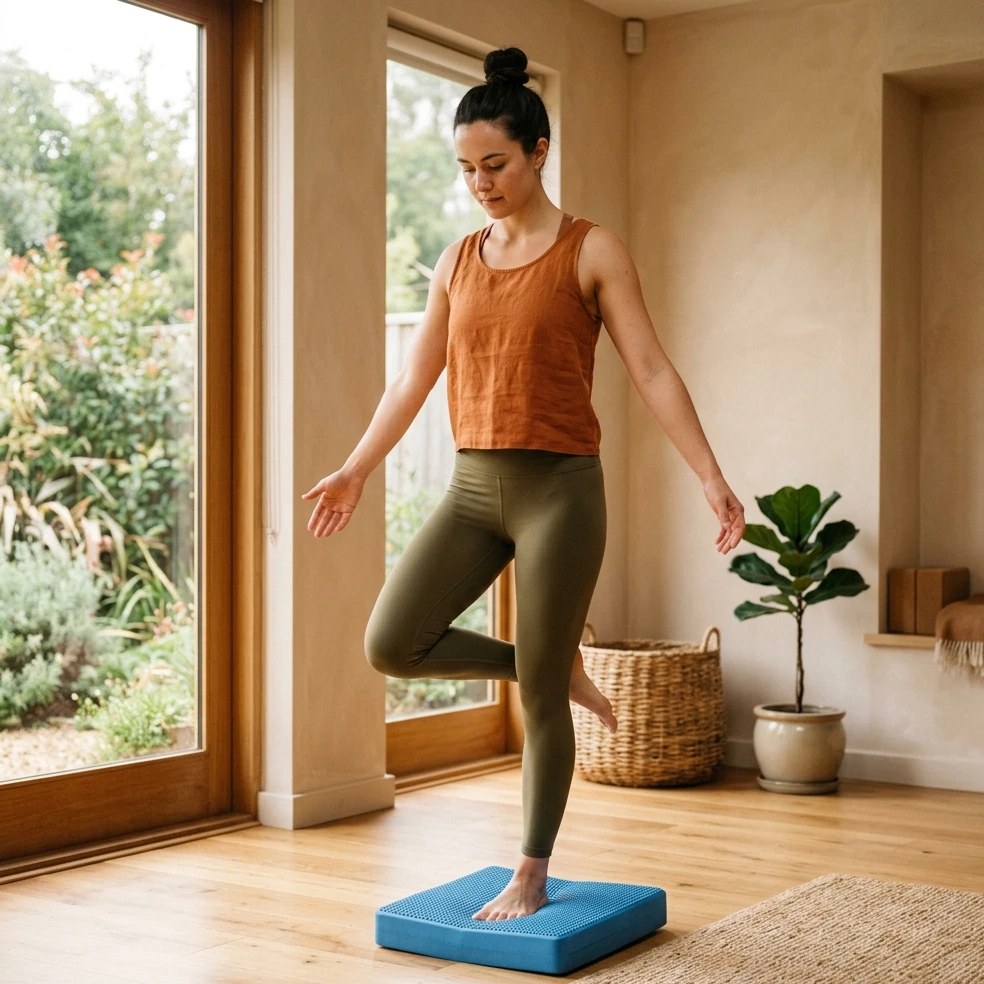
The unique training stimulus comes from the lateral resistance. Land walking trains the sagittal plane (forward propulsion) almost exclusively. Wading against side-to-side current trains the frontal plane (lateral stabilization), which is exactly the recruitment pattern that translates to ankle and hip injury resilience DiStefano 2009.
“Walking against moderate water flow produces oxygen consumption levels equivalent to running on dry land at higher speeds, with notably greater recruitment of the lateral hip stabilizers.”
— Pohl & Skedros, Medicine & Science in Sports & Exercise, 2002 view source
The caveats people skip
The water-temperature variable is the most-overlooked. Cold water (below 18°C) shifts the autonomic response and the energetics. The metabolic cost rises as the body fights to maintain core temperature, which can be useful for athletic conditioning but problematic for rehab populations whose vascular response to cold is impaired Stadler 2024. Warm-water (28-32°C) walking is the rehabilitation default; cool-water (18-24°C) walking is an athletic conditioning tool.
The second issue is footing. Lake-bottom variability — rocks, drop-offs, soft mud — introduces ankle-injury risk that pool walking does not. Wear water shoes for any walk longer than 10 minutes, and avoid the 30-minute mark on unfamiliar bottoms.
Practical takeaways
- Wade at thigh-to-chest depth for the meaningful resistance. Knee-depth gives you almost the same load as dry-land walking; the resistance scales sharply with depth.
- Walk perpendicular to mild current or surf for the strongest lateral demand. Forward and against produces the highest energy cost; lateral produces the highest hip-stabilizer recruitment.
- Wear water shoes. Lake-bottom hazards turn a low-impact session into an ankle injury fast.
- Use cool-water (18-24°C) for conditioning, warm-water for rehab. Temperature matters for the autonomic response.
- Build duration over 3-4 weeks. The unfamiliar lateral demand produces hip-stabilizer soreness that catches first-time waders by surprise.
References
Pohl 2002Pohl MB, McNaughton LR. The physiological responses to running and walking in water at different depths. Research in Sports Medicine. 2003;11(1):63-78. View source →Becker 2009Becker BE. Aquatic therapy: scientific foundations and clinical rehabilitation applications. PM&R. 2009;1(9):859-872. View source →Batterham 2011Batterham SI, Heywood S, Keating JL. Systematic review and meta-analysis comparing land and aquatic exercise for people with hip or knee arthritis on function, mobility and other health outcomes. BMC Musculoskeletal Disorders. 2011;12:123. View source →DiStefano 2009DiStefano LJ, Padua DA, Blackburn JT, Garrett WE, Guskiewicz KM, Marshall SW. Integrated injury prevention program improves balance and vertical jump height in children. Journal of Strength & Conditioning Research. 2010;24(2):332-342. View source →Stadler 2024Stadler J, Dawson EA, Green DJ, et al. Cold water immersion and the physiological response: a systematic review. European Journal of Applied Physiology. 2023;123(11):2389-2410. View source →