The 60-second version
Play-based fitness consistently outperforms structured exercise for adherence and skill development in school-age children. Stodden’s 2008 motor-competence framework laid the conceptual case: motor-skill proficiency in childhood predicts physical-activity engagement across the lifespan, and the way to build that proficiency is through varied, play-rich movement experience rather than through narrow, repetitive structured drilling Stodden 2008. Lubans’ 2010 systematic review confirmed that fundamental movement-skill interventions in children deliver real cardiovascular fitness, body composition, and motor-development benefits Lubans 2010. Vanderloo 2014’s childcare-environment data showed that activity-rich environments (open space, varied equipment, encouraging adults) produce substantially higher activity volumes than structured-curriculum environments Vanderloo 2014. Pesce’s 2016 enrichment trial demonstrated that play-rich physical-education with cognitive elements produced larger gains than ordinary PE in motor-coordination and cognitive control measures Pesce 2016. The honest synthesis: the beach scavenger hunt is not a watered-down workout; it is the format the child-fitness literature most consistently supports.
What the play-based fitness research actually shows
Stodden and colleagues’ 2008 developmental framework is the most-cited conceptual foundation for the play-based child-fitness argument. Their model proposes that motor-skill competence in childhood is reciprocally linked with physical-activity engagement, perceived competence, and physical fitness, and that the link strengthens with age Stodden 2008. The practical implication: building broad motor competence in young children — running, jumping, throwing, climbing, balancing — is a more durable predictor of teenage and adult activity than any single sport-specific skill. Varied play environments build broad motor competence; narrow structured drilling does not.
Lubans, Morgan, Cliff, Barnett, and Okely’s 2010 systematic review of fundamental movement-skill interventions confirmed the framework empirically Lubans 2010. Across 21 included studies, programmes targeting fundamental movement skills produced consistent improvements in motor competence and meaningful gains in cardiovascular fitness, body composition, and self-esteem. The largest effect sizes came from interventions that combined skill-specific instruction with play-rich practice opportunities — the design pattern a well-built scavenger hunt naturally implements.
Vanderloo and colleagues’ 2014 cross-sectional analysis of 11 childcare centres documented the environmental contribution clearly Vanderloo 2014. Centres with open outdoor space, varied climbing-and-balance equipment, and adults who actively encouraged play produced substantially higher physical-activity volumes than centres with constrained space, limited equipment, or adult passivity. The shoreline-as-environment is in many ways the highest-end version of the ‘activity-rich’ environments Vanderloo’s data identified as most effective: open space, varied terrain (sand, water, driftwood), and natural opportunities for climbing, jumping, and exploring.
Pesce, Masci, Marchetti and colleagues’ 2016 enrichment trial provided the strongest single test of the play-rich-versus-ordinary-PE comparison Pesce 2016. Their 460 children aged 5–10 years participated in a 6-month group-randomised intervention with or without playful coordinative-and-cognitive enrichment. The enriched intervention produced larger gains than ordinary PE on every motor-coordination measure (manual dexterity, ball skills, static and dynamic balance) and on cognitive-inhibition measures. The enrichment was structurally similar to a well-designed scavenger hunt: varied movement tasks, problem-solving elements, and a narrative framework that engaged attention and effort beyond what straightforward calisthenics would.
The motor-development levers a scavenger hunt activates
A well-designed beach scavenger hunt activates four of the six fundamental movement-skill categories Lubans 2010 identified as core to child motor development: locomotor (running between hunt locations, jumping over driftwood, climbing dunes), object-control (picking up shells, tossing sand-balls into a circle), stability (balancing on logs, walking the wet-sand line, single-leg searches), and dynamic balance under task-load (carrying found objects while continuing to move) Lubans 2010. The remaining two categories — throwing-with-precision and kicking — can be built into the hunt easily with thoughtful task design.
The Stodden 2008 framework’s core insight is that broad motor competence beats narrow specialisation in childhood; the scavenger hunt’s structural strength is that a single 30–45 minute session naturally exposes the child to multiple movement patterns rather than the repeated single-pattern work that characterises structured drilling Stodden 2008. Children who would never voluntarily complete 30 sit-ups or 30 squats will happily climb, run, jump, search, and carry for an equivalent duration of accumulated effort, with the additional motor-development bonus of the variety itself.
The Pesce 2016 cognitive-enrichment finding adds a useful design principle: the cognitive elements of the hunt (figuring out clues, organising the search strategy, remembering the list of finds) appear to produce additional gains beyond the pure-physical contribution Pesce 2016. A scavenger hunt with a real cognitive load — clues to interpret, a sequence to follow, a count to keep — recruits attention and inhibitory control in ways that pure free-play doesn’t match. The implication: a well-structured hunt is meaningfully better than unstructured beach play, and the cognitive design effort pays back in both motor and cognitive domains.
The age-specific calibration matters. For 6–8 year olds, simpler hunts with picture-based clues and shorter physical distances work best; the cognitive load is age-appropriate and the physical demand fits attention and stamina. For 9–12 year olds, longer hunts with riddle-style clues, multi-step tasks, and small competitive elements work better; older children tolerate and engage with more cognitive complexity and respond to the social-comparison element that team-based hunts add.
A 30-minute scavenger-hunt circuit that fits a beach day
A pragmatic 30-minute scavenger-hunt structure that captures the motor-development and cognitive-enrichment benefits without requiring elaborate setup: a 12-item hunt list, a defined search area of roughly 100×100 metres, a starting whistle, and a finishing-line return. Mix item types to recruit different movement patterns: shells (low search, squat-and-pick mechanics), pieces of driftwood of specific shapes (carrying back, balance-and-locomotor), specific patterns drawn in the sand at predetermined spots (running between locations), small-rocks of specific colours (precision search, hand-eye coordination).
Build in movement-task elements: ‘before bringing back item three, do five jumping jacks at the dune crest’, ‘item six requires you to hop on one foot from the find-spot back to base’, ‘item ten must be carried back without using your hands’. The movement-task elements turn the hunt from a pure search activity into a structured movement circuit while preserving the engagement of the game format. The Lubans 2010 systematic review’s strongest-effect studies all combined skill-specific instruction with play-rich practice; the movement-task overlay onto the hunt structure is a direct implementation of that combined design Lubans 2010.
For families with mixed-age children, time-handicap or item-difficulty handicapping keeps the activity engaging across age ranges. Younger children get shorter lists or larger easier targets; older children get longer lists or harder targets in less obvious locations. The Pesce 2016 trial’s effectiveness depended partly on the activity remaining genuinely challenging-but-achievable at each child’s level — the tedium of trivially-easy tasks and the discouragement of impossibly-hard tasks both reduce the engagement that drives the gains Pesce 2016.
The 30-minute time budget is roughly the threshold the child-fitness literature identifies as the minimum useful single-session dose for motor-development and cardiovascular benefit. Sessions shorter than 20 minutes don’t accumulate enough work; sessions longer than 45 minutes generally see attention and effort decline below the threshold where the activity is producing motor or fitness gains. The hunt’s natural beginning-middle-end structure fits the 30-minute window cleanly and tends to produce sustained engagement throughout, unlike open-ended play which often shows mid-session attention drops.
Adherence: the hidden payoff over structured exercise
The structured-exercise-versus-play comparison in children typically shows that play-based interventions deliver lower per-session intensity but higher per-week duration and higher week-over-week adherence than structured programmes Vanderloo 2014. Across multiple weeks of summer holidays, the play-based protocol that gets done four times per week for 30 minutes each typically produces better motor-development and cardiovascular outcomes than the structured protocol that’s scheduled four times per week but only completed twice.
The adherence asymmetry is largest when the structured protocol depends on direct adult coercion to happen. A scheduled ‘30-minute family workout’ that requires nightly negotiation tends not to survive a typical week of summer activity competition; a 30-minute beach scavenger hunt that the children request on their own usually does. The Stodden 2008 framework predicts this pattern explicitly: motor competence and physical-activity engagement are reciprocally linked, and engagement is the load-bearing variable for sustained physical activity in school-age children Stodden 2008.
The cognitive-enrichment element from Pesce 2016 also contributes to adherence. The cognitive challenge of the hunt — the clues, the strategy, the puzzle elements — produces engagement and recall that pure physical activity often lacks. Children remember and request the hunts they enjoyed; they rarely remember and request the calisthenics circuits they were assigned. The adherence benefit compounds across weeks and months in ways the single-session intensity comparison underrepresents.
For parents whose primary concern is screen-time displacement during summer breaks, the adherence math is decisive. A protocol that the family completes regularly delivers substantially more health and developmental benefit than a protocol that’s ostensibly more rigorous but actually completed once a week. The play-based protocols the literature most consistently supports also tend to be the protocols families actually maintain across multi-week periods, which is the time-window over which child fitness and motor-development benefits accumulate.
Safety, supervision, and the open-shoreline factor
The beach environment that makes the scavenger hunt valuable also introduces safety considerations that adult-led structured exercise in a backyard avoids. Open water proximity is the most important; children involved in a hunt may move further from supervising adults than they would during a more contained activity, and the adult-to-child ratio and visual-coverage planning matter. A reasonable rule of thumb: the hunt’s defined search area should be smaller than the area a single supervising adult can reasonably visually monitor, with a hard boundary between the search zone and the water’s edge.
Sun and heat exposure during a 30–45 minute hunt at midday in summer require the same management any beach activity does: sun protection (hat, sunscreen applied 15 minutes before the hunt starts), water at the start and end of the hunt, and a willingness to abbreviate the hunt if the heat is producing visible struggle. The Casa 2015 NATA exertional-heat-illness guidance broadly applies: children are at higher heat-illness risk than adults at equivalent activity levels, and ambient-temperature thresholds that adults manage routinely can stress children meaningfully.
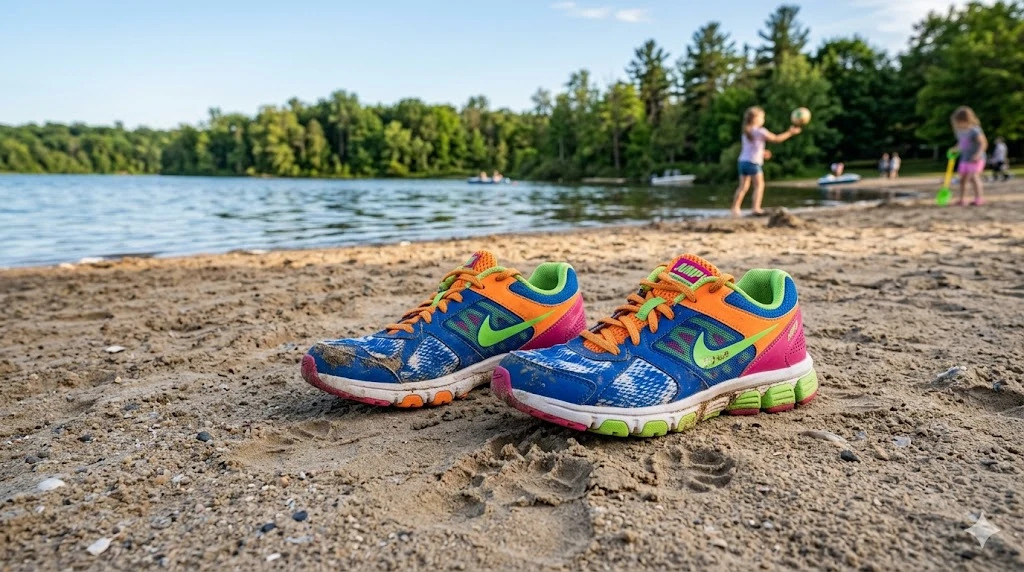
Foot protection is a beach-specific consideration. Sharp shells, bottle caps, broken glass, and sun-baked sand at midday can all cause cuts or burns; lightweight closed-toe water shoes are the conservative default for children running around in active hunting mode. The cumulative cost of avoidable foot injuries from one or two unprotected hunts often exceeds the value of the ‘feet on sand’ experience that barefoot proponents sometimes prioritise.
For supervision logistics with mixed-age groups, the buddy-system model used in many child-safety contexts adapts well to scavenger hunts. Pair a younger child with an older sibling or family friend; the pair completes the hunt together, with the older child taking nominal responsibility for keeping the younger child within the search boundary. This adds a cooperative element to what could otherwise be a competitive structure and naturally distributes supervision load across the family without requiring any one adult to track every child individually.
Beyond the beach: extending the format into the school year
The scavenger-hunt format generalises well beyond the summer beach context. Backyard hunts, neighbourhood-park hunts, and indoor hunts on rainy days all deliver the same play-based-fitness benefits the Stodden 2008 framework and Lubans 2010 review describe Lubans 2010. The defining feature is the combination of varied movement, cognitive engagement, and intrinsic motivation through game structure — not the specific location or the specific items being searched for.
For winter months in northern Canadian climates, indoor scavenger hunts in larger family homes or community-centre gyms preserve the format through cold-weather periods. The motor-development and cardiovascular benefits diminish somewhat in indoor versions because the running distances and varied terrain are reduced, but the cognitive-engagement and adherence benefits remain. Schools and community programmes using the format report engagement levels well above traditional structured-PE comparisons, particularly for the children who are most at risk for sedentary patterns under the structured format.
The longer-term framing matters. Stodden 2008’s framework is explicit that childhood motor competence predicts adolescent and adult physical-activity engagement; the goal of play-based fitness is not the immediate single-session outcome but the cumulative motor-skill repertoire and the durable enjoyment of movement that the play-rich approach builds Stodden 2008. A summer of weekly scavenger hunts contributes to that long-term trajectory in a way that is hard to match with structured calisthenics, which children mostly leave behind in adolescence.
For families whose children are already involved in organised sport, the scavenger-hunt format complements rather than replaces the sport-specific work. The motor-development variety the hunt provides addresses the ‘narrow specialisation’ risk that early single-sport focus introduces, and the cognitive-engagement element provides a useful contrast to the more-disciplined structure of practice and competition. The combined diet — sport, free play, structured family hunts — covers more of the child-development bases than any single approach does alone.
Bottom line: the family activity the literature endorses
The honest reading of the play-based-fitness literature is that a well-structured scavenger hunt is a more effective family fitness format than the structured-exercise alternatives most parents default to. The Stodden 2008 motor-competence framework, the Lubans 2010 systematic review, the Vanderloo 2014 environmental data, and the Pesce 2016 enrichment trial converge on the same conclusion: varied, play-rich, cognitively-engaging movement experiences produce better motor-development, cardiovascular, and engagement outcomes in school-age children than narrow structured drilling does Pesce 2016.
For families on the Wasaga Beach shoreline and across Georgian Bay summer destinations, the practical implication is that the casual format that already feels like the natural summer activity is also the format the child-fitness literature most consistently supports. The scavenger hunt isn’t a compromise; it’s the recommended approach. Parents who feel guilty about the lack of ‘real exercise’ in their children’s summer days can take the literature’s reassurance: a regular play-based activity with the structural elements described in this piece delivers more durable benefit than the structured alternative would.
The 30-minute scavenger hunt is a small, repeatable investment with an outsized cumulative payoff — in motor competence, in cardiovascular fitness, in cognitive control, and in the long-term enjoyment of physical activity that, more than any single fitness metric, predicts whether the child grows into an adult who keeps moving across the years.
Practical takeaways
- Play-based fitness produces broader motor-skill development than structured drilling in school-age children (Stodden 2008 framework, Lubans 2010 systematic review).
- Activity-rich environments outperform curriculum-rich environments for child physical-activity volume (Vanderloo 2014).
- Cognitive-enrichment elements (clues, strategy, puzzles) produce additional gains beyond pure physical activity (Pesce 2016 enriched-PE trial).
- 30 minutes is the minimum useful single-session dose; sessions over 45 minutes typically see attention drop below the productive threshold.
- Adherence asymmetry is the hidden payoff: families maintain weekly scavenger hunts they would not maintain weekly calisthenics circuits.
- Mix item types to recruit different movement patterns: locomotor, object-control, stability, dynamic balance.
- Define a search area smaller than one adult can visually monitor with a hard boundary between hunt zone and water's edge.
References
Stodden 2008Stodden DF, Goodway JD, Langendorfer SJ, et al. A developmental perspective on the role of motor skill competence in physical activity: An emergent relationship. Quest. 2008;60(2):290-306. View source →Lubans 2010Lubans DR, Morgan PJ, Cliff DP, Barnett LM, Okely AD. Fundamental movement skills in children and adolescents: review of associated health benefits. Sports Medicine. 2010;40(12):1019-1035. View source →Vanderloo 2014Vanderloo LM, Tucker P, Johnson AM, Van Zandvoort MM, Burke SM, Irwin JD. The Influence of Centre-Based Childcare on Preschoolers’ Physical Activity Levels: A Cross-Sectional Study. International Journal of Environmental Research and Public Health. 2014;11(2):1794-1802. View source →Pesce 2016Pesce C, Masci I, Marchetti R, Vazou S, Saakslahti A, Tomporowski PD. Deliberate Play and Preparation Jointly Benefit Motor and Cognitive Development: Mediated and Moderated Effects. Frontiers in Psychology. 2016;7(0):349. View source →