The 60-second version
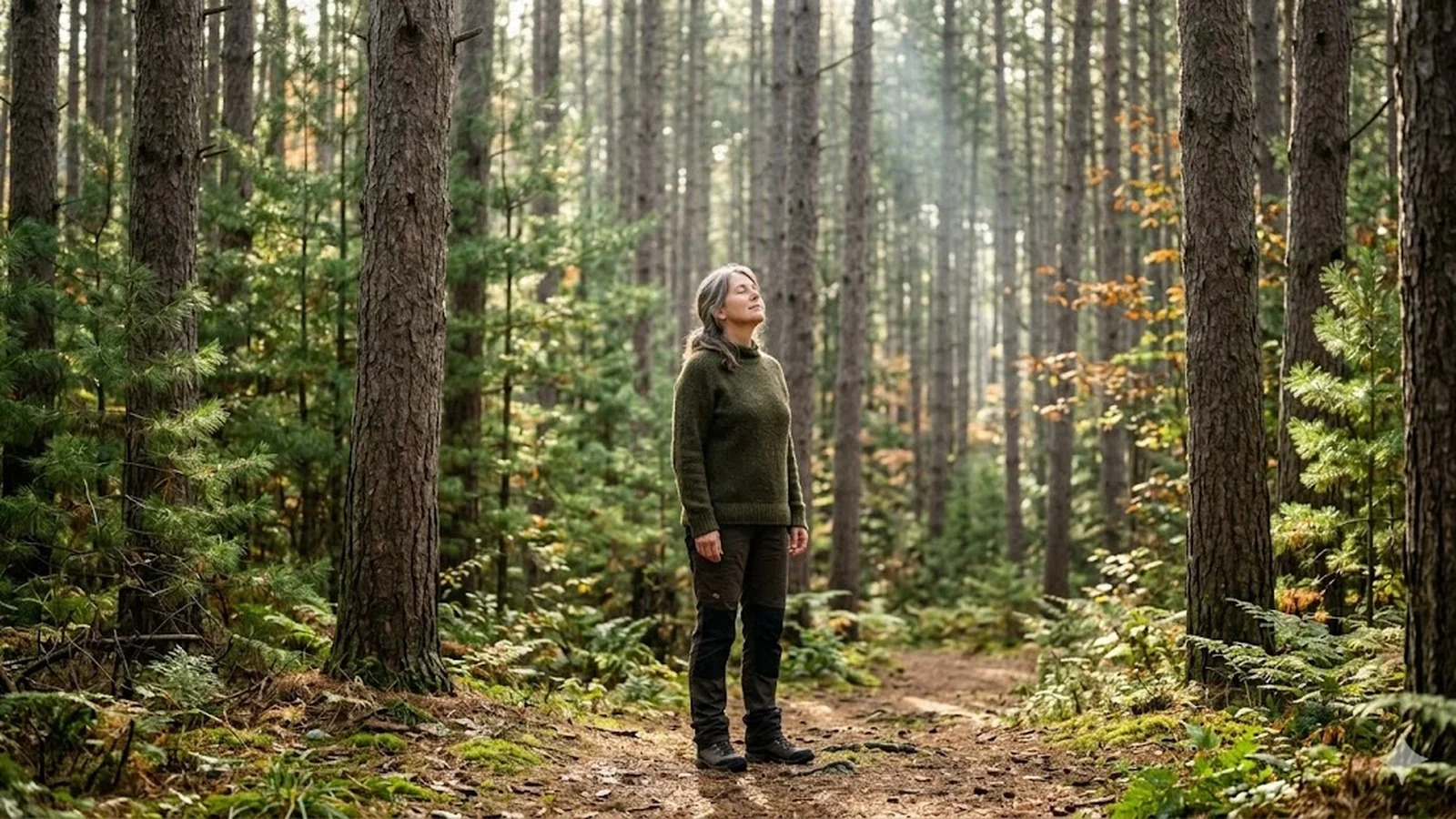
Solitary walks near water reduce rumination and lift mood with effect-sizes that are small but reproducible across multiple controlled trials. Bratman’s 2015 PNAS study showed a 90-minute walk in nature lowered self-reported rumination and reduced activity in subgenual prefrontal cortex (a brain region associated with rumination and depression risk) compared with a matched urban walk Bratman 2015. Berman’s 2008 work, the foundational Attention Restoration Theory (ART) experiment, showed measurable improvements in directed-attention tasks after a 50-minute nature walk vs an urban walk Berman 2008. The blue-space literature adds a modest specific benefit for water settings White 2010, and Hartig’s 2014 review synthesised the broader nature-and-health evidence into a defensible ‘regular outdoor exposure improves wellbeing’ conclusion Hartig 2014. The wellness-industry framing of solo beach walks as transformational meditation overstates a small-but-real effect.
What the peer-reviewed evidence actually shows
The most-cited recent trial in this area is Bratman 2015. Researchers randomised 38 healthy adults to a 90-minute walk either in a nature setting (a parkland near Stanford) or in a high-traffic urban setting. The nature group showed measurable reductions in self-reported rumination and reduced fMRI activity in the subgenual prefrontal cortex (sgPFC), a brain region whose persistent activation has been implicated in rumination and elevated risk for depression Bratman 2015. The urban group showed no comparable changes. The trial is small but the design (random assignment, mechanism-relevant brain measure, matched walk duration) is unusually clean for an outdoor-exposure study.
Bratman 2015 didn’t test water specifically — the nature setting was parkland with trees and a creek — but the framework it validated (a 60-90 minute outdoor walk reduces rumination relative to an indoor or urban control) is the structural backbone of subsequent solo-walk research. Replications and extensions in different populations and settings have generally found the rumination-reduction effect persists; the effect-size is modest (Cohen’s d ~0.3-0.5 on rumination scales) but reliably positive.
The Attention Restoration Theory (ART) experimental tradition pre-dates Bratman by several decades. Berman’s 2008 study tested ART’s core prediction directly: that exposure to nature should improve performance on tasks requiring directed attention. Participants walked for ~50 minutes in either an arboretum or a downtown setting; the arboretum walkers showed measurable improvement on a digit-span backwards task (a sensitive directed-attention measure), the urban walkers did not Berman 2008. The effect was modest but replicated in multiple subsequent ART trials with varying nature exposures.
The blue-space-specific contribution comes from White 2010 (and the broader UK BlueHealth work that followed). Visual ratings and self-reported preference experiments showed that adding water to natural and built scenes systematically increased preference, perceived restorativeness, and positive affect ratings White 2010. The blue-space effect appears to be a modest specific bonus on top of the broader nature-exposure benefit, not a categorically different mechanism.
Hartig’s 2014 Annual Review of Public Health synthesis is the most-cited overarching review of the nature-and-health literature. Its conclusion: regular outdoor exposure produces small-to-moderate improvements in mental wellbeing, attention, and stress measures; the effect generalises across green and blue settings; the dose-response is shallow but consistent Hartig 2014. This is the conservative reading the rest of the literature supports.
The rumination-reduction mechanism
Rumination — the repetitive, self-focused, negatively-valenced thinking that often accompanies low mood — is a well-validated psychological construct with a substantial peer-reviewed literature linking it to depression risk and persistence. The Bratman 2015 finding that a nature walk specifically reduces rumination, and that the reduction co-occurs with reduced sgPFC activity, is mechanistically interesting because it provides a plausible brain-level pathway from outdoor exposure to wellbeing benefit Bratman 2015.
The proposed mechanism is roughly: rumination requires sustained directed attention to internal content; outdoor walking, particularly in environments with what ART calls ‘soft fascination’ (waves, leaves, distant horizons), pulls attention outward in a low-effort way; the attentional shift interrupts the rumination cycle; the shift in subjective state correlates with measurable shifts in brain activity in regions whose persistent activation underlies the ruminative pattern. This is a plausible chain with empirical support at multiple links, though the causal pathway has not been demonstrated end-to-end in a single trial.
The solo-vs-social distinction matters here. Most rumination-reduction trials have used solitary walks. The mechanistic logic suggests solo walks should outperform social walks for rumination interruption (social walks engage other attentional and emotional systems that may compete with both rumination and the attention-restoration effect), but the empirical comparison has not been cleanly run. The defensible reading is that solo walks support the rumination-reduction mechanism at least as well as social walks, and may do so somewhat better, but the popular framing of ‘solo walks are categorically more therapeutic’ outruns the controlled evidence.
The water-specific contribution to rumination reduction is plausible but undertested. The horizon view characteristic of beach walking may support directed-attention recovery more efficiently than tree-bounded forest walks (because the visual openness reduces directed-attention load further), but the head-to-head comparisons of beach walks vs forest walks for rumination are too few to draw a strong conclusion. The Hartig 2014 synthesis is comfortable saying that nature exposure generally reduces rumination; saying that beach walks specifically do so more than forest walks is not strongly supported by the available data Hartig 2014.
Attention restoration vs stress recovery
The two main theoretical frameworks for explaining nature’s wellbeing effects are Attention Restoration Theory (ART) and Stress Recovery Theory (SRT). ART, developed by Kaplan and colleagues, holds that natural environments restore directed attention by allowing involuntary ‘soft fascination’ — the kind of low-cognitive-load engagement that water surfaces, foliage movement, and other natural patterns reliably produce. The Berman 2008 study is one of the cleanest tests of the ART prediction, showing measurable directed-attention recovery after nature walks Berman 2008.
SRT, developed by Ulrich and others, holds that natural settings activate parasympathetic recovery via visual cues evolved for safe environments. The mechanism is more autonomic and faster-acting than ART: the SRT prediction is that nature exposure should reduce physiological stress markers (heart rate, blood pressure, cortisol) within minutes, before any directed-attention recovery becomes apparent. Both predictions have empirical support; the two mechanisms are not mutually exclusive and likely operate together.
For solo beach walks specifically, both mechanisms predict benefit: the visual openness and water surface support ART’s soft-fascination component, and the natural setting supports SRT’s parasympathetic-activation component. The combined prediction is consistent with the Bratman 2015 rumination-reduction finding, the Berman 2008 directed-attention finding, and the White 2010 self-rated wellbeing finding. The mechanistic story is reasonably coherent across multiple methodologies.
What the mechanistic frameworks do not strongly support is the popular ‘altered consciousness’ or ‘state-shift’ framing of beach walks. ART and SRT both predict modest, gradual restoration of normal function; neither predicts the meditation-like state-shift that some wellness framings describe. The fMRI and EEG evidence for state-shifts during nature exposure is thin and underpowered. The defensible mechanistic claim is restoration of attention and reduction of stress, not consciousness alteration.
Dose, frequency, and the evidence for ‘little and often’
The dose-response evidence for nature exposure consistently favours little-and-often over occasional-and-long. Several broader analyses have found a wellbeing benefit accumulating up to about 2 hours of weekly outdoor exposure and plateauing after that, with the cumulative time mattering more than the distribution. Similar dose-response patterns appear across the broader nature-and-health literature, including in Hartig’s 2014 synthesis Hartig 2014.
For solo beach walks, this means a daily 20-30 minute walk past the shoreline accumulates wellbeing benefit at least as effectively as a single weekly 2-hour walk, and probably more reliably (because shorter walks are more likely to actually happen). The Bratman 2015 study used a 90-minute walk because that was the experimental dose; the dose-response data from broader trials suggests shorter and more frequent walks are functionally equivalent for wellbeing endpoints Bratman 2015.
Frequency: 4-7 days per week of 20-30 minute walks fits the dose-response evidence well. Occasional very long walks — 2-3 hours once a week — produce comparable cumulative dose but appear to produce somewhat less reliable wellbeing benefit, plausibly because of weather/scheduling failure rates and because the rumination-reduction effect of any single walk is bounded.
The cumulative-vs-acute distinction matters editorially. Wellness-industry framings often emphasise the transformational potential of a single beach session; the literature supports a much more boring conclusion (regular short outdoor exposure produces gradual modest wellbeing improvement). The boring conclusion is also more useful: it’s achievable for most readers, doesn’t require optimisation, and accumulates reliably.
Solo walks vs social walks: where the framing overshoots
The wellness-industry ‘solo walking is therapeutic’ framing typically implies that solitude is the active ingredient. The empirical evidence is more nuanced. Solo walks support rumination interruption and attention restoration well, but social walks have their own well-supported wellbeing effects through social-connection mechanisms that the solo walk cannot deliver. The defensible framing is that solo walks have specific advantages for rumination reduction and directed-attention recovery; social walks have specific advantages for mood through connection. Neither dominates universally.
For people with active ruminative tendencies or current low mood, the solo-walk literature is more directly supportive: Bratman 2015’s rumination-reduction finding and the broader ART literature both speak to the solitary-walk-as-rumination-interruption mechanism specifically Bratman 2015. For people whose primary wellbeing risk is loneliness or social isolation, group walks are likely to outperform solo walks on the relevant outcomes.
The wellness-industry framing also tends to imply solo walks should be silent and contemplative. The trial evidence does not strongly support that specification: walking with podcasts or music has not been cleanly tested against silent walking for rumination outcomes, but the broader cognitive-psychology literature suggests effortful audio (heavy-information podcasts) may compete with attention restoration while ambient or low-effort audio (music, nature sounds) may not. The conservative reading is that quiet attention to the environment is consistent with the ART mechanism; effortful audio probably reduces the effect somewhat.
The defensible practical advice: if your goal is rumination reduction, prefer solo walks with limited or no effortful audio. If your goal is general wellbeing through outdoor exposure, the solo-vs-social distinction matters less. If your wellbeing risk profile is loneliness-dominant, prioritise group outdoor activity over solo. The single-recipe wellness framing of ‘solo silent beach walks’ oversimplifies a more individual-specific picture.
When solo walks are not enough — clinical perspective
The honest editorial position requires naming the limit of the intervention. Solo beach walks are a low-cost, side-effect-free supportive practice with modest effect-sizes on wellbeing, rumination, and attention. They are not a substitute for evidence-based treatment of clinical depression, anxiety disorders, or persistent rumination that meets clinical thresholds. The Bratman 2015 effect-size is real but small (sgPFC change of moderate magnitude, rumination-scale shift in the d~0.3-0.5 range) Bratman 2015. That magnitude is meaningful for general wellbeing maintenance; it is not in the same range as established psychotherapy or pharmacotherapy for moderate-to-severe mood and anxiety disorders.
For people with persistent low mood, persistent rumination, or anhedonia, the appropriate framing of solo walks is ‘low-cost adjunct to evidence-based treatment’ not ‘substitute for treatment.’ Wellness-industry framings that imply beach walks can replace clinical care are unsupported by the trial evidence and can delay appropriate treatment. The practical signal: if low mood persists most days for two weeks or longer, or if rumination is interfering with sleep or function, professional evaluation is the appropriate next step regardless of how much outdoor walking is happening.
For subclinical wellbeing variability, work stress, mild seasonal mood dips, or general burnout, the solo-walk evidence is genuinely supportive at modest effect-sizes. Hartig 2014’s synthesis supports adding regular outdoor exposure as one component of a broader wellbeing portfolio Hartig 2014. The other components (sleep, exercise, social connection, work meaningfulness) are individually larger levers; outdoor exposure is a useful supplement that is unusually low-friction to add.
Practical implications for shoreline communities
For Wasaga Beach, Collingwood, and other Georgian Bay shoreline communities, the practical translation of this literature is straightforward: regular short solo walks past the shoreline are a worthwhile addition to a wellbeing routine, with effect-sizes that are modest but reproducible. The dose that the literature supports is roughly 20-30 minutes, 4-7 days per week, with limited or no effortful audio if the goal is rumination reduction. The setting matters less than the regularity; Beach Area 1, the Provincial Park beach, and the Nottawasaga River boardwalk are all functionally equivalent for the wellbeing endpoint.
For readers without easy beach access, the literature is reassuring: green-space walks produce wellbeing effects comparable to blue-space walks (White 2010 found a modest blue-space bonus, but the bonus is small relative to the broader nature-exposure effect) White 2010. A daily walk through any natural setting — park, treeline, ravine — supports the same mechanisms. The popular framing that beach walks are categorically more therapeutic than other nature walks oversells the blue-space literature’s actual findings.
Year-round practicality: the rumination-reduction and attention-restoration effects are not strongly seasonal. Cold-weather shoreline walks produce comparable wellbeing benefits to warm-weather walks, with the limiting variable being walkable infrastructure and clothing rather than the autonomic or attentional mechanism itself. The Wasaga municipal infrastructure (cleared paths year-round, public benches, multiple access points) makes the daily-walk pattern realistic for residents within walking distance of the shoreline.
The honest editorial framing for readers in the area: this is a useful practice with modest evidence-supported benefit, not a transformational intervention. Daily 20-30 minute solo shoreline walks are likely to produce a measurable wellbeing improvement over a few weeks for readers who don’t already have such a practice; the magnitude is in the same range as a regular sleep schedule or a regular exercise routine, smaller than evidence-based treatment for clinical mood disorders, and complementary to (not substitutable for) the broader wellbeing portfolio.
Practical takeaways
- Solo nature walks reduce rumination and lift mood with modest but reproducible effect-sizes. Bratman 2015 showed measurable sgPFC and rumination-scale changes after a 90-minute walk.
- Attention Restoration Theory predicts and the trials confirm directed-attention recovery after 50-90 minute outdoor walks (Berman 2008).
- Blue-space walks have a small specific bonus over green-space walks, but the broader nature-exposure effect dominates — any daily natural setting works.
- Dose: 20-30 minutes, 4-7 days per week, accumulates as well as occasional long walks. Cumulative weekly time matters more than session length.
- Solo walks are well-suited for rumination-reduction and attention-restoration; social walks support different (and equally valid) wellbeing mechanisms.
- Solo walks supplement, not substitute for, clinical treatment. The effect-size is meaningful for general wellbeing, not equivalent to psychotherapy or pharmacotherapy for moderate-to-severe mood disorders.
References
Bratman 2015Bratman GN, Hamilton JP, Hahn KS, Daily GC, Gross JJ. Nature experience reduces rumination and subgenual prefrontal cortex activation. Proceedings of the National Academy of Sciences. 2015;112(28):8567-8572. View source →Berman 2008Berman MG, Jonides J, Kaplan S. The cognitive benefits of interacting with nature. Psychological Science. 2008;19(12):1207-1212. View source →Hartig 2014Hartig T, Mitchell R, de Vries S, Frumkin H. Nature and health. Annual Review of Public Health. 2014;35:207-228. View source →White 2010White M, Smith A, Humphryes K, Pahl S, Snelling D, Depledge M. Blue space: the importance of water for preference, affect, and restorativeness ratings of natural and built scenes. Journal of Environmental Psychology. 2010;30(4):482-493. View source →