The 60-second version
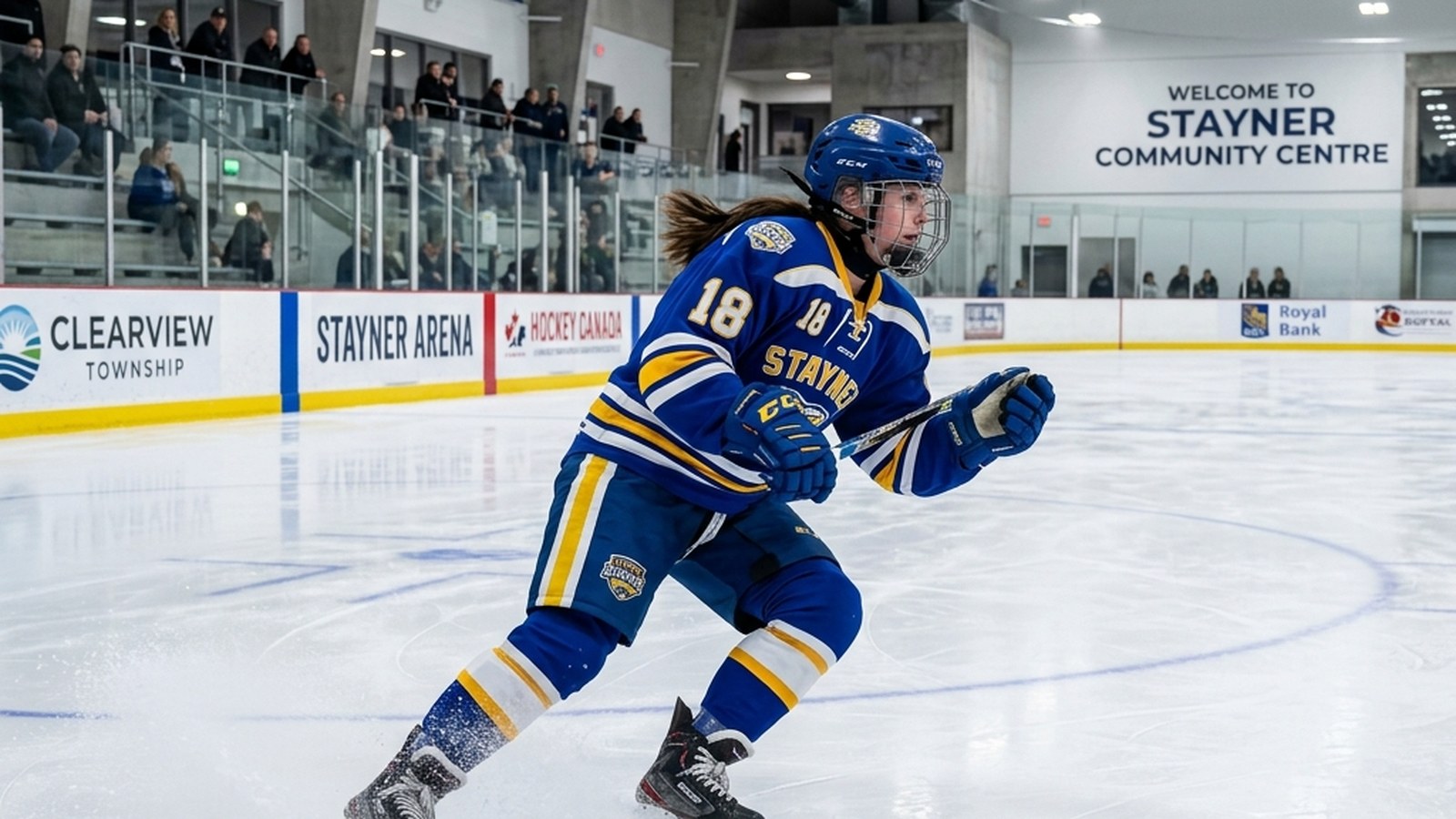
Indoor skating at the Stayner and Wasaga Beach arenas is an exceptional "non-impact" power builder for local athletes. By utilizing the low-friction surface of the ice, skaters can generate significant anaerobic force while bypassing the joint-loading associated with sprinting or jumping. This guide audits the Stayner Community Centre and Wasaga Stars Arena facilities, analyzes the biomechanical load on the gluteus medius and lateral stabilizers (based on Hoshizaki 1989), and provides an 8-week skating power protocol. Whether you are a hockey player seeking technical edge or a fitness enthusiast looking for a high-wattage winter cardio alternative, the local arena is a premier facility for lower-body conditioning.
The Non-Impact Power Alternative
In the context of the **Wasaga Hinge**—our platform’s framework for posterior-chain resilience—skating is a unique outlier. It is one of the few high-power activities that is almost entirely **eccentric-free**. Because the foot glides rather than impacts, the "braking forces" that cause muscle damage and joint strain in running are virtually eliminated. This makes skating an ideal high-intensity interval (HIIT) venue for athletes recovering from lower-body injuries or those seeking to increase their metabolic output without increasing their injury risk.
For the Stayner and Wasaga communities, the local arena is more than a hockey rink; it is a specialized training environment for lateral power and aerobic endurance.
Biomechanics: The Skating Stride & Lateral Stability
Efficiency on the ice is a product of technical precision. We break the skating stride down into three critical phases for fitness development:
1. The Loading Phase (Deep Flexion)
The "skater’s crouch" requires significant isometric strength in the quadriceps and glutes. By maintaining a deep knee-angle (ideally 90 degrees), you maximize the distance over which you can apply force. This "time under tension" is what builds the exceptional leg endurance associated with speed skaters.
2. The Lateral Extension (Power Drive)
Unlike running, where the force is applied backward, skating power is applied **laterally**. This engages the gluteus medius and the adductor group in a way that linear sports cannot replicate. Research by Hoshizaki et al. (1989) shows that the lateral drive of a skating stride produces significantly higher EMG activity in the hip stabilizers than a standard running stride.
3. The Recovery (Balance & Core)
As the driving leg returns to the center, the athlete must balance on a single 1/8th-inch steel blade. This creates a high-fidelity proprioceptive stimulus, requiring the deep core muscles to stabilize the pelvis during the "glide phase."
Physiological Demands: The Hoshizaki Analysis
Hoshizaki (1989) identified that skating is a "Hybrid Metabolic" sport. A 60-minute public skating session, when approached with intent, combines the heart rate profile of moderate jogging with the muscular fatigue profile of a light leg-press session. For those utilizing the Stayner arena for power-skating intervals, the anaerobic demand can reach 90% of max heart rate, making it one of the most efficient tools for "skating-specific" metabolic conditioning.
Local Arena Audit: Stayner vs. Wasaga
Local residents have access to two distinct training environments:
Stayner Community Centre (The Classic Training Hub)
The Stayner rink is known for its "harder" ice, which typically results from lower arena temperatures. For the power skater, this means less blade-drag and higher glide-efficiency, making it the ideal venue for high-cadence speed intervals and technical edge-work.
Wasaga Stars Arena (The Modern Facility)
The new Wasaga Beach facility offers superior amenities for the hybrid athlete. We recommend utilizing the walking track for a "Thermal Warm-up" before stepping onto the ice, ensuring the joint capsule is mobile and the muscles are primed for the high-force lateral extensions of the skating protocol.
The 8-Week Skating Power Protocol
Transform your public skating session into a high-output power block with this progression:
| Weeks | Focus | Sample Session (Stayner Arena) |
|---|---|---|
| 1-2 | Edge Stability | 40 min. Focus on "Long Glides"—balancing on one foot for 3 seconds per stride. |
| 3-4 | Lateral Drive | 50 min. 10 x 30-sec "Power Sprints" focusing on full leg extension. 1-min recovery. |
| 5-6 | Crossover Agility | 60 min. Incorporate 15 minutes of figure-eight patterns to build hip rotational strength. |
| 7-8 | Anaerobic Capacity | 60 min total. 5 x 2-min "Game Speed" intervals followed by 3-min active recovery. |
Gear Selection: Fitness vs. Hockey Skates
For the pure fitness athlete, **Fitness Skates** (which combine a soft boot with a hockey blade) are often the best choice. They provide the necessary ankle support for long-duration sessions without the "stiffness fatigue" of a high-end hockey skate. However, if your goal is maximum power and edge control, a traditional hockey skate allows for more precise "bite" into the ice, enabling the high-force extensions described in our power protocol.
Deep Dive: Centripetal Force and the Crossover Mechanics
The technical pinnacle of indoor skating at the Stayner and Wasaga arenas is the **crossover**. When you enter a turn at the ends of the rink, your body must manage significant **centripetal force**. To maintain velocity while changing direction, you must cross your outside skate over the inside one. This movement requires a sophisticated "weight-transfer" that is unique to the ice.
As you lean into the turn, your center of mass moves toward the center of the rink, requiring the outside gluteus medius to fire at near-maximal capacity to prevent the hip from "dropping." Simultaneously, the inside leg must produce a powerful push-off from the *outside edge* of the blade. Research by Marino (1977) highlights that the crossover is not just an agility move but a primary power-generator, allowing the athlete to maintain acceleration throughout the circular sections of the rink. For the Stayner fitness skater, mastering the crossover is the key to transitioning from "recreational gliding" to "power conditioning."
Physiological Adaptation: The Unilateral Load of the Skate Stride
Because the skating stride is almost entirely unilateral (one leg working at a time), it drives a specific adaptation in the **deep spinal stabilizers**, particularly the multifidus and the quadratus lumborum. Every stride requires the core to resist the rotational torque created by the lateral leg extension. Over a 12-week winter season, this build-up of "anti-rotational" strength provides a massive protective benefit for the lower back, a common site of injury for Wasaga golfers and gardeners in the spring.
Furthermore, the "Skater’s Crouch" required to maintain an aerodynamic profile on the ice places the quadriceps in a state of **occluded blood flow**, similar to Blood Flow Restriction (BFR) training. This induces a high level of metabolic stress and growth-hormone release without the need for heavy external loads. This "metabolic conditioning" effect is why professional hockey players often return from the off-season with exceptional leg power despite minimal heavy squatting.
Training Practical: The Edge-Control Drill
To build the specific ankle stability and hip control needed for high-power skating, incorporate the **Stayner Edge-Control Circuit** into your next public skating session.
- Single-Leg Slalom: Balance on one skate and navigate a "snake" pattern down the length of the rink. Focus on shifting your weight between the inside and outside edges of that single blade. This builds the proprioceptive fidelity needed for stable high-speed glides.
- The "Wall" Push-Off: Stand near the boards. Perform 10 explosive lateral push-offs against the base of the boards with one leg, then switch. This allows you to practice the "lateral drive" mechanics in a controlled, stationary environment.
- Crossover Holds: In a turn, cross your outside skate over the inside and **hold the position** for as long as possible (the "statue" glide). This tests your balance and forces the gluteus medius to stabilize the hip under the centripetal load.
Pay close attention to **skate sharpening and edge maintenance**. The "radius of hollow" (the depth of the groove carved into the blade) determines the balance between "bite" and "glide." A deeper hollow (e.g., 3/8 inch) provides more grip for aggressive crossovers and tight turns at the Stayner rink, but it increases friction on the straightaways, requiring more energy to maintain speed. Conversely, a shallower hollow (e.g., 5/8 inch) offers superior glide but requires much higher ankle stability and technical precision to prevent "washing out" in the turns. We recommend a standard 1/2 inch hollow for fitness skaters, as it provides the most versatile platform for the interval protocols described in this guide.
Indoor skating in Stayner and Wasaga Beach is a high-leverage winter training tool. It solves the "impact fatigue" problem of road running while providing a premier stimulus for the hip stabilizers and cardiovascular system. By mastering the biomechanics of the lateral extension and following a structured power protocol, you can turn your local arena into a world-class lower-body conditioning facility. The ice is waiting—push off with intent.
Practical logistics and edge cases
Beyond the core protocol above, several recurring practical considerations come up for visitors and regular users of this location. Most are not safety-critical but they meaningfully affect the experience and outcome of a session.
Parking and access. Wasaga’s main parking infrastructure follows the Beach Drive corridor, with most lots paid in summer (typically late May through Labour Day) and free in shoulder seasons. Off-peak weekday mornings provide the easiest parking; summer weekend mid-mornings (10 AM–1 PM) are the toughest. For trail destinations outside the Beach Drive corridor, smaller informal lots can fill quickly during peak weeks; arriving by 9 AM provides reliable access on weekends.
Cell coverage. The main shoreline corridor and most trail systems have reliable cell service. The notable exceptions are the deeper forest sections of Tiny Marsh, the gorge bottom at Devil’s Glen, and the longer Ganaraska Trail traverses, where coverage is intermittent. Solo users on multi-hour outings should consider a satellite messenger or at minimum a check-in plan with someone offsite.
Bathroom access. Beach Areas 1–3 have reliable summer-season bathroom access. Forested trails and Provincial Park interior sections have minimal facilities — plan accordingly for longer outings, particularly with children.
Group sessions and pace mismatch. The most common cause of a frustrating shared outing is pace mismatch between participants. Pre-discuss the target distance, pace, and turnaround landmark before starting; for mixed-ability groups, the pace must be set by the slowest participant. Pulling ahead of slower partners is the classic failure mode that produces falls, exhaustion, or wandering separation.
Weather changes mid-session. Georgian Bay weather can shift quickly — a calm sunny morning can produce thunderstorm activity by mid-afternoon. Check the forecast before extended outings, identify the nearest exit point at the halfway mark, and don’t hesitate to abort an outing if conditions deteriorate.
Wildlife encounters. The most likely encounters are deer, turkeys, foxes, and waterfowl — all best observed at distance. Black bear activity exists in the broader region (particularly outside the immediate Wasaga shoreline) but is uncommon enough that bear-protocol training is sensible only for users heading to the more remote sections of the trail system.
References
Hoshizaki TBBiomechanical analysis of the skating stride. View source →Marino GWKinematics of ice skating at different velocities. View source →Upjohn TThree-dimensional analysis of ice hockey skating. View source →Foster CPhysiological profiles of speed skaters. View source →