The 60-second version
The honest framing of toddler beach safety: ages 1–3 carry the highest age-specific drowning rate of any age group worldwide, and the modal scenario is brief (under 5 minutes) lapse in caregiver supervision while the child is within 25 m of water (Quan 2003 Quan 2003; Brenner 2003 Brenner 2003). The supervision distinction the American Academy of Pediatrics drowning-prevention statement and the Canadian Paediatric Society 2019 guidance both make is between ‘active supervision’ (within arm’s reach for a non-swimmer toddler, eyes-on-not-on-phone) and the more passive watchfulness most beach families default to (CPS 2019 CPS 2019). The developmental side: ages 1–3 are also the period when fundamental movement skills (walking, running, climbing, throwing, kicking) develop most rapidly — sand and uneven terrain provide an excellent practice substrate for the dynamic balance work this window depends on (Logan 2018 Logan 2018). The two goals are compatible but require active design, not the ‘put down the towel and watch’ default that the supervision literature identifies as the failure mode.
What the toddler-drowning literature actually shows
Brenner 2003, the AAP’s drowning-prevention policy statement, and Quan 2003 (the companion epidemiology paper) both identified the 1–4 age band as the highest-risk age group for drowning on a per-population basis worldwide Brenner 2003Quan 2003. The combined data: drowning rates in this age group are 2–4 times higher than rates in school-age children, and approximately 70% of toddler drownings occur in residential pools, but the open-water (lake, beach, river) cases share a consistent pattern: brief supervision lapse (typically under 5 minutes), child within 25 m of water, no flotation device, witness saw the child playing seconds-to-minutes before the incident.
The supervision-distance evidence is the part most relevant to beach families. Quan 2003 examined caregiver-distance-to-victim across 1,000+ pediatric drowning cases and found a sharp gradient: incidents where the caregiver was within arm’s reach were rare (under 3% of fatal cases); incidents where the caregiver was within 5 m but not arm’s reach accounted for ~25%; the remaining ~70% involved caregiver distances of 5+ m or no caregiver visual contact at the moment of incident Quan 2003.
The Canadian Paediatric Society’s 2019 statement codified what these findings meant for practice: ‘active supervision’ for a non-swimming child under 5 means within arm’s reach in or near water, with caregiver attention undivided CPS 2019. The qualifier ‘undivided’ is doing real work — phone use, conversation with another adult, or attention to a sibling all qualify as divided attention in the policy framing.
The developmental fitness window: ages 1-3
The same age band that carries the highest drowning risk is also the period of fastest fundamental movement skill (FMS) acquisition. Logan 2018’s systematic review of FMS terminology and assessment confirmed that locomotor skills (walking, running, jumping), object-control skills (throwing, catching, kicking), and stability skills (single-leg balance, dynamic balance) all show their steepest developmental gains between ages 18 months and 4 years Logan 2018.
Sand and uneven beach terrain are an unusually rich substrate for the stability-skill component. The constantly-shifting surface forces continuous postural adjustment — the kind of dynamic-balance practice that adult fall-prevention programs reproduce with foam pads and BOSU balls. For a toddler, ten minutes of walking from blanket to water and back delivers more stability-skill reps than an hour of carpet play.
The honest implication: the goal isn’t to keep the toddler off the beach — the developmental case is real. The goal is to design the day so the active supervision the safety literature requires is sustainable for 3–6 hours, not just the first 30 minutes.
The active-supervision vs helicopter distinction
The CPS 2019 guidance and the AAP statements draw a careful distinction between active supervision and what some literature calls ‘helicopter parenting’ CPS 2019. Active supervision means the caregiver is positioned to intervene within seconds (within arm’s reach near water; within 5 m on dry sand) and is paying attention. It does not mean preventing the toddler from doing things — from the developmental perspective Logan 2018 documented, the toddler needs to walk, fall, climb, and explore Logan 2018.
The practical pattern that satisfies both: a clearly-bounded play zone, a designated water-side adult who rotates every 20–30 minutes (sustaining undivided attention is hard; rotation is the design solution), and an explicit handoff (‘you’re on water duty, I’m taking the towel break’) when the watch changes. The pattern that fails is the implicit watch — both adults assume the other is watching, and neither is.
Brenner 2003 specifically called out the supervision-handoff failure as a recurrent theme in fatal-incident reports Brenner 2003. The technical fix is verbal handoff. The cultural fix is treating water duty as a defined role with a defined relief schedule.
Beach-specific risks the pool literature underweights
Most pediatric drowning literature draws on pool data because pools account for ~70% of toddler cases. Beach environments add risk vectors the pool literature underweights: tidal currents (can pull a toddler from ankle-deep to waist-deep water in seconds), wave dynamics (a knee-high wave on an adult is a face-high wave on a toddler), uneven submerged terrain (sudden drop-offs that aren’t visible from shore), and high-distraction environments (multiple children, watercraft, shore activities competing for caregiver attention).
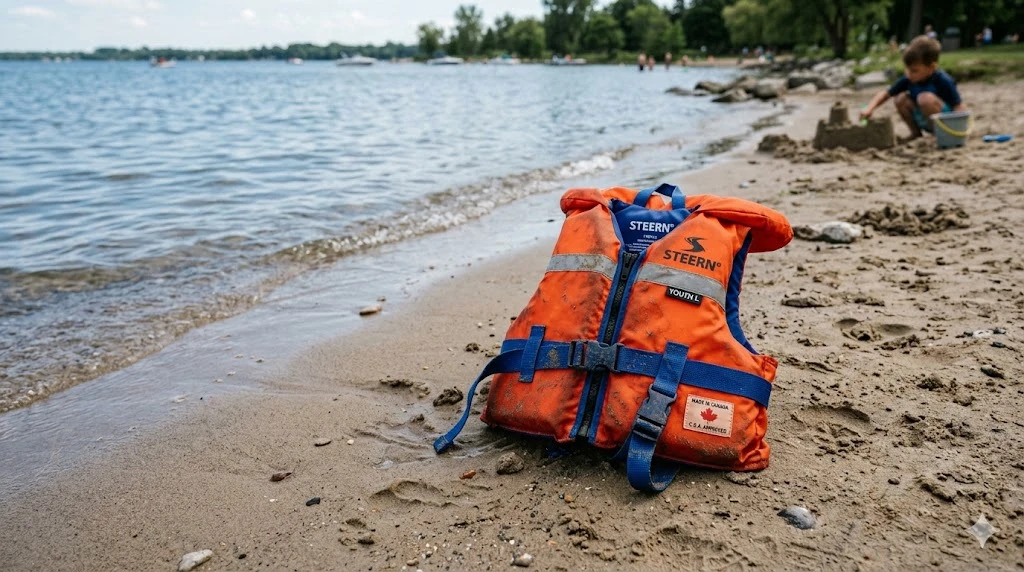
The Canadian Surf Lifesaving and equivalent organisations recommend specific behaviours for the under-5 set: (1) flotation device worn at all times within 25 m of water (Coast Guard-approved, properly fitted, snug under the arms), (2) hand-holding or arm-grip in water any deeper than knee-high on the toddler, (3) avoidance of water on days with surf or current advisories regardless of how it looks from shore. These aren’t in the AAP or CPS statements per se; they’re organisation-level operational policies that translate the broader supervision-distance evidence into beach-specific practice.
Designing the day for both safety and movement development
The integration: an active supervision pattern that doesn’t preclude the FMS development the toddler needs. Three operational principles.
Bounded zones. A defined play area (towel-marked, 5×5 m, with the water-side adult positioned at the water-side edge) gives the toddler room to walk, fall, climb sandcastles — all the FMS reps Logan 2018 identified as developmentally critical — while keeping caregiver-to-water-distance manageable Logan 2018.
Active games at the water edge, not in it. Bucket-fill, sand-bucket-pour, wet-sand-castle building, and shell-collecting at the water’s edge deliver high-engagement FMS practice while keeping the child in the ankle-depth zone where supervision distance is shortest. Reserve in-water play for explicit hand-holding sessions when the water-duty adult is fully present.
Rotating relief. Adult attention degrades over 20–40 minutes — a finding consistent across the supervision literature. The Quan 2003 incident pattern (caregiver visual lapse of seconds to minutes) is consistent with attention failure, not negligence Quan 2003. Rotation isn’t about distrust; it’s about acknowledging that humans can’t sustain undivided attention for hours.
The practical hour-by-hour pattern
A typical 3-hour beach window with a toddler, designed to satisfy CPS 2019 active-supervision guidance and deliver the FMS reps Logan 2018 documented:
0:00–0:20: arrival, sunscreen, blanket setup. Toddler explores the immediate area. Adult A is on water duty (positioned facing the water, with the toddler in the bounded zone).
0:20–0:40: ankle-depth water play with hand-holding. Adult B handoff to water duty (verbal: ‘I’m on water now’). Adult A breaks for towel-time, hydration, attending to siblings.
0:40–1:00: dry-sand play (digging, scavenger objects, water-bucket games). Caregiver-to-toddler distance up to 5 m, attention undivided.
1:00–1:20: shade break, snack, hydration. Both adults engaged with the toddler — this is the rotation buffer.
1:20 onward: repeat the rotation pattern. Avoid more than 30 minutes of continuous water-edge play in any rotation cycle — attention quality degrades.
The pattern delivers approximately 90 minutes of active toddler movement (the FMS development case), 30–45 minutes of structured rest, and continuous active supervision throughout (the safety case).
What this guidance can’t do
Three honest limits. First: no supervision pattern eliminates risk — the Quan 2003 and Brenner 2003 data make clear that even brief lapses produce incidents Quan 2003Brenner 2003. Active supervision plus flotation devices reduces risk substantially; it doesn’t zero it. Second: the FMS development case Logan 2018 documented requires consistent practice over years, not one beach trip Logan 2018. Sand-walking is one input among many. Third: the rotating-adult model assumes two adults are present. Single-adult beach trips with a toddler are higher risk — the supervision literature would suggest sticking to lifeguarded beaches when this is the configuration.
One final practical note on cultural variation in caregiver expectations. The CPS 2019 active-supervision standard was developed in a North American context where the prevailing default is permissive recreational supervision — the policy aim is to shift the modal practice toward closer engagement with non-swimming children near water CPS 2019. In some other cultural contexts the modal practice already includes very close water-edge supervision, and the policy framing reads differently. The fundamental safety mechanism (within-arm’s-reach positioning for non-swimmer toddlers) is universal; the household conversation about what counts as ‘helicopter parenting’ versus what counts as appropriate caution is local. The Logan 2018 fundamental movement skill case is the counterweight on the other side — the toddler genuinely needs space to fall, climb, and explore Logan 2018. The integration that works is: very close near water, moderately close on dry sand, room to explore in the bounded play zone — not a single supervision distance applied uniformly across the day.
Practical takeaways
- Ages 1-4 carry the highest age-specific drowning rate (Quan 2003, Brenner 2003) — the modal incident is a brief supervision lapse with caregiver under 25 m away.
- Active supervision (CPS 2019) for a non-swimmer toddler means within arm's reach of water, with undivided attention.
- Phone use, conversation, or sibling attention all qualify as divided attention in the policy framing.
- Sand and uneven beach terrain are an excellent FMS practice substrate (Logan 2018) — the developmental case for beach time is real.
- Rotate adults on water duty every 20-30 minutes; verbal handoff is the operational pattern.
- Ankle-depth water play with hand-holding handles most of the in-water exposure safely.
- Single-adult toddler beach trips are higher-risk — favor lifeguarded beaches when this is the configuration.
References
Quan 2003Quan L, Cummings P. Characteristics of drowning by different age groups. Pediatrics. 2003;112(2):437-439. View source →Brenner 2003Brenner RA; American Academy of Pediatrics Committee on Injury, Violence, and Poison Prevention. Prevention of drowning in infants, children, and adolescents (policy statement). Pediatrics. 2003;112(2):440-445. View source →CPS 2019Canadian Paediatric Society. Promoting physical activity for children and youth (statement). Paediatrics & Child Health. 2019;24(5):337-340. View source →Logan 2018Logan SW, Ross SM, Chee K, Stodden DF, Robinson LE. Fundamental motor skills: a systematic review of terminology. Journal of Sports Sciences. 2018;36(7):781-796. View source →