The 60-second version
Stand-Up Paddleboarding (SUP) in Wasaga Beach is more than a recreational pastime; it is a **high-fidelity stability lab** for the core and posterior chain. By leveraging the dynamic surface of Georgian Bay, local athletes can develop a level of functional balance that pavement-based training cannot replicate. This guide analyzes the metabolic cost of SUP (based on Schram 2016), details the "Wasaga Stand" technique for managing shoreline chop, and provides an 8-week progression for transitioning from leisure paddling to high-intensity core conditioning. Whether you are traversing the Beach Area 1–6 shoreline or navigating the Nottawasaga river mouth, SUP is the ultimate tool for "invisible" core strength and injury prevention.
The Bay as a Balance Board: The SUP Stimulus
Most gym-based "balance" exercises utilize unstable surfaces like Bosu balls or foam pads. While useful, these tools lack the **dynamic, multi-planar resistance** of open water. In Wasaga Beach, the shallow shelf of the Georgian Bay shoreline creates a unique set of "micro-oscillations" in the water surface. For a paddleboarder, these oscillations require the deep stabilizers—specifically the multifidus and transversus abdominis—to fire at a high frequency to maintain equilibrium.
This "continuous correction" is what makes SUP an exceptional tool for local athletes. It builds the **Wasaga Hinge**—the foundational stability required to transition from the soft sand of the beach to the hard pavement of the town’s trail network without the typical risk of ankle or knee strain.
Biomechanics of the "Wasaga Stand"
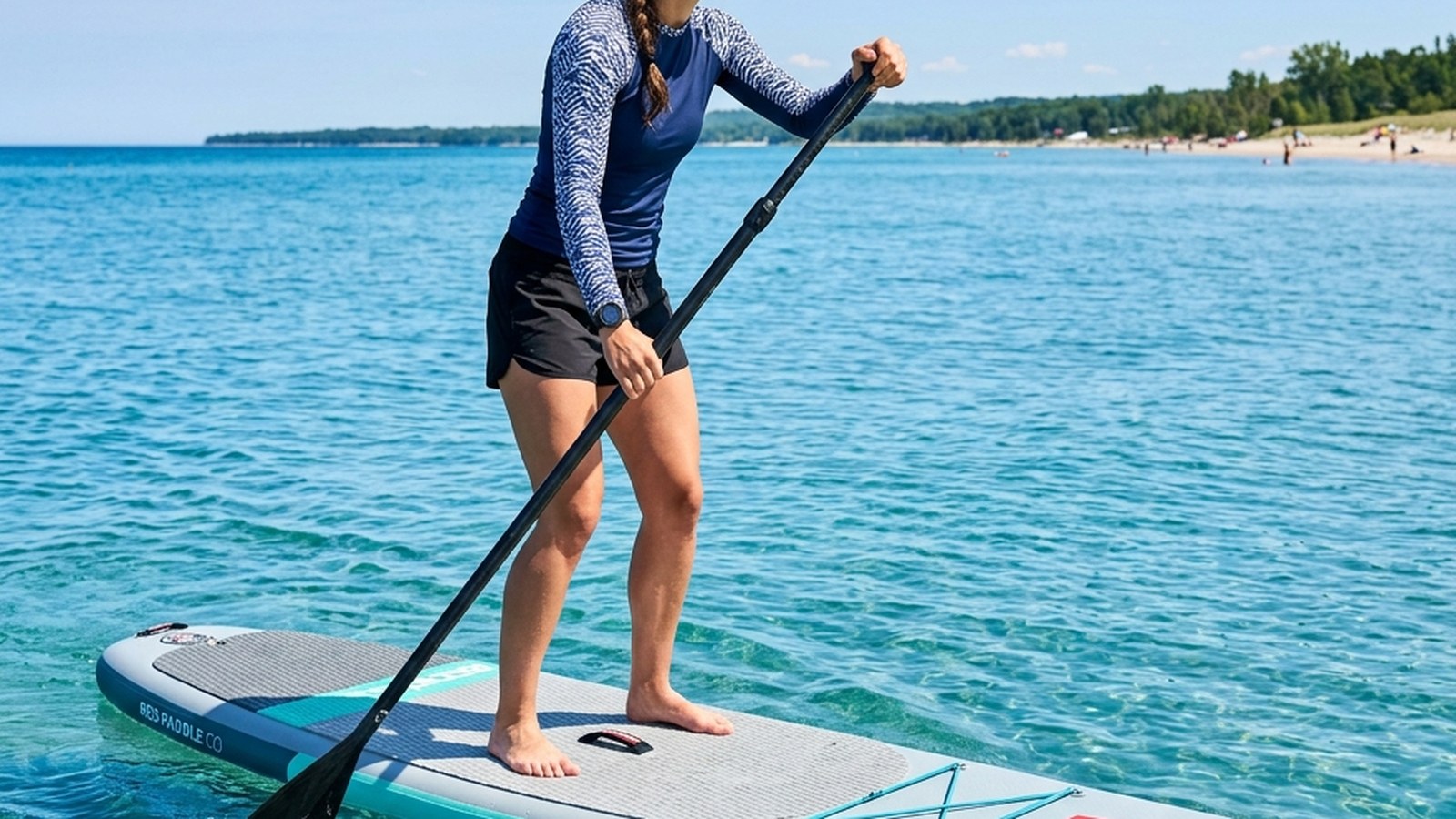
Standing on a board in the Bay is fundamentally different from standing on a river. The "Wasaga Stand" involves a specific postural alignment designed to absorb shoreline chop:
- The Athletic Ready Position: Feet are shoulder-width apart, parallel, and centered on the board’s handle. Knees are "soft" (not locked), acting as shock absorbers for the waves.
- The Tripod Effect: The paddle acts as the third leg of a tripod. When the blade is in the water, you have a secondary point of stability. This is why technique is most vulnerable *between* strokes.
- The Eye-Line: Looking at the board is a recipe for a swim. By keeping the gaze 20 metres ahead on the horizon (or the Blue Mountains in the distance), you leverage the vestibular system’s natural balance cues.
The Technical Stroke: Power from the Core
Paddling is a pulling motion that should originate in the large muscles of the torso. Research by Schram et al. (2016) identifies that elite SUP athletes generate significantly higher peak forces by utilizing a "piston-like" leg drive coupled with a full torso rotation. The arms should remain relatively straight, acting as "struts" that transfer the force from the water to the core.
- The Catch: Spear the blade into the water as far forward as possible without lunging.
- The Power Phase: Push down on the top handle and pull the board past the paddle using the lats and obliques.
- The Release: Exit the water at the feet. Dragging the paddle further back creates a "braking" effect and kills your momentum.
Metabolic Demands: More than a Walk
Casual SUP is often equated to a slow walk, but the data suggests otherwise. Schram (2016) found that recreational paddling on open water typically maintains a heart rate between 120 and 150 bpm, placing it firmly in **Zone 2/3 aerobic training**. When factoring in the energy required for stabilization, a 60-minute session on the Wasaga shoreline can burn 400–600 calories—comparable to a moderate-intensity run, but with zero impact on the meniscus or spinal discs.
Local Route Audit: Beach Area 1 to 6
The 14-kilometre stretch of Beach Area 1 through 6 is the premier SUP corridor in Ontario. For training purposes, we divide this into three zones:
Zone A: The River Mouth (Dynamic Current)
The area where the Nottawasaga River meets the Bay at Beach Area 1 introduces complex water movement. This is the "Technical Lab" where you can practice cross-current stability and navigating boat wakes.
Zone B: The Mid-Shoreline (Steady State)
Beach Area 3 to 5 offers the most consistent water conditions. This is the "Endurance Corridor," ideal for long, uninterrupted steady-state sessions of 5km or more.
Zone C: The Western Rocks (Navigation)
As you approach Beach Area 6, the bottom profile shifts. This requires more active navigation and shorter, more frequent strokes to maintain course against the prevailing westerly wind.The 8-Week Core Stability Progression
To maximize the fitness benefits of your SUP sessions, follow this structured progression:
| Weeks | Focus | Training Protocol |
|---|---|---|
| 1-2 | Stability Base | 30 min sessions. Focus on "Soft Knee" shock absorption. 1:1 work-to-rest ratio. |
| 3-4 | Rotational Power | 45 min. Incorporate 10 x 30-sec "Power Pulls" focusing on torso rotation. |
| 5-6 | Endurance Build | 60 min continuous. Maintain a stroke cadence of 40-50 strokes per minute. |
| 7-8 | Bay Intervals | 90 min total. 4 x 5-min high-intensity laps (paddling into wind) with 3-min drift recovery. |
Weather and the Wasaga "Fetch"
The distance over which wind blows across water is called "fetch." Georgian Bay has a massive fetch, meaning even a moderate wind can create significant waves. In Wasaga, a Northwest wind (NW) is the most challenging, creating a "quartering sea" that hits the board at a 45-degree angle. **Always check the local buoy data** at the Nottawasaga River mouth before launching. If whitecaps are visible from the shore, the stability requirement shifts from "Fitness" to "Survival"—it is better to move your session into the protected river corridor.
Deep Dive: The Hydro-Kinetic Feedback Loop
The primary reason SUP is superior to gym-based balance training lies in the concept of **viscous damping**. When you stand on a Bosu ball, the surface has a fixed "springiness." The body quickly learns the frequency of this bounce and adapts, eventually reducing the neural demand. In contrast, the water of Georgian Bay is a fluid medium that provides variable resistance. Every micro-wave and current shift creates a unique perturbation that cannot be predicted by the central nervous system.
This creates what researchers call a **High-Fidelity Feedback Loop**. The deep spinal stabilizers, such as the multifidus and the transversus abdominis, must engage in a constant state of "reflexive anticipation." On a calm day in Wasaga, the surface might seem still, but the underlying swell requires the obliques to fire at a sub-threshold level just to keep the "Wasaga Stand" aligned. When you add the propulsive force of the stroke, you are layering high-intensity muscular contraction on top of this stabilization requirement. This is the definition of functional core strength: the ability to generate power from a shifting base.
Furthermore, SUP leverages the **closed-kinetic chain** nature of the paddle in the water. For the brief second the blade is buried (The Catch and Power Phase), the paddle acts as a temporary "fixed" point in space. This allows the athlete to leverage their entire body weight against the water, engaging the posterior chain—the glutes, hamstrings, and erector spinae—in a way that mimics the mechanics of a heavy deadlift, but without the compressive spinal load. This makes SUP an ideal rehabilitation tool for Wasaga athletes recovering from lower-back issues who still need to maintain high levels of athletic conditioning.
Training Practical: The 5-Minute Stability Warm-up
Before heading out into the deeper waters of the Bay, perform this sequence within the first 50 metres of the shoreline where the water is waist-deep. This "primes" the vestibular system and ensures your deep stabilizers are firing before you encounter the heavier chop further out.
- The Prone Activation (1 Minute): Lie face down on the board. Perform a standard plank, but focus on the board’s movement. Every time a ripple passes under the board, resist the tilt using your core. This wakes up the transversus abdominis.
- Kneeling Dynamic Balance (2 Minutes): Move to a kneeling position. Extend one arm forward and the opposite leg back (Bird-Dog). The board will wobble significantly; your goal is to keep the nose of the board pointed straight at the horizon. Switch sides every 30 seconds.
- The Slow-Motion Catch (2 Minutes): Stand up in the "Wasaga Stand" position. Perform your strokes at 25% speed. Focus entirely on the "Catch" phase—the moment the blade enters the water. Try to feel the connection between the paddle blade and your opposite-side oblique.
By the end of this five-minute block, your "Wasaga Stand" will feel significantly more rooted. You are no longer just standing on the board; you are integrated with it, allowing you to absorb the energy of the Bay rather than fighting it.
Conclusion: The Ultimate Functional Gym
Paddleboarding in Wasaga Beach is a high-leverage fitness intervention. It solves the "modern posture" problem by requiring an upright, engaged torso while simultaneously building the aerobic capacity of a distance runner. By treating the Bay as your stability lab and following the "Wasaga Stand" protocol, you can build a core that is as resilient as it is powerful. Spearing the water at dawn at Beach Area 1 is the most effective way to start your day and your fitness journey.
Practical logistics and edge cases
Beyond the core protocol above, several recurring practical considerations come up for visitors and regular users of this location. Most are not safety-critical but they meaningfully affect the experience and outcome of a session.
Parking and access. Wasaga’s main parking infrastructure follows the Beach Drive corridor, with most lots paid in summer (typically late May through Labour Day) and free in shoulder seasons. Off-peak weekday mornings provide the easiest parking; summer weekend mid-mornings (10 AM–1 PM) are the toughest. For trail destinations outside the Beach Drive corridor, smaller informal lots can fill quickly during peak weeks; arriving by 9 AM provides reliable access on weekends.
Cell coverage. The main shoreline corridor and most trail systems have reliable cell service. The notable exceptions are the deeper forest sections of Tiny Marsh, the gorge bottom at Devil’s Glen, and the longer Ganaraska Trail traverses, where coverage is intermittent. Solo users on multi-hour outings should consider a satellite messenger or at minimum a check-in plan with someone offsite.
Bathroom access. Beach Areas 1–3 have reliable summer-season bathroom access. Forested trails and Provincial Park interior sections have minimal facilities — plan accordingly for longer outings, particularly with children.
Group sessions and pace mismatch. The most common cause of a frustrating shared outing is pace mismatch between participants. Pre-discuss the target distance, pace, and turnaround landmark before starting; for mixed-ability groups, the pace must be set by the slowest participant. Pulling ahead of slower partners is the classic failure mode that produces falls, exhaustion, or wandering separation.
Weather changes mid-session. Georgian Bay weather can shift quickly — a calm sunny morning can produce thunderstorm activity by mid-afternoon. Check the forecast before extended outings, identify the nearest exit point at the halfway mark, and don’t hesitate to abort an outing if conditions deteriorate.
Wildlife encounters. The most likely encounters are deer, turkeys, foxes, and waterfowl — all best observed at distance. Black bear activity exists in the broader region (particularly outside the immediate Wasaga shoreline) but is uncommon enough that bear-protocol training is sensible only for users heading to the more remote sections of the trail system.
References
Schram BPhysiological and anthropometric characteristics of stand-up paddleboarders. View source →Furness JA profile of injuries in stand-up paddleboarding. View source →Moran JThe effect of stand-up paddleboarding on balance and core strength. View source →Harris NStand-up paddleboarding: A new tool for core and balance training. View source →