The 60-second version
Active beach games matter for one specific reason: in mixed-age family groups, the games where everyone can participate determine the activity dose. Children’s physical activity is strongly predicted by parent participation rather than parent encouragement (Trost 2003 Trost 2003; Sallis 2000 Sallis 2000), and beach games that demand similar skill from a 7-year-old and a 47-year-old generate the kind of joint participation the literature identifies as the actual lever. Bocce, kubb (Swedish lawn game), spikeball, and KanJam are four games where the skill ceiling is low enough for kids and the gameplay engaging enough for adults — and each delivers 3,000–6,000 steps over a typical 60–90 minute beach session, putting it in the moderate-intensity activity range that fundamental movement skill development depends on (Lubans 2010 Lubans 2010; Stodden 2008 Stodden 2008). The honest framing: this is not high-intensity training. It is the activity-versus-sedentary swap that most family beach time still loses.
Why parent participation, not encouragement, drives the dose
Trost 2003, a model-fit paper based on parent-child dyads, found that parental physical activity behaviour explained more variance in children’s activity than parental encouragement, parental support, or parental modelling intent Trost 2003. The mechanism is simple: kids do what their parents do, not what their parents tell them to do. Sallis 2000 reviewed 108 studies of correlates of children’s and adolescents’ physical activity and reached the same conclusion — family participation in active recreation was one of the strongest and most consistent correlates across age, sex, and study design Sallis 2000.
The implication for beach time: a parent reading a book on a towel while a child is told to ‘go play’ produces the lowest activity dose available. A parent throwing a frisbee back-and-forth produces a moderate dose — but only for one child. A parent participating in a 4–6 person game produces high dose for everyone involved. The game design that scales best is therefore the one that the parent will actually play, not the one the parent says the child should play.
Lubans 2010 (the Sports Medicine review of fundamental movement skills and health in children) tied this back to the developmental stakes Lubans 2010. Children with stronger fundamental movement skill (object control, locomotor, stability) showed higher physical activity levels in adolescence and adulthood — the dose-response went both directions. Beach games that practice underhand throw (bocce, kubb), overhead throw (KanJam), striking (spikeball), and dynamic balance on uneven ground (all four) build the FMS portfolio Stodden 2008 modeled as the rate-limiting step for lifetime activity engagement Stodden 2008.
Bocce: low skill, mixed-age, surprisingly active
Bocce is the lowest-barrier game on the list. Eight balls, one pallino (target ball), no fixed court — just a marked rough rectangle of about 4×15 m on flat-ish sand. Each player rolls or lobs balls underhand, trying to land closest to the pallino. Scoring is simple enough for a 5-year-old to track.
The activity profile: players walk to and from the pallino each round (typically 8–12 m), bend to retrieve balls, and rotate positions. Trost 2003 captured this as the difference between sedentary parent supervision and what they called ‘active joint engagement’ Trost 2003. A 60-minute bocce session typically logs 3,000–4,500 steps for adult players, with comparable counts (scaled to leg length) for children. Soft sand adds the energy-cost premium beach surfaces always do.
Why it works for mixed ages: throwing accuracy depends more on consistency than power, so older players don’t systematically dominate young players the way they would in baseball or football. The game has the property the family-PA literature identifies as critical — everyone can plausibly win.
Kubb: the throwing-skill builder Stodden modeled as foundational
Kubb is a Swedish lawn game played with wooden batons (kastpinnar) thrown underhand at wooden blocks (kubbs). Players knock down opponent kubbs from the baseline, then advance to knock down the central king. The game scales 2-vs-2, 3-vs-3, or 6-vs-6 and runs 20–45 minutes.
The fundamental movement skill payoff is direct. Stodden 2008’s developmental model of motor competence identifies underhand throw as one of the eight gateway object-control skills that predict broader physical activity engagement Stodden 2008. Kubb practices it 30–60 times per game per player — an order of magnitude more reps than a typical beach toss session. Lubans 2010’s review identified throwing skill specifically as the most consistently associated with later-life physical activity Lubans 2010.
The activity dose: 4,000–5,500 steps per session. The sand-surface advantage: the unstable footing engages stabiliser muscles in a way grass play doesn’t.
Spikeball and KanJam: the high-intensity options
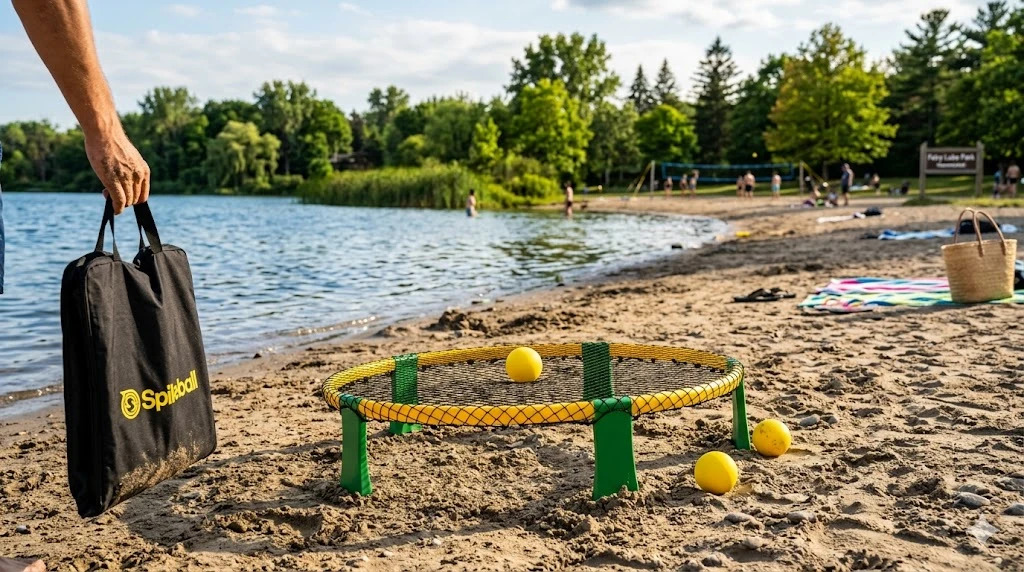
Spikeball (a 2-vs-2 game with a small trampoline-style net at ground level) and KanJam (a 2-vs-2 frisbee-into-can game) sit at the higher-intensity end of the family-game range. Spikeball especially generates short repeated dives, sprints, and jumps that push players into the moderate-to-vigorous activity zone Sallis 2000 identified as the threshold for cardiovascular adaptation Sallis 2000.
The activity dose for a 60-minute spikeball session: 5,500–8,000 steps for adult players, with peak heart rates regularly hitting 75–85% of age-predicted max. The honest caveat: the skill floor is higher than for bocce or kubb. A 6-year-old can’t meaningfully play spikeball; an 8-year-old can rally but not compete; a 10-year-old can play full games. KanJam is more forgiving — the disc-throwing skill develops faster than the rapid hand-eye coordination spikeball requires.
For mixed-age family groups, the practical pattern: bocce or kubb for the under-8 set, KanJam or spikeball for the 10+ set, with adults rotating between games to keep everyone moving.
Why ‘catch’ alone leaves activity on the table
Catch with a baseball, football, or frisbee is the default beach game for most families. It’s not bad — it’s just inefficient. Two-person catch produces 1,500–2,500 steps per hour for each player; the rest of the family is sedentary. Adding a third player typically degrades engagement (one person ends up watching). Adding a fourth without changing the game often results in two parallel games, not one.
The Lubans 2010 framing is useful here Lubans 2010: catch practices one or two FMS (overhand throw, two-handed catch). Bocce, kubb, spikeball, and KanJam each practice 4–6 FMS, including throws of varying distances, strike skills, dynamic balance, and quick directional change. The skill-development case is part of why the sport-organisation literature has been pushing ‘modified games’ in youth sport — the multi-skill demand is the developmental signal.
Picking the game that fits your group
The decision matrix the family-PA literature would support: if the youngest player is under 7, start with bocce. The skill floor is essentially zero, and the game-flow doesn’t leave a 4-year-old waiting for their turn the way a complex game would. If the group is 8–12 with one or two adults, kubb is the strongest pick — the throwing-skill development is foundational, the team format scales, and the rules are quick to learn. If the group is teens and adults, spikeball delivers the highest activity dose per minute and the strongest cardiovascular signal.
For the very common ‘mixed age 4–adult’ family case, rotation works better than committing to a single game. A 90-minute beach window splits cleanly: 30 minutes of bocce while the youngest is fresh, 30 minutes of kubb when the middle kids want more challenge, 30 minutes of KanJam or spikeball with the older kids and an adult while the youngest builds sandcastles — and the adult who built the sandcastle rotates back in.
The Trost 2003 finding bears repeating: the parent who plays produces children who play Trost 2003. The parent who watches doesn’t.
One specific picking note for households with one child versus multiple children. With a single child, kubb and bocce work well as 1-vs-1 family games when both parents play; spikeball and KanJam are technically possible 1-vs-1 but sustain less engagement. With three or more siblings, all four games scale comfortably; the rotation pattern shifts from game-to-game to position-to-position within a single game. The match-the-game-to-the-group framing the family-PA literature endorses is general; the application varies with household composition.
What the games don’t do
Three honest caveats. First: these are moderate-intensity activities, not training. They contribute to the 60-min/day moderate-to-vigorous physical activity (MVPA) target Sallis 2000 and the WHO youth guidelines support, but they don’t replace structured sport practice for kids who play competitive games Sallis 2000. Second: the FMS development case Stodden 2008 modeled requires repetition over years, not one summer of beach games Stodden 2008. The games are useful inputs to a longer development process, not a shortcut. Third: hot-day caveats apply. Beach play in 30°C+ conditions for kids requires the same hydration and shade discipline as any extended outdoor activity.
The case for these games is narrow but real: they convert the most common low-activity family beach pattern into a moderate-activity pattern, with the joint-participation feature the family-PA literature identifies as the high-leverage variable.
One additional honest framing point. The peer-reviewed literature on family physical activity tends to be observational rather than experimental — the Sallis 2000 review captured cross-sectional and longitudinal cohort data, not randomized intervention trials Sallis 2000. The associations between parental participation and child activity are robust across study designs, but the effect-size estimates carry the limitations the observational study designs always do. The practical implication: the bocce-and-kubb-and-spikeball recommendation is a high-confidence behavioural shift with low downside risk and reasonable evidence backing, not a peer-reviewed-tested protocol with quantified outcome data. The honest framing for any family considering the change: try it for a month, observe whether the kids’ activity-and-engagement pattern shifts, and adjust accordingly. The literature gives us the direction; the household-level test gives the calibration.
Practical takeaways
- Parent participation, not parent encouragement, predicts kid activity (Trost 2003, Sallis 2000) — pick games the parent will actually play.
- Bocce: lowest skill floor, scales 2–6 players, 3,000–4,500 steps/hour. Best for groups with kids under 7.
- Kubb: practices the underhand throw Stodden 2008 modeled as a foundational FMS; 4,000–5,500 steps/hour. Best for mixed 8–12 + adults.
- Spikeball and KanJam: highest intensity, 5,500–8,000 steps/hour, peak heart rates at 75–85% max. Best for teens and adults.
- Catch is fine but inefficient — only two people active at a time, only one or two FMS practiced.
- Rotate games across a 90-minute beach window for mixed-age family groups; the rotation keeps everyone moving.
- These are activity inputs, not training. The case is the sedentary-to-active swap, not high-intensity development.
References
Lubans 2010Lubans DR, Morgan PJ, Cliff DP, Barnett LM, Okely AD. Fundamental movement skills in children and adolescents: review of associated health benefits. Sports Medicine. 2010;40(12):1019-1035. View source →Stodden 2008Stodden DF, Goodway JD, Langendorfer SJ, et al. A developmental perspective on the role of motor skill competence in physical activity: an emergent relationship. Quest. 2008;60(2):290-306. View source →Sallis 2000Sallis JF, Prochaska JJ, Taylor WC. A review of correlates of physical activity of children and adolescents. Med Sci Sports Exerc. 2000;32(5):963-975. View source →Trost 2003Trost SG, Sallis JF, Pate RR, Freedson PS, Taylor WC, Dowda M. Evaluating a model of parental influence on youth physical activity. Am J Prev Med. 2003;25(4):277-282. View source →