The 60-second version
Apartment training adds two constraints that single-family-home training doesn’t face: noise transmission to neighbours and limited floor space. The training literature is clear that quiet, low-impact protocols (bodyweight, slow tempo, isometrics, bands) produce nearly equivalent strength and hypertrophy outcomes to higher-impact training in untrained-to-intermediate populations when matched for effort Schoenfeld 2017. The honest playbook: jumping is optional; bodyweight + bands cover most of the strength stimulus; slow eccentric tempos extend bodyweight stimulus when loads cap out; cardio happens via stairs, walking, or low-impact intervals. This article covers the apartment-specific protocols, the noise-management strategies, the equipment that fits a small space, and the surprising number of training options that don’t require jumping or thudding.
The two real constraints
- Noise to neighbours below: jumping, dropping weights, fast cardio movements transmit through floors. Hardwood and concrete-slab buildings transmit more; carpeted upper floors less.
- Floor space: typical apartment workout area is 6 ft x 6 ft (between bed and wall) to maybe 10 ft x 10 ft. Limits some movements (long lunges, jump rope).
Quiet strength options
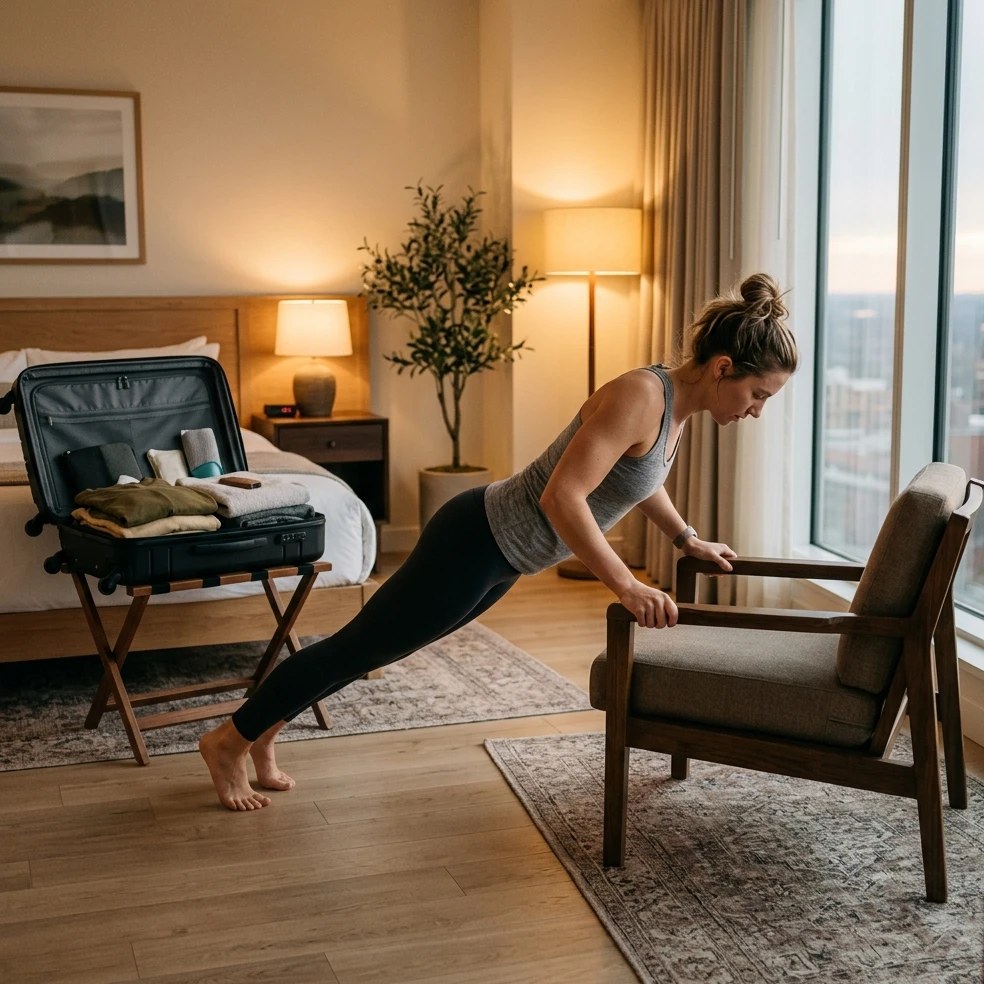
- Bodyweight: squats, lunges, push-ups, planks, glute bridges. All silent.
- Resistance bands: rows, presses, pulls, squats, deadlifts. Silent. Cheap. Pack small.
- Slow tempo training: 4-second descent, 2-second pause, 2-second rise. Extends bodyweight stimulus dramatically without external load.
- Isometric holds: planks, wall sits, single-leg balances. Silent.
- Light dumbbells (5–25 lb): covers most accessory work. Don’t drop them; place them down.
- Kettlebell on a mat: swings work in many apartments if you’re careful with placement; landing-quietly is a skill.
- TRX or door-anchor straps: rows, pulls, single-leg work.
The slow-tempo trick
The 2017 Schoenfeld review of training tempo found slowing the eccentric (lowering) phase to 4–6 seconds doubles the time-under-tension and roughly equates bodyweight stimulus to ~70% 1RM equivalent in many movements Schoenfeld 2017. A push-up at 4-second descent is meaningfully harder than a normal push-up. Apartment lifters can keep getting stronger with bodyweight much longer than gym-trained lifters expect.
Quiet cardio options
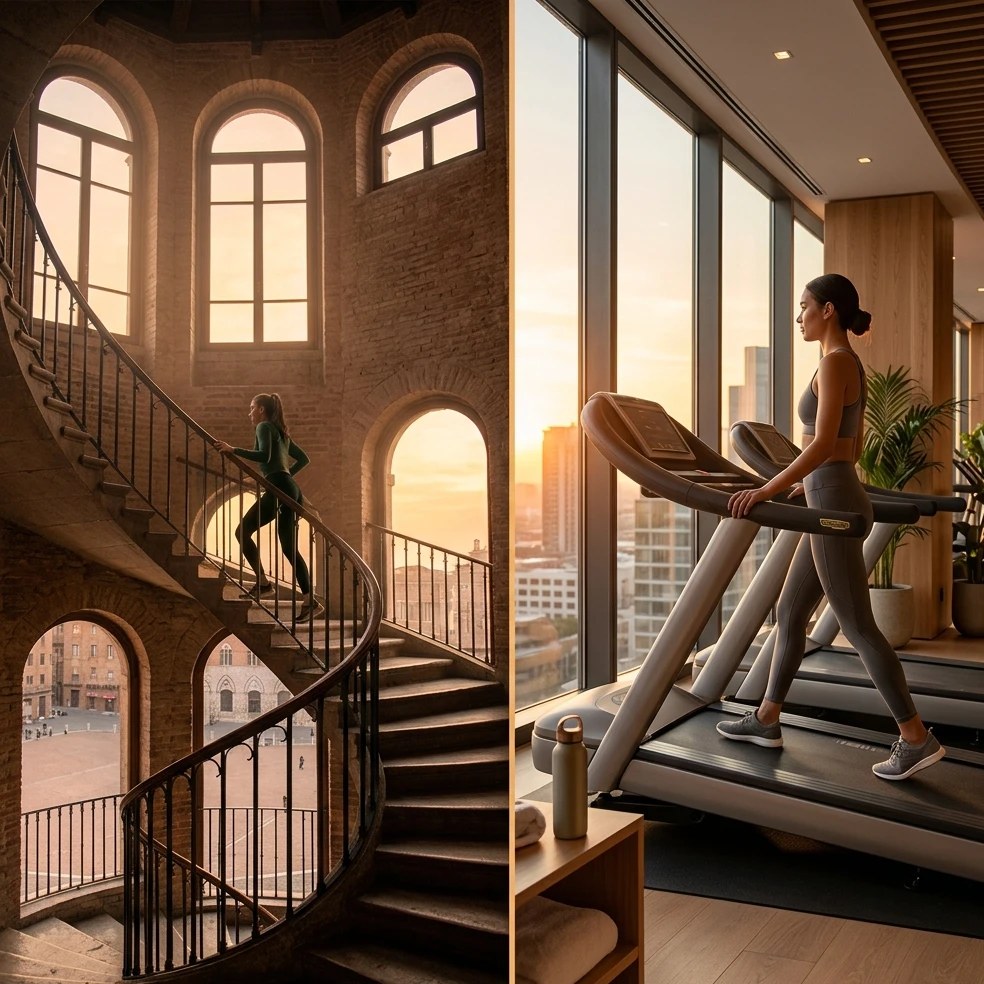
- Stair walking/running: building stairs are the apartment cardio gold standard.
- Walking outside: same-day cardio session.
- Quiet rowing on a low-impact rower: many modern rowers are very quiet. Air-resistance and water rowers louder than magnetic.
- Indoor cycling on a mat: low noise transmission with a thick mat under the bike.
- Slow burpees (without the jump): step out to plank, step back. Most cardio benefit, no jumping.
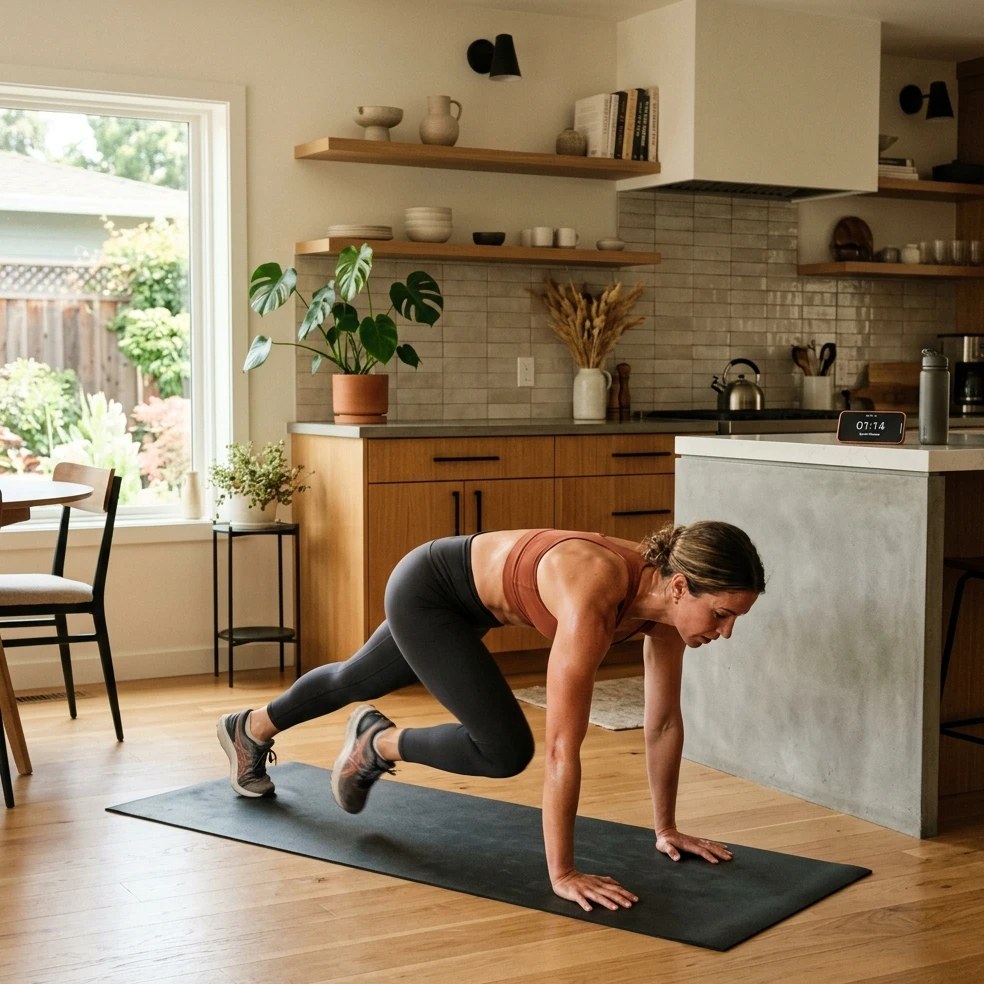
- Mountain climbers (slow tempo): silent if done deliberately rather than fast.
- Shadow boxing: silent, surprisingly intense.
Movements to avoid (or modify)
- Jump rope (unless you have ground-floor or basement space).
- Box jumps, plyometric jumps.
- Jumping jacks (do step-jacks instead).
- Heavy deadlift drops (slow descent; don’t drop).
- Heavy kettlebell swings (modify with lighter loads, controlled landing).
- Burpees with a jump (step-out instead).
Time-of-day awareness
- Avoid early morning (before ~8 a.m.) and late evening (after ~10 p.m.) for any noise-producing exercises.
- Mid-day, late afternoon, early evening: most acceptable times.
- Weekends: more flexibility; still avoid before 9 a.m.
- If you have downstairs neighbours, be especially conservative.
Apartment workout setup
- Yoga mat (~6 ft x 2 ft) for most floor work.
- Thick exercise mat or interlocking foam tiles for kettlebell or heavier load work.
- Door-anchor band kit for rows and pulls.
- Pull-up bar (doorway or wall-mounted, with caution for older buildings).
- One or two pairs of light dumbbells (10–25 lb covers most needs).
- One adjustable kettlebell (saves space vs multiple sizes).
- TRX-style suspension trainer (door anchor option).
Common myths
- “You can’t get strong in an apartment.” Wrong. Bodyweight + bands + slow tempo cover the untrained-to-intermediate strength range entirely. Only advanced lifters hit a load ceiling.
- “Cardio requires jumping.” Wrong. Stairs, walking, slow burpees, shadow boxing all work.
- “The noise from a workout is fine; neighbours are too sensitive.” Frequent dropping or jumping noise is genuinely annoying. Quiet adaptations are courteous and protect the relationship.
Practical takeaways
- Bodyweight + bands + slow tempo + isometrics = full strength stimulus, silent.
- Stair walking, walking outside, and low-impact intervals cover cardio.
- Avoid jumping movements; modify with step versions.
- Time-of-day awareness: mid-day to early evening for noise-producing work.
- Minimum-effective equipment: yoga mat, bands, light dumbbells, pull-up bar.
- Slow tempo (4-second descents) doubles bodyweight stimulus.
References
Schoenfeld 2017Schoenfeld BJ, Grgic J, Ogborn D, Krieger JW. Strength and hypertrophy adaptations between low- vs. high-load resistance training. J Strength Cond Res. 2017;31(12):3508-3523. View source →Kotarsky 2018Kotarsky CJ, Christensen BK, Miller JS, Hackney KJ. Effect of progressive calisthenic push-up training on muscle strength & thickness. J Strength Cond Res. 2018;32(3):651-659. View source →Morton 2016Morton RW, Oikawa SY, Wavell CG, et al. Neither load nor systemic hormones determine resistance training-mediated hypertrophy or strength gains in resistance-trained young men. J Appl Physiol. 2016;121(1):129-138. View source →Calatayud 2014Calatayud J, Borreani S, Colado JC, Martín FF, Rogers ME, Behm DG. Muscle activation during push-ups with different suspension training systems. J Sports Sci Med. 2014;13(3):502-510. View source →Schoenfeld 2015Schoenfeld BJ, Ogborn DI, Krieger JW. Effect of repetition duration during resistance training on muscle hypertrophy. Sports Med. 2015;45(4):577-585. View source →Piercy 2018Piercy KL, Troiano RP, Ballard RM, et al. The Physical Activity Guidelines for Americans. JAMA. 2018;320(19):2020-2028. View source →Ratamess 2009Ratamess NA, Alvar BA, Evetoch TK, et al. American College of Sports Medicine position stand. Med Sci Sports Exerc. 2009;41(3):687-708. View source →Colado 2018Colado JC, Triplett NT. Effects of a short-term resistance program using elastic bands versus weight machines for sedentary middle-aged women. J Strength Cond Res. 2008;22(5):1441-1448. View source →Aboodarda 2016Aboodarda SJ, Page PA, Behm DG. Muscle activation comparisons between elastic and isoinertial resistance: a meta-analysis. Clin Biomech. 2016;39:52-61. View source →Burgomaster 2008Burgomaster KA, Howarth KR, Phillips SM, et al. Similar metabolic adaptations during exercise after low volume sprint interval and traditional endurance training in humans. J Physiol. 2008;586(1):151-160. View source →Schoenfeld 2018Schoenfeld BJ, Grgic J. Evidence-based guidelines for resistance training volume to maximize muscle hypertrophy. Strength Cond J. 2018;40(4):107-112. View source →Garber 2011Garber CE, Blissmer B, Deschenes MR, et al. American College of Sports Medicine position stand. Med Sci Sports Exerc. 2011;43(7):1334-1359. View source →