The 60-second version
Barefoot lifting on a stable platform and barefoot training on shifting sand load entirely different biomechanics. Barefoot lifting on stable floor improves force transfer and intrinsic-foot stability Lieberman 2010; barefoot or minimal-shoe training on sand adds a substantial proprioceptive demand and 1.6–2.5x energy cost Behm 2010. The two are complementary, not interchangeable. Robbins 1987’s foundational work Robbins 1987 on barefoot adaptation framed the transition as a weeks-to-months process; Squadrone 2009 Squadrone 2009 found experienced barefoot runners had distinct biomechanics from shod runners that took years to fully develop. The honest framing: each surface trains a real and useful capacity; the popular collapsing of “barefoot is barefoot” misses the actual adaptive demand of each.
What surface biomechanics actually does
The surface a foot lands on dictates the biomechanical demand. A stable, hard floor (concrete, hardwood, lifting platform) produces predictable ground-reaction forces; the foot can be passive, the lower-leg muscles can work as static stabilisers, and the force transfer from leg drive to load is efficient. Lieberman 2010’s work on barefoot vs shod runners Lieberman 2010 documented this directly: stable-surface barefoot loading produced higher peak forces but distributed across a different timing pattern than shod loading.
An unstable surface — sand, gravel, balance pad, foam — introduces continuous postural-correction demand. The foot is constantly recruiting intrinsic and extrinsic stabilisers to maintain position; the lower leg works dynamically rather than statically; the energy cost rises substantially. Behm 2010’s instability-training literature Behm 2010 framed this as the “instability premium”: real proprioceptive and stabiliser benefit, but reduced force-production capability and reduced suitability for maximal-load work.
The collapsing of these two modes into a single “barefoot training” category misses what each actually trains. Stable-surface barefoot lifting is for force transfer and intrinsic-foot stability; unstable-surface barefoot training is for proprioception and conditioning. They’re both useful and they’re both barefoot, but they’re not interchangeable. The popular framing that one substitutes for the other is the source of much misallocated training time.
Barefoot lifting on a stable surface
The case for barefoot lifting on a stable platform rests on three biomechanical claims, all reasonably well-supported. First, force transfer from foot to floor is more efficient without the cushioning compression of a shoe sole; this matters most for deadlifts and back squats where peak vertical force exceeds 2–3 body weights. Second, ankle dorsiflexion and intrinsic-foot stability are loaded more directly without the shoe’s mechanical stabilisation; this is a long-term adaptation benefit if the lifter has the requisite mobility (the knee-to-wall test of at least 4–5 inches dorsiflexion is the typical screening floor).
Third, proprioceptive feedback from the foot to the central nervous system is unmuted when the foot is in direct contact with the floor; this matters for technique refinement at heavy loads where small balance corrections become high-value. Lieberman 2010’s broader framing of barefoot-vs-shod biomechanics Lieberman 2010 supports this: trained barefoot subjects show distinctly different motor patterns than shod-only subjects, with the proprioceptive feedback being the dominant proposed mechanism.
The case against barefoot lifting on a stable surface is mostly practical. Most public gyms have hygiene policies that prohibit bare feet; the platform may be cleaner with a thin-soled flat shoe than truly bare. The compromise position — a flat-soled minimal cross-trainer or a dedicated lifting shoe with a flat sole — reproduces about 80–90% of the barefoot biomechanical benefit while solving the hygiene and platform-protection problem. For most adults, this compromise is the practical recommendation.
Barefoot training on sand
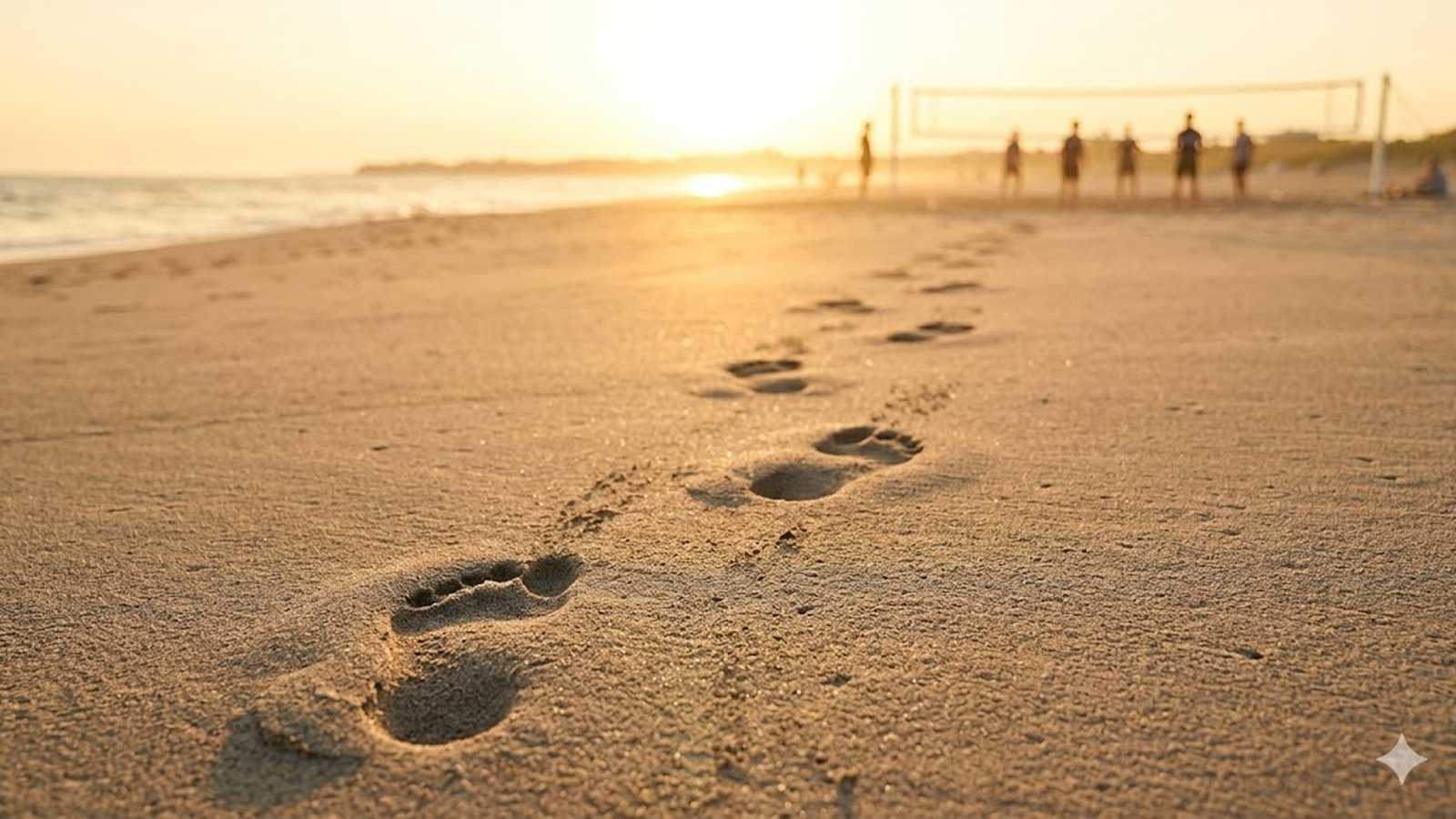
Sand-surface training is biomechanically different from stable-surface training in nearly every measurable way. The shifting surface absorbs energy from each step; the foot must compensate continuously for surface deformation; the lower-leg stabilisers fire at higher and more variable rates; the metabolic cost rises substantially. Behm 2010 Behm 2010 framed the energy cost markup at roughly 1.6–2.5 times the equivalent stable-surface effort, with the higher end applying to deeper or drier sand.
This is not a strength-training environment in the classical progressive-overload sense; the unstable surface caps the load you can productively lift to roughly 60–70% of your stable-surface maximum, and the technique consistency required for clean progressive-overload work is substantially harder to maintain. Sand training is a conditioning and stabiliser-development environment — valuable, but not interchangeable with the stable-surface lifting work the strength curve depends on.
The proprioceptive benefit is real and supported by the broader literature. Robbins 1987 Robbins 1987 documented intrinsic-foot strengthening from barefoot loading on natural surfaces; Squadrone 2009 Squadrone 2009 found experienced barefoot trainees retained these adaptations across years. The Wasaga shoreline is a productive sand-training environment for these adaptations — shifting wet sand at the waterline produces the highest stabiliser demand; dry sand higher up the beach produces the highest energy cost.
The ankle-mobility prerequisite
Both barefoot lifting and barefoot sand training have an ankle-mobility prerequisite that the popular framing tends to skip. Adequate ankle dorsiflexion (typically 4–5 inches knee-to-wall, or 35–40 degrees of plantar-fixed dorsiflexion) is the floor for barefoot squat work; below that, the heel-elevated lifting shoe is the safer default. For barefoot sand training, the demand is lower because the unstable surface forgives some of the mobility limitations — but a basic plantar-flexion-to-dorsiflexion range of motion is still required to avoid heel-rocker compensation.
The mobility-improvement work is straightforward: daily 5–10 minutes of calf stretches, ankle dorsiflexion drills (knee-to-wall for the gastrocnemius, banded ankle distractions for the joint capsule), and progressive loaded mobility (overhead squats with a band, paused goblet squats with a focus on knees-over-toes positioning). Most adults can improve their ankle dorsiflexion by 1–2 inches over 8–12 weeks of consistent daily work.
Lieberman 2010’s broader framing of barefoot adaptation Lieberman 2010 explicitly acknowledged the multi-week-to-multi-month timeline; this isn’t a single-session decision. The popular framing that you can transition from heeled lifting shoes to flat or barefoot in a single session is the source of most of the early-transition injury reports (achilles tendinopathy, plantar fasciitis, calf strains) the orthopaedic literature documents.
When each surface genuinely belongs
The honest synthesis: barefoot stable-surface lifting belongs in the heavy-compound-lift portion of a training program for trainees who have the requisite ankle mobility and access to an appropriate lifting environment. The targets are squats, deadlifts, Romanian deadlifts, single-leg work where force transfer matters most. The compromise of a flat-sole minimal cross-trainer is the practical default for most public-gym lifters.
Barefoot sand training belongs in the conditioning and proprioceptive portion of a program. The targets are walking, running, lateral-shuffle drills, single-leg balance work, basic bodyweight movements where the unstable-surface stimulus is the actual training point. Behm 2010’s instability literature Behm 2010 supports 2–3 weekly sessions of unstable-surface work as a productive accessory to stable-surface progressive overload — complementary to, not a substitute for, the strength curve.
The collapsing error to avoid: treating sand training as if it builds the same strength qualities as stable-surface lifting, or treating barefoot lifting as if it produces the same proprioceptive demand as sand work. Each surface trains a real and useful capacity; each one’s capacity is distinct from the other’s.
The hot-sand thermal problem
Pure barefoot sand training in the summer has a thermal-injury problem that the popular framing usually skips. Direct-sun beach sand reaches 50–65°C surface temperature by mid-afternoon at southern Ontario latitudes; sustained barefoot contact above ~52°C produces first-degree burns within 60–90 seconds and second-degree burns within 5–10 minutes. This is not a hypothetical; emergency departments at Lake Huron and Georgian Bay see seasonal foot-burn presentations almost every July and August weekend.
The thermal-injury fix is straightforward: train barefoot only in the morning (before 10 AM, when sand surface is below 35–40°C) or evening (after 6 PM, when the sand has begun to cool); use a thin water shoe for mid-afternoon sessions; or move to wet packed sand at the waterline where evaporative cooling keeps the surface in the 25–30°C range even at peak heat. The wet-sand training is also where the stabiliser demand is highest, so this constraint conveniently aligns with the most-productive sand-training surface.
For Wasaga readers, the practical pattern is morning beach sessions (6–9 AM) for the barefoot dry-sand work, mid-day or evening waterline sessions for the wet-sand work, and a thin water shoe in the kit bag for the unplanned heat days. The combination preserves the year-round outdoor training without the seasonal injury pattern.
Combining the two surfaces in one program
The practical programming question is how to fit both surfaces into one training week. The answer for most adults: stable-surface lifting twice or three times per week (with the appropriate footwear for the lift demand), unstable-surface conditioning once or twice per week (sand walking, sand running, sand bodyweight circuits), with at least 24 hours of recovery between heavy unstable-surface conditioning and heavy stable-surface lifting.
The most-common programming error is back-to-back heavy days that combine unstable-surface conditioning with stable-surface heavy lifting. The unstable-surface stabiliser fatigue elevates injury risk on the next-day lifts; the recovery demand compounds. The 24-hour gap is the floor; 48 hours is the more conservative default for adults over 40 or for trainees in a hypertrophy phase where total recovery demand is already high.
For Wasaga readers with weekend-only beach access, the practical pattern is gym lifting Monday/Wednesday/Friday with sand conditioning Saturday or Sunday morning. The seasonal split — sand work April through October, all gym work November through March — preserves the year-round training without forcing the transition every week.
Bottom line: pick the surface for the demand
The honest bottom line for adult readers is that barefoot training is not a single category — it’s a description of a footwear choice that produces different training stimuli depending on the surface. Barefoot lifting on a stable platform is for force transfer, intrinsic-foot stability, and proprioceptive precision under heavy load; barefoot training on sand is for proprioceptive demand, stabiliser recruitment, and conditioning energy cost. Both are useful; neither substitutes for the other.
For Wasaga and Georgian Bay readers specifically, the practical lever is to use both surfaces deliberately within a single training week: gym lifting in flat-sole shoes (or genuinely barefoot if facility allows) for the strength progression, beach sand work in the morning or evening for the conditioning and stabiliser progression. The 8–12 week adaptation window for either surface is realistic; the popular framing that “barefoot is barefoot” obscures what actually drives each adaptation. The correct framing is that you’re training two distinct capacities; both happen to involve no shoes.
Practical takeaways
- Stable-surface barefoot lifting trains force transfer and intrinsic-foot stability. Heavy compound lifts where force production matters most.
- Unstable-surface barefoot sand training trains proprioception and stabiliser recruitment. The energy cost is 1.6–2.5x stable-surface equivalent.
- Adequate ankle dorsiflexion is the prerequisite for both modes. 4–5 inches knee-to-wall is the typical screening floor.
- Sand surface temperature above 50°C is a thermal-injury risk. Train barefoot in the morning or evening; use water shoes for mid-afternoon.
- Combine both modes with 24–48 hours of recovery between heavy days. Back-to-back unstable-and-stable elevates injury risk.
- The barefoot-adaptation timeline is weeks to months, not sessions. Single-session transitions are the source of most early-transition injuries.
References
Lieberman 2010Lieberman DE, Venkadesan M, Werbel WA, et al. Foot strike patterns and collision forces in habitually barefoot versus shod runners. Nature. 2010;463(7280):531-535. View source →Robbins 1987Robbins SE, Hanna AM. Running-related injury prevention through barefoot adaptations. Med Sci Sports Exerc. 1987;19(2):148-156. View source →Behm 2010Behm DG, Drinkwater EJ, Willardson JM, Cowley PM. The use of instability to train the core musculature. Appl Physiol Nutr Metab. 2010;35(1):91-108. View source →Squadrone 2009Squadrone R, Gallozzi C. Biomechanical and physiological comparison of barefoot and two shod conditions in experienced barefoot runners. J Sports Med Phys Fitness. 2009;49(1):6-13. View source →