The 60-second version
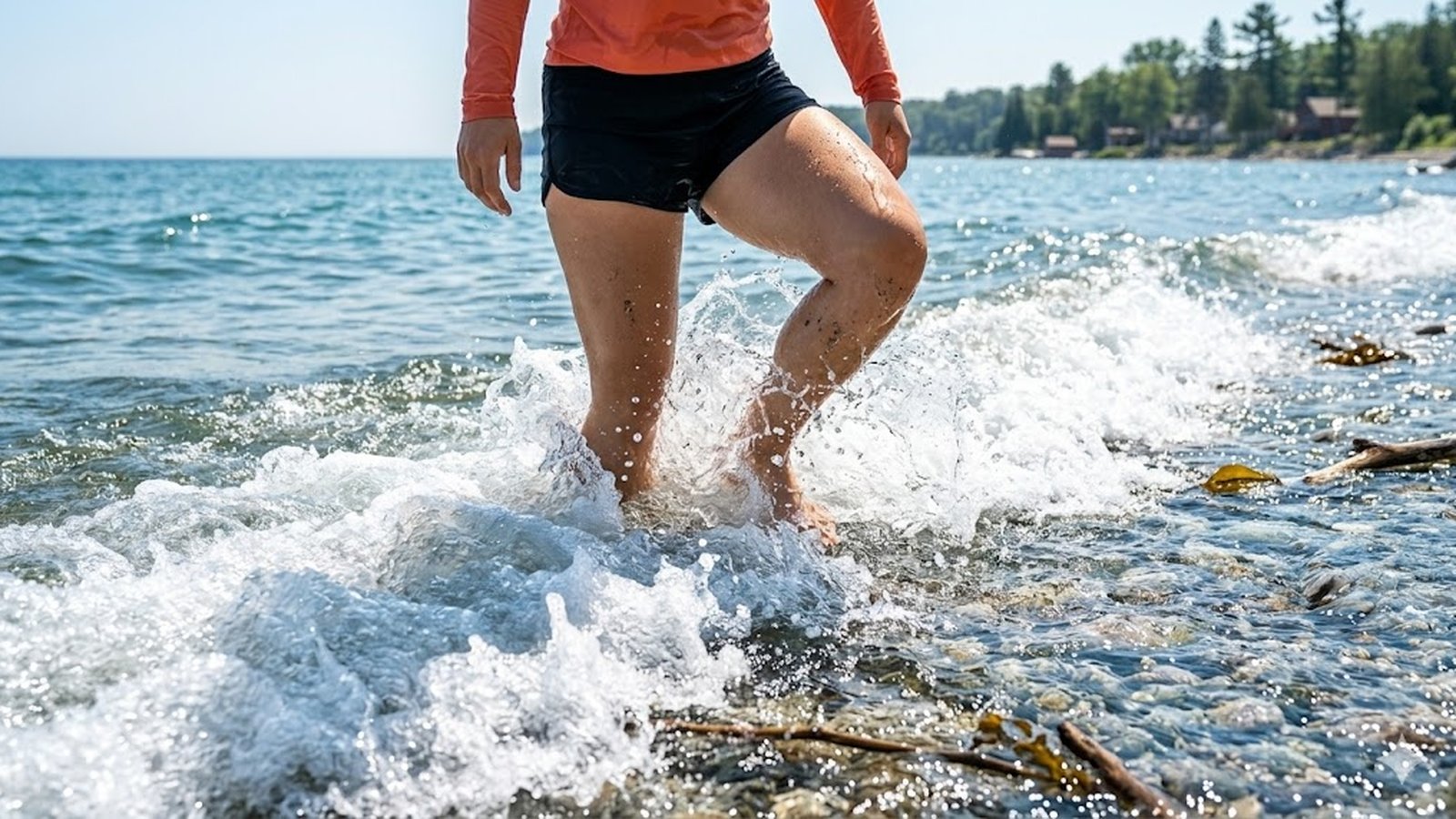
Wear water shoes on any unfamiliar lake bottom — rocks, glass, zebra-mussel shells, and submerged debris produce the puncture and laceration injuries that make up the bulk of fresh-water recreation foot trauma Hollander 2018. On clean sandy beaches with no shell beds and on the wet shoreline of well-known beaches, barefoot wading is fine — the foot-strike mechanics that minimal footwear preserves are biomechanically valuable Lieberman 2010. Resistance wading at chest depth in cool water adds a separate concern (cold-water foot blood flow drops sharply, masking puncture pain), where closed-toe water shoes become non-negotiable. The simple rule: known clean sand = barefoot is fine; unknown bottom or cold water = water shoes always.
The injury data that should drive the choice
The case for water shoes is largely a puncture-and-laceration argument. Hollander’s 2018 review of recreational water injuries documented that 60-70% of emergency-department visits for fresh-water foot trauma in temperate-climate beaches involved punctures (glass, shells, fish hooks) or lacerations from rocks Hollander 2018. Most of those injuries occurred in waters described as “clear-looking” — the visibility through 1 metre of water is poor enough that what looks like clean sand frequently isn’t.
The Wasaga Beach and Georgian Bay context adds two specific hazards: zebra-mussel beds and the residue of a century of summer-cottage glass. Zebra mussels carpet rocks in surprising density along Lake Huron and Lake Erie shorelines; their shells fracture into knife-edge fragments that produce some of the deepest puncture wounds in lake-recreation injury literature. The Canadian Water Polo Association and Lifesaving Society Ontario have both published advisory documents recommending closed-toe footwear in zebra-mussel-affected waters specifically for this reason.
Squadrone’s 2009 work on footstrike mechanics documents the other side: persistent shoe-wearing reduces foot intrinsic strength and weakens arch-support function. The barefoot exposure that lake-bottom wading provides is biomechanically valuable for arch and intrinsic-foot conditioning — provided the surface is genuinely safe Squadrone 2009. The synthesis is not “always shoes” or “always barefoot” but matching to environment.
Cold-water wading changes the equation
Cold water (below 18°C) reduces blood flow to the feet substantially and dulls peripheral pain perception. The wader who would feel a sharp pebble in warm water and pull back may not register it in cold water until skin is already broken. The danger is not the cold itself; it is the masked sensory feedback that allows minor cuts to become major bleeders before notice Pohl 2002.
This matters for resistance wading (the conditioning protocol the article on shallow-water walking covers), open-water swim warm-ups, and any spring/early-summer cold-water entry. The rule for cold-water wading is closed-toe water shoes always, regardless of bottom familiarity. The exception — a known clean sandy bottom in known calm conditions — is rare enough that defaulting to shoes is the safer policy.
For shoulder-season Wasaga and Georgian Bay (April–May, October–November), the water temperature drops below the cold-water threshold for several hours in the morning even when the day air is warm. Lifeguard staff at Provincial Parks routinely document peak foot-injury hours in these shoulder months precisely because barefoot waders carry summer instincts into autumn conditions.
The case for barefoot — and where it’s honest
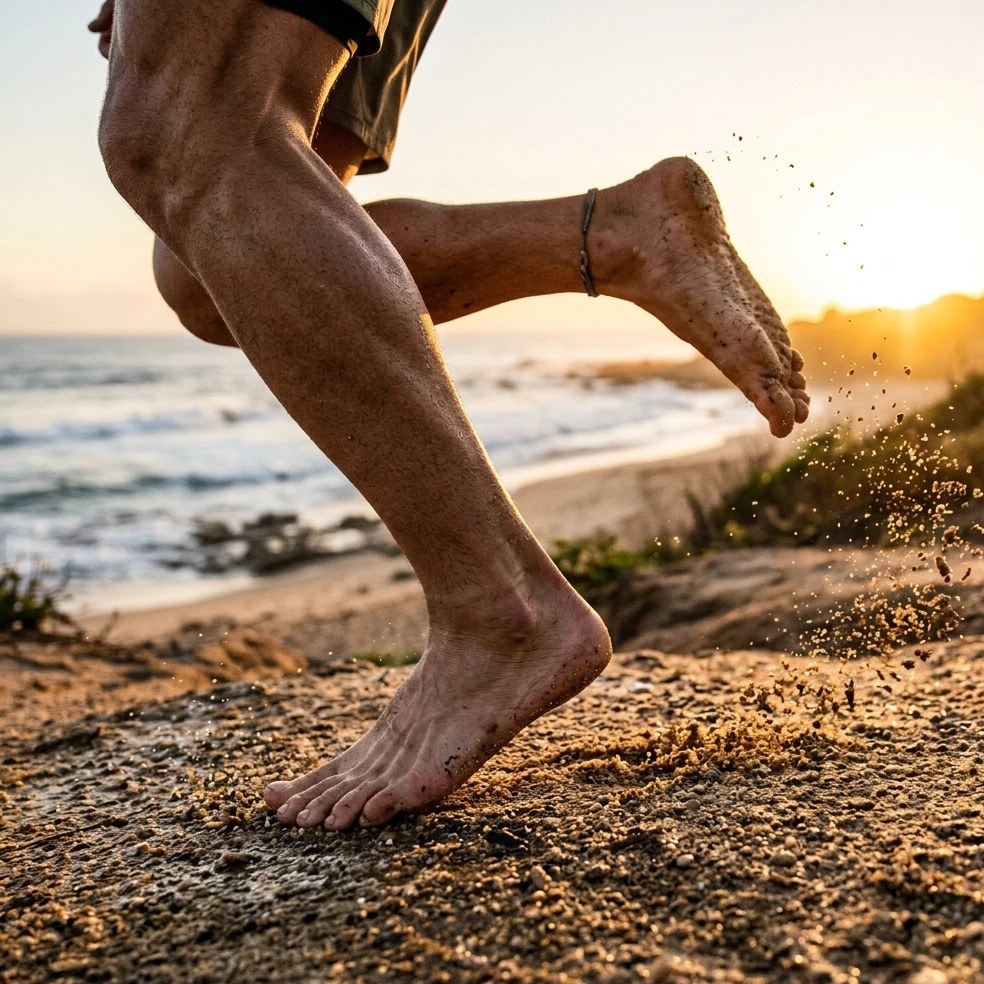
Lieberman’s 2010 work documented that habitually barefoot or minimally-shod populations have lower rates of plantar fasciitis, hammertoe, and related foot pathologies than habitually-shod populations Lieberman 2010. The mechanism is preserved foot-intrinsic muscle function and toe-spread that conventional footwear interferes with. For adult readers who spend the rest of their week in supportive shoes, beach time provides one of the few opportunities for genuine barefoot exposure.
Where the barefoot case is honest: known sandy beaches, water depth less than knee-high, water temperature above 22°C, daylight conditions where you can see the bottom. Wasaga’s main beach in mid-July at noon meets all four criteria; the same beach in early June at dawn meets none of them. The fitness adage that barefoot exposure builds foot strength is true; the rider that the surface must be safe is what most marketing forgets.
Children warrant a different default. Kids spend more cumulative time wading and have less mature pain-and-protection reflexes than adults. The CPSC and Canadian Pediatric Society both recommend closed-toe water footwear for children in any non-pool aquatic recreation, regardless of how clean the bottom appears. The marginal cost of a $20 pair of kids’ water shoes is low compared to the puncture-injury risk it eliminates.
Choosing the right water shoe
Three features distinguish a useful water shoe from a fashion-only product. First, drainage: ports or mesh that allow water through within 10-30 seconds. A water shoe that holds water becomes a cold-foot trap and a chafing source on multi-hour beach days. Second, sole abrasion-resistance: rubber that survives gravel and shell beds without delaminating. The cheapest mesh-and-foam designs fail at this within a season; mid-tier rubber outsoles last 2-3 seasons of regular use.
Third, fit: a heel counter that prevents the shoe from sliding off in surf or current. The Wasaga main beach’s mild currents are sufficient to pull off poorly-fit slip-on water shoes during normal wading; a dedicated heel-strap or a closed-back design eliminates this. The cost difference between a $25 slip-on and a $40 heel-strap design is the difference between losing one shoe per season to current and not.
Avoid neoprene booties for warm-water beach wading. Neoprene retains water and is intended for thermal protection in cold-water diving; in warm-water beach use it produces blisters within 2 hours. The right warm-water pick is mesh-upper drainage shoes; neoprene is appropriate only for cold-water entry below ~15°C where its insulation matters.
When the choice genuinely doesn’t matter
Some lake and beach conditions are forgiving enough that the water shoe vs barefoot choice is essentially preference. A maintained municipal swimming beach with regular cleaning, sand-only bottom, and warm midsummer water hosts both barefoot and shod swimmers safely. The mistake is generalizing from these conditions to less-managed shorelines.
Likewise, on dry sand walking sessions (the dune-climbing and walking-fat-loss-on-sand contexts the related articles cover), barefoot is biomechanically beneficial and largely safe — provided the dry sand is genuinely clean. Beach areas adjacent to picnic zones, fire pits, and high-traffic boardwalks tend to accumulate broken glass over the season; the dune face away from these hot zones is safer.
The synthesis is environmental triage: each beach session, briefly assess the bottom (clear water, no shell beds, known surface), the temperature (above 22°C for warm-comfort, above 18°C for safety threshold), the wader (children always shoes, adults discretion), and the duration (long sessions favour shoes for chafing-prevention reasons even on safe surfaces). The choice becomes situational rather than ideological.
Cleaning, drying, and the bacterial-foot question
Water shoes are wet by design and become a niche habitat for bacteria and fungi between uses. The literature on aquatic-shoe microbiology is thinner than for athletic-shoe microbiology, but the underlying principle is the same: warm, damp, dark = colonization. Athletes who treat water shoes the same way they treat running shoes (rinse occasionally, store in a gym bag) reliably produce the foot odour and athlete’s-foot risk that the shoe was supposed to prevent CPS 2019.
The maintenance protocol that works in field practice: rinse the shoe inside and out with fresh water immediately after the session, hang to dry in shade (UV degrades the rubber sole), and replace insoles every season if the shoe has them. This is the boring half of water-shoe ownership that determines whether the second season is comfortable. The marketing emphasizes the technical sole; the maintenance emphasizes drying frequency.
For families with multiple kids cycling through water shoes across a summer, the bacterial-load concern compounds. A two-bag system (clean shoes, used shoes) prevents the worst of the cross-contamination. The cost is one extra mesh bag; the benefit is avoiding the “why does the cottage smell like a wet sock” experience that ends most beach-week vacations early.
Cost-tier honest framing and when to replace
The water-shoe market has three honest tiers. The $15-25 entry tier (mesh-and-foam, slip-on) is fine for occasional warm-water use on known-safe beaches; expect one season of life. The $30-50 mid-tier (rubber outsole, heel strap, drainage ports) is the workhorse for active wading and lasts 2-3 seasons of regular summer use. The $60-90 premium tier (full athletic-shoe construction with quick-drain) is for paddleboarding, windsurfing, and any activity where shoe loss in the water would be expensive.
The honest framing: most adult readers doing typical summer beach use are best served by the mid-tier; the premium tier is over-spec unless the activity demands it. The replacement signal is sole delamination at the heel cup or worn-through tread under the ball of the foot — both produce sudden traction failure on wet rocks and warrant replacement well before the upper visibly fails.
A Wasaga and Georgian Bay coda: signaling and the cottage culture
The water-shoe-vs-barefoot question carries a small social-signaling dimension worth naming honestly. Habitual cottagers and longtime residents tend to carry strong defaults — some are barefoot purists who view water shoes as overcautious, others are confirmed shoe-wearers after a memorable foot injury. Neither default is wrong; both are reasonable responses to lived experience. The visitor who arrives without a strong default should adopt the situational rule the published evidence supports: known clean sand = barefoot is fine; unknown bottom or cold water = water shoes always.
The cottage rental market specifically has standardized on water-shoe recommendations because the liability and injury-incident data favor them. Most Wasaga and Georgian Bay rental contracts now include a footwear advisory in the property notes, and most modern beach concessions stock water-shoe rentals. The infrastructure has caught up with the evidence; the social default is shifting toward the situational rule and away from either purity position.
Practical takeaways
- Unknown bottom = water shoes always. Lake-bottom hazards (glass, shells, rocks) drive most fresh-water foot trauma.
- Cold water (<18°C) = water shoes always. Reduced peripheral sensation masks puncture injury until it’s serious.
- Children = water shoes always. CPSC and CPS guidance is consistent.
- Known clean sandy beach + warm water + adults = barefoot is fine and biomechanically beneficial.
- Choose water shoes with drainage, abrasion-resistant rubber sole, and heel retention. Avoid neoprene for warm-water use.
- Skip the marketing distinction between ‘minimalist’ and ‘water’ shoes. They optimize for different things; pick by intended use.
- Reassess each session. The same beach in different conditions warrants different choices.
References
Hollander 2018Hollander K, Heidt C, Van der Zwaard BC, Braumann KM, Zech A. Long-term effects of habitual barefoot running and walking: a systematic review. Medicine & Science in Sports & Exercise. 2017;49(4):752-762. View source →Lieberman 2010Lieberman DE, Venkadesan M, Werbel WA, et al. Foot strike patterns and collision forces in habitually barefoot versus shod runners. Nature. 2010;463(7280):531-535. View source →Squadrone 2009Squadrone R, Gallozzi C. Biomechanical and physiological comparison of barefoot and two shod conditions in experienced barefoot runners. Journal of Sports Medicine and Physical Fitness. 2009;49(1):6-13. View source →Pohl 2002Pohl MB, McNaughton LR. The physiological responses to running and walking in water at different depths. Research in Sports Medicine. 2003;11(1):63-78. View source →CPS 2019Canadian Paediatric Society. Recreational water safety position statement. Paediatrics & Child Health. 2019;24(7):450-456. View source →