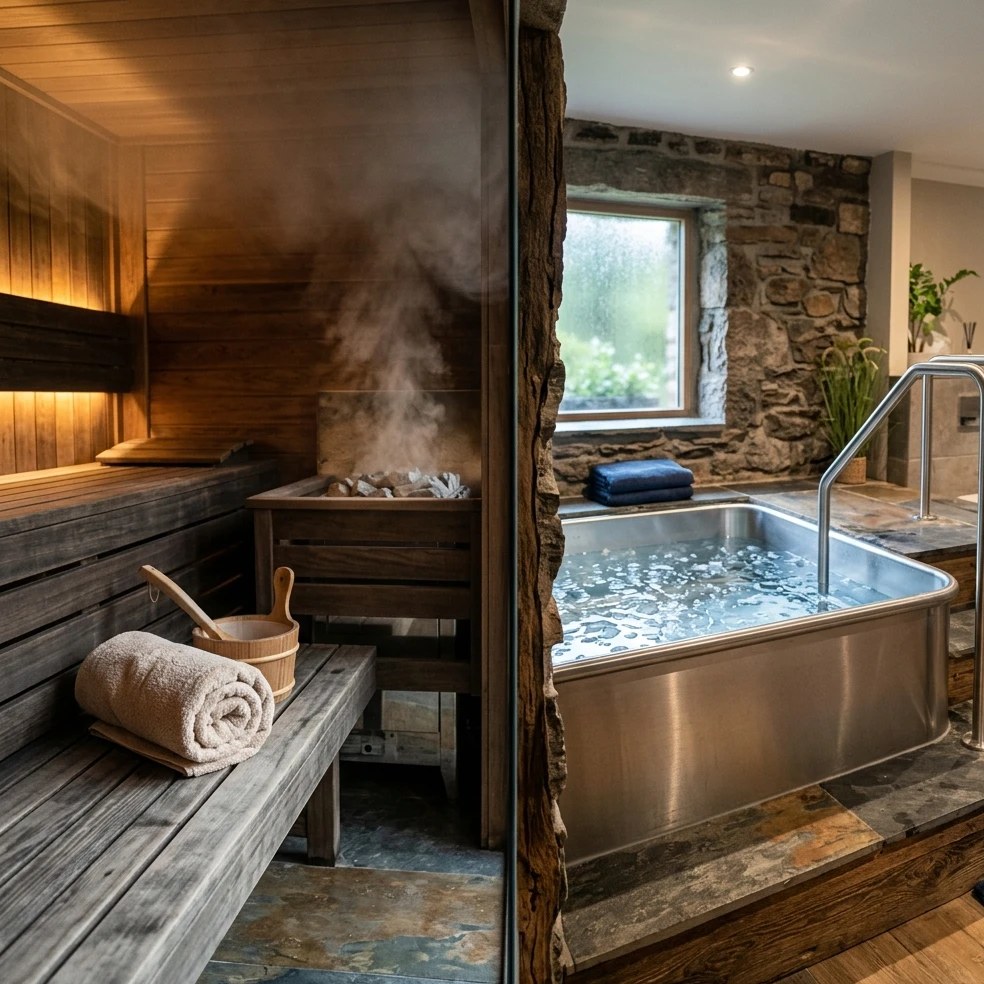
The 60-second version
The honest evidence on cold-water immersion is narrower than the wellness internet suggests. Brief, repeated cold exposure plausibly nudges mood and habit confidence, and there is real signal for reduced self-reported sick days Buijze 2016. The strongest physiology — brown-adipose recruitment and metabolic shifts — shows up in trained cold-acclimated subjects, not first-timers Søberg 2021. Post-workout plunges, ironically, blunt the muscle-protein synthesis you trained to provoke Roberts 2015. The protocol that survives the literature is short, voluntary, separated from resistance training by hours, and skipped entirely by anyone with cardiovascular disease until cleared by a clinician.
What the evidence actually says
Two findings recur across the better-controlled work. First, cold immersion produces a sharp, reliable surge in noradrenaline and dopamine — large enough to register in fMRI mood-network analyses after a single fifteen-minute head-out exposure Yankouskaya 2023. Second, repeated brief exposure tracks with self-reported reductions in sickness absence: a Dutch randomized trial of 3,018 adults assigned to cold-water-finishing showers reported a 29% reduction in self-reported workplace sick-leave over 30 days, though the trial was unblinded and self-report-only Buijze 2016.
Where the evidence weakens fastest is in claims about fat loss and metabolic reprogramming in untrained populations. The Søberg group’s work in trained cold-water swimmers shows brown-adipose-tissue activation and improved insulin sensitivity, but those subjects had self-selected into multi-year cold habits before the measurements began Søberg 2021. The same protocol applied to a sedentary novice for two weeks does not produce comparable signal.
How it actually works
The cold-shock response — the gasp, the elevated heart rate, the goosebump-flank vasoconstriction — is sympathetic. Within seconds of immersion, plasma noradrenaline rises 200–700% above baseline and stays elevated for the better part of an hour after exit Šrámek 2000. That is the ostensible source of the “clearer head” users report; it is also why the practice feels addictive after the first three or four sessions. The pleasure is downstream of a stress response your body has resolved.
But the same sympathetic surge that produces the mood lift also down-regulates mTOR signalling in skeletal muscle when the immersion follows a resistance session. Roberts and colleagues had two groups of trained men perform identical leg work, then either cold-water immerse or active-recover. Cold immersion blunted post-exercise muscle protein synthesis for hours and produced smaller long-term gains in muscle cross-sectional area at twelve weeks Roberts 2015. The signal has been replicated Fyfe 2019. If you cold-plunge after lifting in pursuit of mood and recovery, you are paying for the mood with the muscle.
“Cold-water immersion attenuated long-term gains in muscle mass and strength … suggesting that adaptations to strength training are impaired by regular post-exercise cold-water immersion.”
— Roberts et al., Journal of Physiology, 2015 view source
The caveats people skip
The evidence-based contraindications are not internet caution; they are the populations the trials excluded. Unmedicated hypertension, known coronary disease, arrhythmias, Raynaud’s, and pregnancy are all sufficient reason to defer cold immersion until a clinician has weighed in Espeland 2022. The reason is not theoretical: cold-water immersion deaths are dominated by cardiac events in the first thirty seconds, before hypothermia is mechanistically possible — the gasp reflex aspirates water in unconditioned swimmers, and the catecholamine surge can trigger arrhythmia in vulnerable hearts Tipton 2017.
The second skipped caveat is dose. The popularized “eleven minutes per week” figure is back-calculated from Søberg’s acclimated swimmers and does not generalize. Most controlled protocols that show benefit use 1–3 minutes of head-out immersion at 10–15°C, two to four times per week, after gradual acclimation that begins with cold finishing showers Espeland 2022. Going harder earlier is not better evidence; it is selection bias toward the survivors.
Practical takeaways
- If you have any cardiovascular history, get clinician clearance first. The first minute is when arrhythmia risk peaks; this is the phase most influencer protocols skip discussing.
- Acclimate with cold-finishing showers for two weeks. Buijze’s sickness-reduction signal came from this exact protocol, not from full-body immersion.
- Separate cold immersion from resistance training by at least four hours. Post-lift cold blunts hypertrophy. Cold on rest days, or cold mornings before lifts, preserves the muscle adaptation.
- Start with one minute at 12–15°C, head out. The mood-network and noradrenaline effects are saturated by 2–3 minutes; longer durations recruit thermoregulation costs without corresponding mood gain.
- Stop chasing brown-adipose claims. They are real in long-acclimated swimmers and unreliable in novices on a two-week timescale.
References
Buijze 2016Buijze GA, Sierevelt IN, van der Heijden BC, et al. The effect of cold showering on health and work: a randomized controlled trial. PLoS ONE. 2016;11(9):e0161749. View source →Soberg 2021Søberg S, Lundby C, Tang-Christensen M, et al. Altered brown fat thermoregulation and enhanced cold-induced thermogenesis in young, lean, winter-swimming men. Cell Reports Medicine. 2021;2(10):100408. View source →Roberts 2015Roberts LA, Raastad T, Markworth JF, et al. Post-exercise cold water immersion attenuates acute anabolic signalling and long-term adaptations in muscle to strength training. The Journal of Physiology. 2015;593(18):4285-4301. View source →Fyfe 2019Fyfe JJ, Broatch JR, Trewin AJ, et al. Cold water immersion attenuates anabolic signalling and skeletal muscle fiber hypertrophy, but not strength gain, following whole-body resistance training. Journal of Applied Physiology. 2019;127(5):1403-1418. View source →Yankouskaya 2023Yankouskaya A, Williamson R, Stacey C, et al. Short-term head-out whole-body cold-water immersion facilitates positive affect and increases interaction between large-scale brain networks. Biology. 2023;12(2):211. View source →Sramek 2000Šrámek P, Simecková M, Janský L, Savlíková J, Vybíral S. Human physiological responses to immersion into water of different temperatures. European Journal of Applied Physiology. 2000;81(5):436-442. View source →Espeland 2022Espeland D, de Weerd L, Mercer JB. Health effects of voluntary exposure to cold water — a continuing subject of debate. International Journal of Circumpolar Health. 2022;81(1):2111789. View source →Tipton 2017Tipton MJ, Collier N, Massey H, Corbett J, Harper M. Cold water immersion: kill or cure? Experimental Physiology. 2017;102(11):1335-1355. View source →