The 60-second version
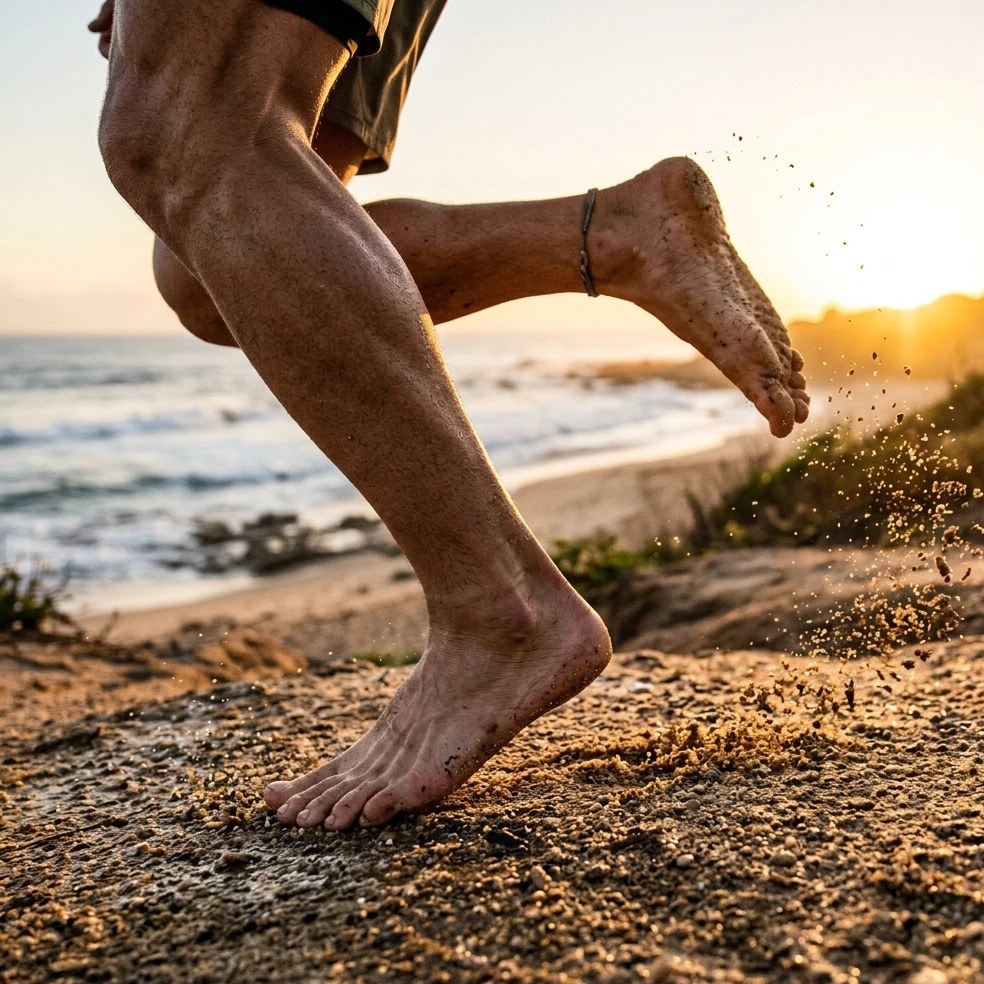
Walking barefoot on sand has two distinct possible benefits, only one of which is well-evidenced. The first is “earthing” or grounding — the claim that direct skin contact with the earth’s surface neutralizes free radicals via electron transfer Chevalier 2012. That literature is small, often unblinded, and largely confined to low-tier journals; honest readers should treat it as plausible but unproven Oschman 2015. The second is foot-mechanics: yielding surfaces (sand, grass) recruit intrinsic foot musculature differently than rigid floors Robbins 1987 and barefoot foot-strike patterns reduce vertical loading rate compared to shod patterns Lieberman 2010. That literature is much stronger and is reason enough on its own to walk barefoot on the Wasaga shoreline regularly.
What the peer-reviewed evidence actually shows
The earthing literature is small, mostly unblinded, and largely concentrated in a handful of low-impact journals. Chevalier 2012, the most-cited review, summarized roughly a dozen studies of grounding interventions across cardiovascular, inflammatory, and sleep endpoints Chevalier 2012. The published effect-sizes were typically moderate in absolute terms but the underlying studies were small (10–30 subjects), often single-site, and rarely independently replicated. The journal — J Environ Public Health — is appropriately flagged as low-tier, which doesn’t mean the studies are wrong but does mean the methodological scrutiny they received before publication was lighter than would be expected for a higher-impact venue. The honest framing of grounding evidence is “suggestive but unproven.”
Oschman 2015 in J Inflamm Res offered a more mechanism-focused review and proposed an electron-transfer pathway whereby direct skin contact with conductive surfaces allows free electrons from the earth to neutralize reactive oxygen species in the body Oschman 2015. The proposed mechanism is biologically plausible at the level of physical chemistry — free electrons do exist on conductive surfaces — but the leap from that physical fact to a measurable therapeutic effect has not been bridged by independently replicated controlled trials. The wellness market sells the mechanism as established; the journal record does not support that framing.
Where the evidence is genuinely strong is the foot-mechanics side of barefoot exposure on yielding surfaces. Lieberman 2010 in Nature analyzed foot-strike patterns in habitually barefoot Kenyan and US runners and habitually shod runners, finding measurable differences in initial-contact pattern (forefoot vs heel-strike) and in vertical loading rate Lieberman 2010. Barefoot strike patterns produced lower initial loading rates, which the paper proposed as part of the explanation for lower repetitive-stress injury rates in habitually barefoot populations. Robbins 1987 in Med Sci Sports Exerc demonstrated complementary findings on the surface side: compliant surfaces (sand, grass, foam) recruit intrinsic foot musculature differently than rigid surfaces and require greater proprioceptive integration Robbins 1987. These are well-established findings that have been replicated across multiple labs.
The grounding mechanism: what is plausible, what is not
The proposed grounding mechanism — that the earth’s surface is a reservoir of free electrons that can equilibrate with the body when bare skin contacts a conductive surface like wet sand or moist soil — rests on a real physical fact. The earth’s surface does carry a slight negative charge relative to the atmosphere, and the human body, when grounded, will equilibrate with that potential. This is uncontroversial physics. The contested step is what happens biologically as a result.
The biological claim — that free electrons enter the body in measurable quantities and neutralize reactive oxygen species — runs into several quantitative problems. The amount of charge transfer involved is small relative to the body’s normal electrochemical activity. The free-radical pool that earthing is supposed to address is itself a small fraction of the redox dynamics of normal metabolism, and the body has well-evolved enzymatic antioxidant systems (superoxide dismutase, catalase, glutathione peroxidase) that handle this load efficiently. The question is whether earthing’s contribution rises above this baseline noise floor in any clinically meaningful way Oschman 2015.
The published trials have not resolved this question. The effect-sizes reported are typically larger than the proposed mechanism would predict, which raises the standard concern that some of the apparent benefit reflects placebo, expectation, or unblinding rather than the proposed electron-transfer pathway. None of this proves the mechanism is null — it could be real and simply small — but it does mean that the wellness market’s confident claims of established benefit substantially outrun the journal record.
The foot-mechanics side: this is where the real benefit lives
The foot-mechanics evidence for barefoot exposure on yielding surfaces is much stronger and is largely independent of any electrical claim. Three lines of evidence converge. First, the foot-strike-pattern work: barefoot walking and running on natural surfaces tend to produce a midfoot or forefoot initial contact rather than the heel-strike pattern common in shod walking on hard surfaces Lieberman 2010. The midfoot pattern produces a longer, more gradual loading curve and a lower peak vertical loading rate, which is associated with lower repetitive-stress injury risk in the running literature.
Second, the intrinsic-foot-musculature work. The arch of the foot is supported by a complex of intrinsic muscles (abductor hallucis, flexor digitorum brevis, quadratus plantae, lumbricals) that receive less load and stimulus when the foot is supported by a structured shoe. Robbins 1987 and subsequent work showed that walking on yielding compliant surfaces — sand, grass, foam — engages these muscles substantially more than walking on rigid surfaces in supportive shoes Robbins 1987. The functional implication is that regular barefoot exposure on natural surfaces is a low-grade strength stimulus for the intrinsic foot musculature.
Third, the proprioceptive-integration work. Compliant surfaces require continuous postural correction that supportive shoes on hard floors do not. Standing or walking on sand engages the ankle stabilizers, the small postural muscles of the lower leg, and the proprioceptive feedback loops that integrate plantar sensation with balance control. This is not a dramatic or rapid training effect, but for adults whose daily walking is otherwise on rigid surfaces in supportive footwear, regular barefoot beach walking is a meaningful addition to overall lower-limb proprioceptive function.
Practical implications: how to think about beach walking
The practical implication for readers in Wasaga, Collingwood, and other Georgian Bay shoreline towns is that the value of beach walking does not depend on accepting any contested electrical claim. The foot-mechanics, proprioceptive, and general activity benefits are well-evidenced, low-risk, and largely free. Readers can adopt the practice on the strength of those findings alone, regardless of where they fall on the grounding question.
For readers who want to incorporate the mechanics benefit specifically, the published research suggests that consistent rather than occasional exposure produces the larger effect. A 20–30 minute barefoot walk on sand 2–3 times per week is closer to the dose used in foot-strength studies than a single long beach day per month Robbins 1987. The wading-in-shallows variant has the additional benefit of cool-water exposure, which is a separate (also real) wellness lever discussed elsewhere in The Reader’s recovery coverage.
For readers who want to layer in the speculative grounding component, the operational requirement is direct skin contact with damp or wet conductive surface (wet sand at the waterline, moist soil). Dry beach sand far from the waterline is much less conductive than wet sand. The evidence does not support specific dose-response claims about minutes per session, so readers can treat the grounding component as a no-cost addition to a walk that is justified by the foot-mechanics evidence on its own terms.
Who should be cautious
Bare-feet exposure on natural surfaces is generally low-risk for healthy adults, but a few populations warrant additional care. People with peripheral neuropathy — from diabetes, chemotherapy, or other causes — have reduced plantar sensation and may not feel cuts, hot sand, glass, or sharp shells; the published foot-injury literature flags this as a meaningful risk in unsupervised barefoot exposure. The conservative recommendation for this population is to remain in soft, regularly-cleaned beach sections and to inspect feet after exposure.
People with active foot wounds, plantar warts, or fungal infections should keep barefoot exposure on shared beach surfaces minimal until the condition is treated. The contagion risk from communal sand is small but non-zero and is the standard infection-control reasoning that applies to gym-floor and pool-deck exposure.
Children require supervision more for non-grounding reasons (heat from dark sand, broken shells, undertow at the waterline) than for any specific contraindication to bare feet. The pediatric foot-development literature is consistent with the adult work in supporting age-appropriate barefoot exposure on safe surfaces as part of normal foot strengthening.
How this fits into the broader wellness portfolio
The most defensible synthesis is that bare-feet beach walking is a useful, low-cost, low-risk addition to a wellness portfolio that is justified by the foot-mechanics and proprioceptive evidence on its own terms, with any grounding-related benefit as an unproven possible bonus. Readers should not rely on grounding claims as a substitute for evidence-based interventions for inflammation, sleep, or chronic pain, all of which have substantially better-evidenced alternatives in standard medical practice.
For readers comparing the wellness-industry framing of earthing to the actual journal record, the gap is roughly the same shape as the gap discussed in our blue-mind-theory and forest-bathing coverage. A modest, plausibly real environmental wellness lever has been marketed as a transformational therapy. The honest editorial position is to take the well-evidenced parts seriously, flag the unproven parts honestly, and let readers make their own choices with accurate information about what the evidence actually supports.
The Wasaga shoreline specifically is well-suited to the practice. Long stretches of clean shallow sand, predictable summer water access, and infrastructure that supports both casual walking and longer beach hikes make the foot-mechanics dose easy to accumulate. For readers within walking distance of Beach Area 1 or the Provincial Park beach, the practice fits naturally into existing daily-walk routines.
Seasonal context for Ontario shoreline use
The Ontario shoreline season is short, which has practical implications for accumulating barefoot exposure consistent with the published foot-mechanics dose. The ice-free walking-comfortable window at most Wasaga and Georgian Bay beaches runs roughly mid-May through mid-October, with the warm-sand-comfortable subset closer to mid-June through early September. Within that window, morning and late-afternoon exposure is more comfortable than midday because dark sand surfaces can reach surface temperatures uncomfortable for unconditioned bare skin even when the air temperature is moderate.
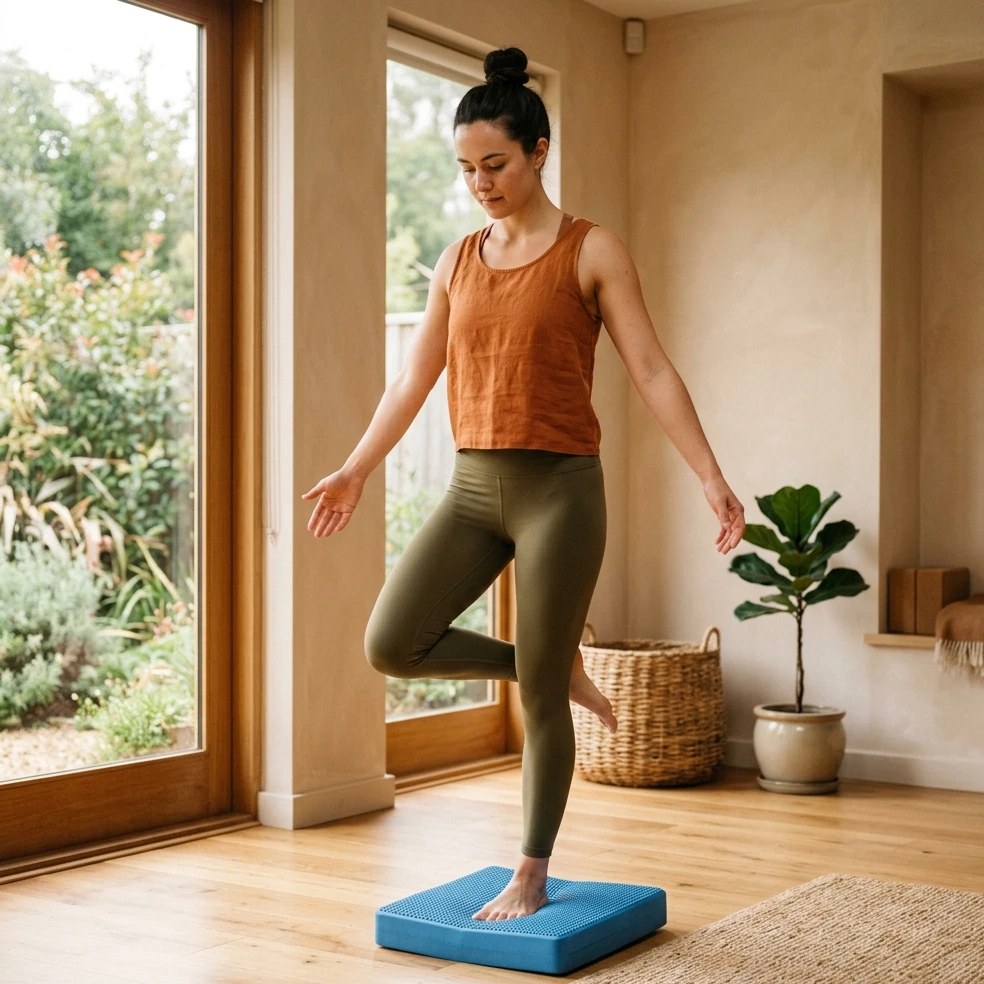
The off-season substitute that preserves the foot-mechanics input is reasonably accessible: indoor balance-board or proprioceptive-pad work delivers a meaningful fraction of the same intrinsic-foot stimulus, and a structured program of 10–15 minutes 3 times per week through the off-season largely preserves the adaptation accumulated through the summer barefoot months. Lieberman’s broader running-biomechanics work and the subsequent minimalist-footwear literature offer additional carry-over options for readers who want to extend the practice into year-round daily wear Lieberman 2010.
The combined picture: a summer barefoot-on-sand practice plus an off-season balance-board practice gives Ontario residents reasonable continuity in the foot-mechanics input without requiring constant beach access. The grounding component of the practice, even if real, is necessarily seasonal in this climate; the foot-mechanics component does not have to be.
Practical takeaways
- The foot-mechanics benefit is real and well-evidenced. Lieberman 2010 and Robbins 1987 support reduced loading rate and increased intrinsic-foot strength from barefoot exposure on yielding surfaces.
- The grounding/earthing mechanism is plausible but unproven. Chevalier 2012 reviewed the small literature; the journal is low-tier and replication is sparse.
- Wet sand at the waterline is the most conductive substrate. If layering in the grounding component, that’s where the proposed mechanism would operate.
- 20–30 minutes, 2–3 times per week. Closer to the published foot-mechanics dose than a single long beach day per month.
- Caution for peripheral neuropathy. Reduced plantar sensation increases risk of unfelt cuts, burns, and abrasions.
- Don’t use earthing as a substitute for evidence-based care. For chronic inflammation, sleep, or pain, standard medical pathways have far better evidence.
References
Chevalier 2012Chevalier G, Sinatra ST, Oschman JL, Sokal K, Sokal P. Earthing: health implications of reconnecting the human body to the Earth's surface electrons. Journal of Environmental and Public Health. 2012;2012:291541. View source →Oschman 2015Oschman JL, Chevalier G, Brown R. The effects of grounding (earthing) on inflammation, the immune response, wound healing, and prevention and treatment of chronic inflammatory and autoimmune diseases. Journal of Inflammation Research. 2015;8:83-96. View source →Lieberman 2010Lieberman DE, Venkadesan M, Werbel WA, Daoud AI, D'Andrea S, Davis IS, Mang'eni RO, Pitsiladis Y. Foot strike patterns and collision forces in habitually barefoot versus shod runners. Nature. 2010;463(7280):531-535. View source →Robbins 1987Robbins SE, Hanna AM. Running-related injury prevention through barefoot adaptations. Medicine and Science in Sports and Exercise. 1987;19(2):148-156. View source →