The 60-second version
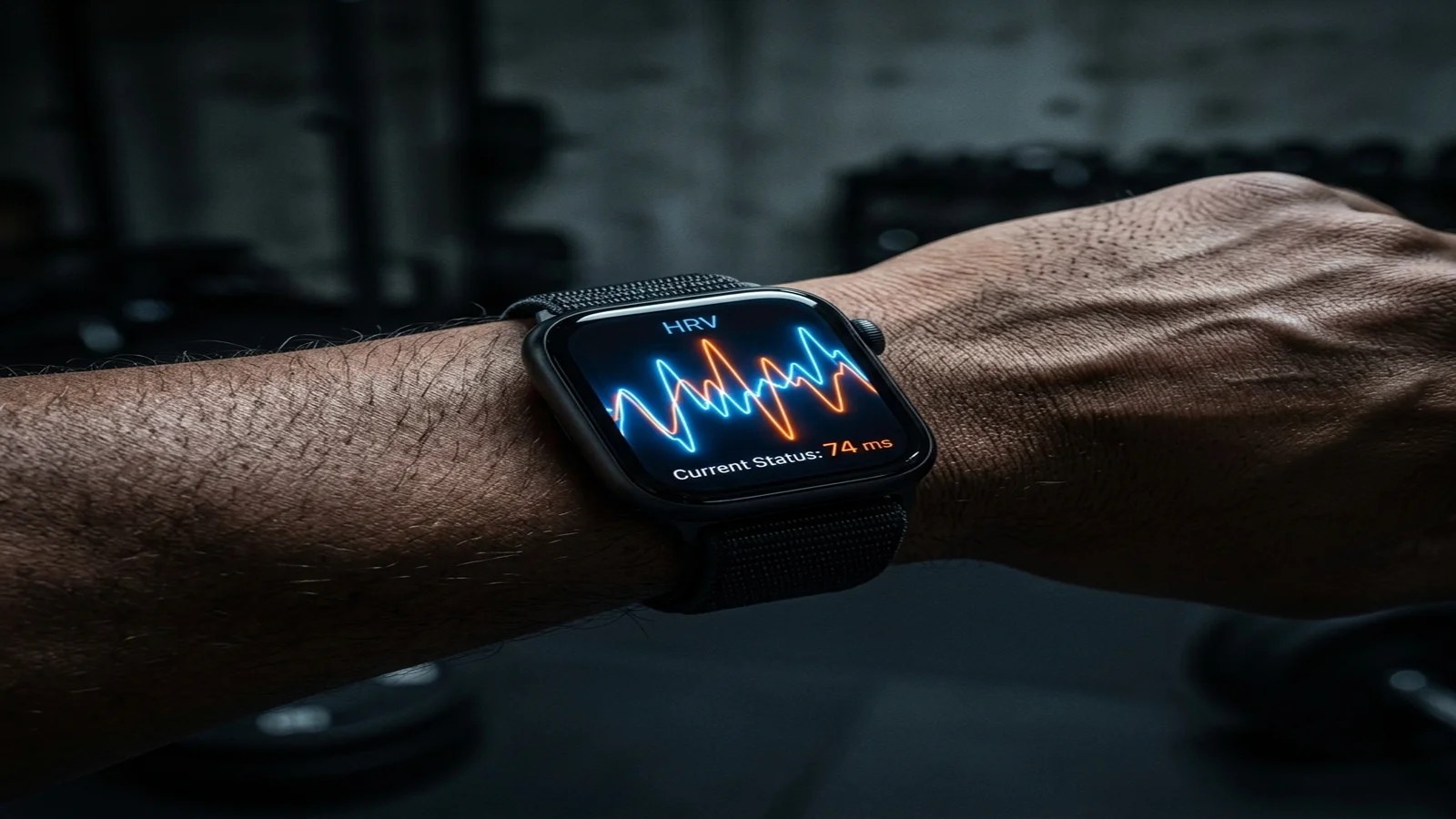
Heart Rate Variability is the millisecond-level variation between consecutive heartbeats. Higher = parasympathetic ("rest and digest") dominance; lower = sympathetic ("fight or flight") dominance. It is the single most actionable metric a fitness wearable produces — but only if you read the trend, not the daily number. Plews 2013 reviewing elite-athlete HRV data found 7-day rolling averages reliably track training adaptation; daily readings are noisy because alcohol, sleep, hydration, and emotional stress all move HRV more than training does on a single day. The decision rules are simple: ignore single-day deviations, scale back when 3+ days sit suppressed, change the program when the rolling average drifts down for 2+ weeks. Anything more elaborate is mostly noise.
What HRV actually measures
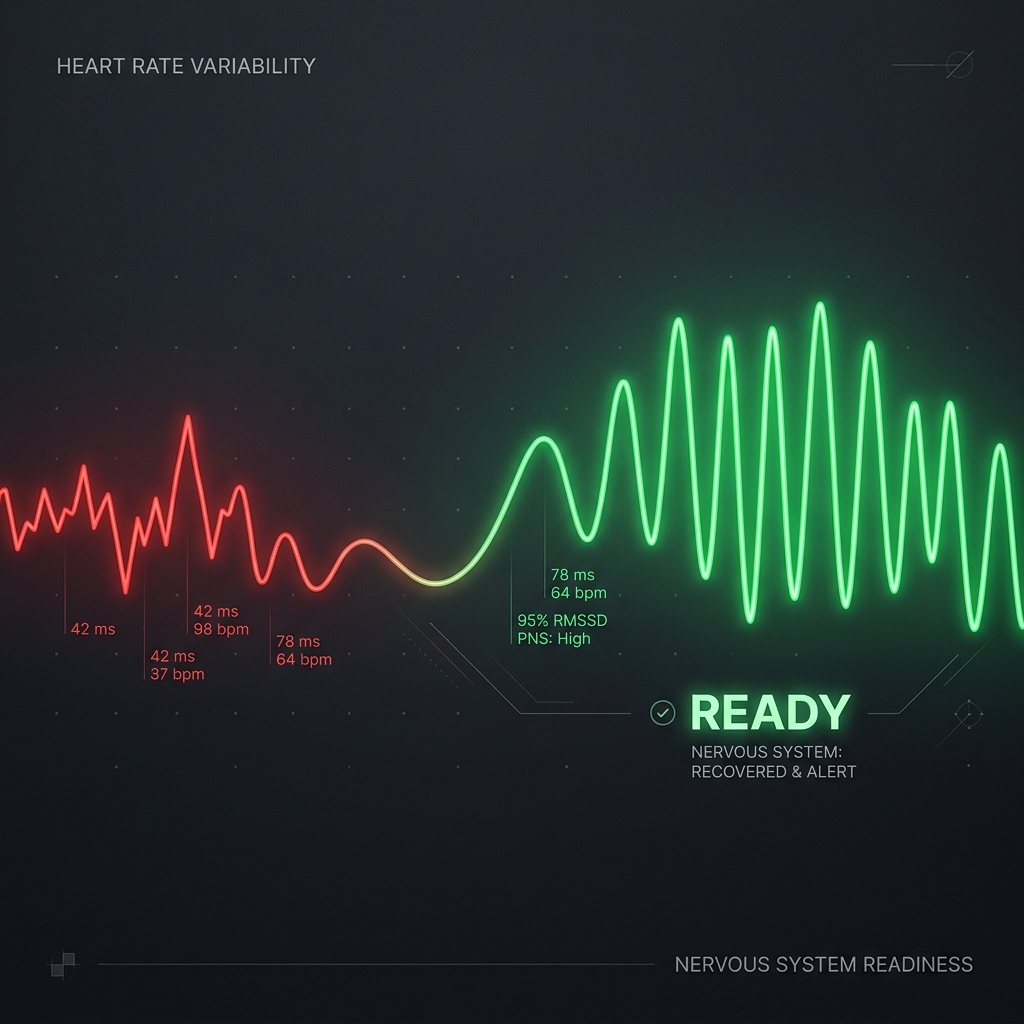
HRV is the variation in time between consecutive heartbeats, measured in milliseconds. A heart that beats 60 times a minute does not produce a beat every 1.000 second; it produces beats at varying intervals (say, 0.94, 1.06, 0.98, 1.04 seconds). That variation is HRV.
Higher variability indicates your parasympathetic (“rest and digest”) nervous system is dominant. Lower variability indicates sympathetic (“fight or flight”) dominance. Trained athletes tend to have higher resting HRV than sedentary people because their parasympathetic tone is stronger.
The number is highly individual. A 22-year-old elite endurance athlete can have a resting HRV of 130 ms. A healthy 55-year-old can have a resting HRV of 35 ms. Both can be doing fine. Comparing your number to anyone else’s is the first mistake most people make.
What the research supports
Plews and colleagues (2013, Sports Medicine) reviewed HRV monitoring in elite athletes and concluded that trends in HRV reliably track training adaptation and overreaching Plews 2013. Daily HRV is noisy — sleep, alcohol, caffeine, hydration, and emotional stress all move it more than training does on a day-to-day basis. The signal is in the rolling average, not the morning alert.
Buchheit (2014) and Stanley et al. (2013) extended this to recreational athletes and found similar patterns: 7-day rolling averages predict overreaching and recovery quality; single-day readings do not Buchheit 2014.
The three patterns that matter
1. The rolling baseline
Track your morning HRV every day for at least 30 days before the number means anything. Most apps will surface a “baseline” or 7-day rolling average. That is your reference point, not your individual daily reading.
A daily reading 5 to 10 ms below baseline is normal noise. A reading 15+ ms below baseline that persists for 3 to 5 days is signal — your nervous system is asking for less.
2. The trend across weeks
If your 7-day rolling average is steadily rising over a 4-week training block, you’re adapting well to the load. If it’s flat, you’re maintaining. If it’s falling steadily across multiple weeks, you’re accumulating fatigue faster than you’re recovering. This is the most useful HRV pattern to watch.
In a structured periodization plan, the trend typically looks like: rising during base phase, flat during build phase, dipping during peak phase, recovering sharply during taper. If your trend doesn’t follow that arc, the program isn’t producing the adaptation it’s supposed to.
3. The recovery slope after stressors
After a hard race, a long flight, an illness, or a major life event, HRV typically drops sharply and then climbs back to baseline over 3 to 14 days. The slope of that recovery is more diagnostic than the depth of the dip. A fast recovery slope (back to baseline in 3 to 5 days) indicates good adaptive capacity. A flat or negative slope after a stressor is the strongest single signal that you need either more sleep or fewer training stimuli.
“In trained endurance athletes, weekly mean HRV showed strong relationships with training-load and performance changes that daily HRV did not. The signal is in the rolling average; the daily number is mostly noise.”
— Plews et al., Sports Medicine, 2013 view source
The decision rules
Once you’ve established a baseline, three simple rules capture most of HRV’s training value.
- Single-day deviation: ignore. If today’s reading is 5 to 10 ms below your baseline but you slept poorly or had a glass of wine, train normally. The number is reflecting acute lifestyle inputs, not training capacity.
- 3+ days of suppression: scale back. If your reading has sat 10 to 20 ms below baseline for three consecutive days, reduce intensity by 20 percent for that day and add an extra hour of sleep opportunity. Don’t skip — light movement keeps the recovery process moving — but don’t push through with a planned hard session.
- Rolling average drift: change the program. If your 7-day rolling average has fallen for two consecutive weeks, the issue is the training load itself or a lifestyle factor outside training. A deload week is the cheapest intervention. If a deload doesn’t restore the trend, look outside training: sleep, work stress, life events.
What HRV doesn’t tell you
- Whether a workout will go well. Elite athletes often PR with mediocre HRV readings; readiness is a probability, not a forecast.
- Cardiovascular health risk. HRV correlates loosely with cardiovascular health in population studies but is not a diagnostic tool.
- Exact training load. It’s a recovery metric, not a load metric. Pair it with subjective RPE, session volume, and resting heart rate for a fuller picture.
- Whether you should skip a session. Almost never. Reduce intensity rather than skip.
HRV across the menstrual cycle
HRV varies meaningfully across the menstrual cycle in women. Tenan 2014 and Schmalenberger 2019 both document the same pattern: HRV is higher in the follicular phase (cycle days 1 to 14) and lower in the luteal phase (cycle days 15 to 28) by 5 to 12 ms on average Schmalenberger 2019. The difference is large enough that comparing a luteal-phase reading to a follicular-phase rolling average will produce false “suppressed” signals that have nothing to do with training.
The practical fix: track your cycle alongside HRV and either use phase-specific baselines (a 7-day average within the same phase) or accept the natural rhythm as part of the read. Don’t deload because of a luteal-phase dip that’s actually just luteal-phase physiology. Hormonal contraceptives flatten the cycle-related HRV variation; women on combined pills can use a single rolling baseline without phase adjustment.
HRV during illness
HRV drops sharply at the onset of viral infection — often 24 to 48 hours before subjective symptoms appear. The drop is typically 30 to 50% below baseline, which is much larger than any training-load effect. If your HRV crashes overnight without an obvious training or lifestyle cause, treat it as an early warning sign of incoming illness and modify training accordingly. Recovery slope post-illness is also useful: a slow climb back to baseline (more than 10 to 14 days) suggests the immune system is still working and aggressive training will set it back further.
Choosing a device
Wrist-based optical sensors (Apple Watch, Garmin, Fitbit) are convenient but their HRV readings are noisier than chest-strap or ring-based measurements. The reliability rank, by available research:
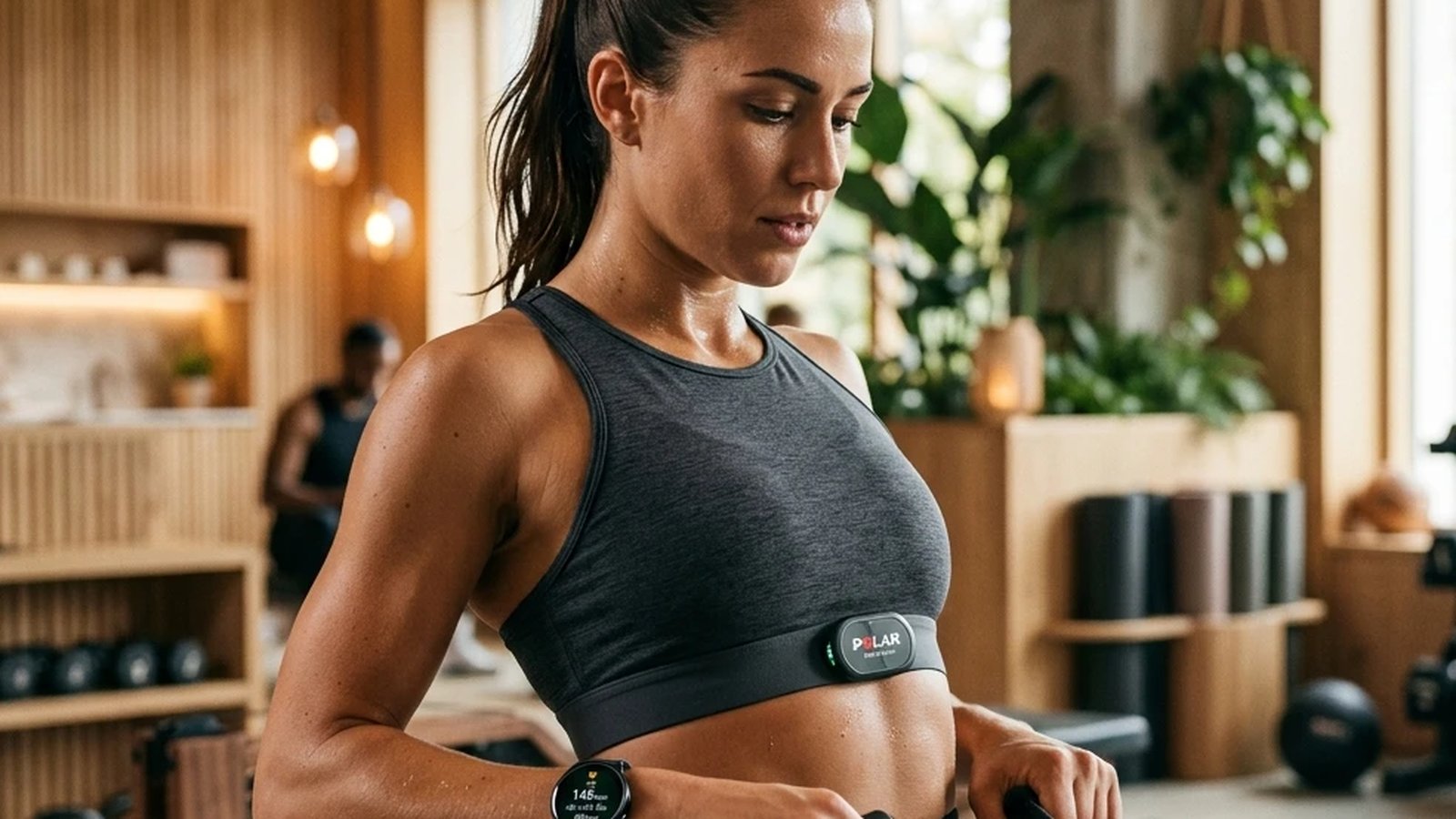
- Chest-strap (Polar H10, Wahoo TICKR) during a controlled morning measurement — gold standard for accuracy.
- Oura Ring, Whoop Strap — measure during sleep, when motion artifact is minimal. Solid for tracking trend.
- Apple Watch / Garmin wrist — opportunistic readings during stillness. Trend tracking only; daily readings are too noisy to act on.
The cheapest reliable approach is a chest strap (around $90 CAD) plus a free HRV app like EliteHRV, taking a 1-minute reading at the same time each morning before getting out of bed. Pair this with our heart rate zones calculator to convert resting HR + max HR into Karvonen-method training zones.
Practical takeaways
- Track for 30 days before the number means anything. The first month is purely about establishing your individual baseline.
- Watch the rolling 7-day average, not the daily number. Daily HRV is dominated by sleep + alcohol + emotional state; weekly average is dominated by training load.
- Three rules: ignore single-day dips, scale back at 3+ days suppressed, deload at 2+ weeks of drift. Anything more elaborate is mostly noise.
- Take the morning reading before coffee. Caffeine slightly suppresses HRV; consistent timing matters more than the absolute number.
- Don’t compare to anyone else. Resting HRV varies 4× between individuals at the same fitness level.
References
Plews 2013Plews DJ, Laursen PB, Stanley J, Kilding AE, Buchheit M. Training adaptation and heart rate variability in elite endurance athletes: opening the door to effective monitoring. Sports Medicine. 2013;43(9):773-781. View source →Buchheit 2014Buchheit M. Monitoring training status with HR measures: do all roads lead to Rome? Frontiers in Physiology. 2014;5:73. View source →Stanley 2013Stanley J, Peake JM, Buchheit M. Cardiac parasympathetic reactivation following exercise: implications for training prescription. Sports Medicine. 2013;43(12):1259-1277. View source →Schmalenberger 2019Schmalenberger KM, Eisenlohr-Moul TA, Wurth L, et al. A systematic review and meta-analysis of within-person changes in cardiac vagal activity across the menstrual cycle. Journal of Clinical Medicine. 2019;8(11):1946. View source →ESC 1996Task Force of the European Society of Cardiology. Heart rate variability: standards of measurement, physiological interpretation, and clinical use. European Heart Journal. 1996;17:354-381. View source →