The 60-second version
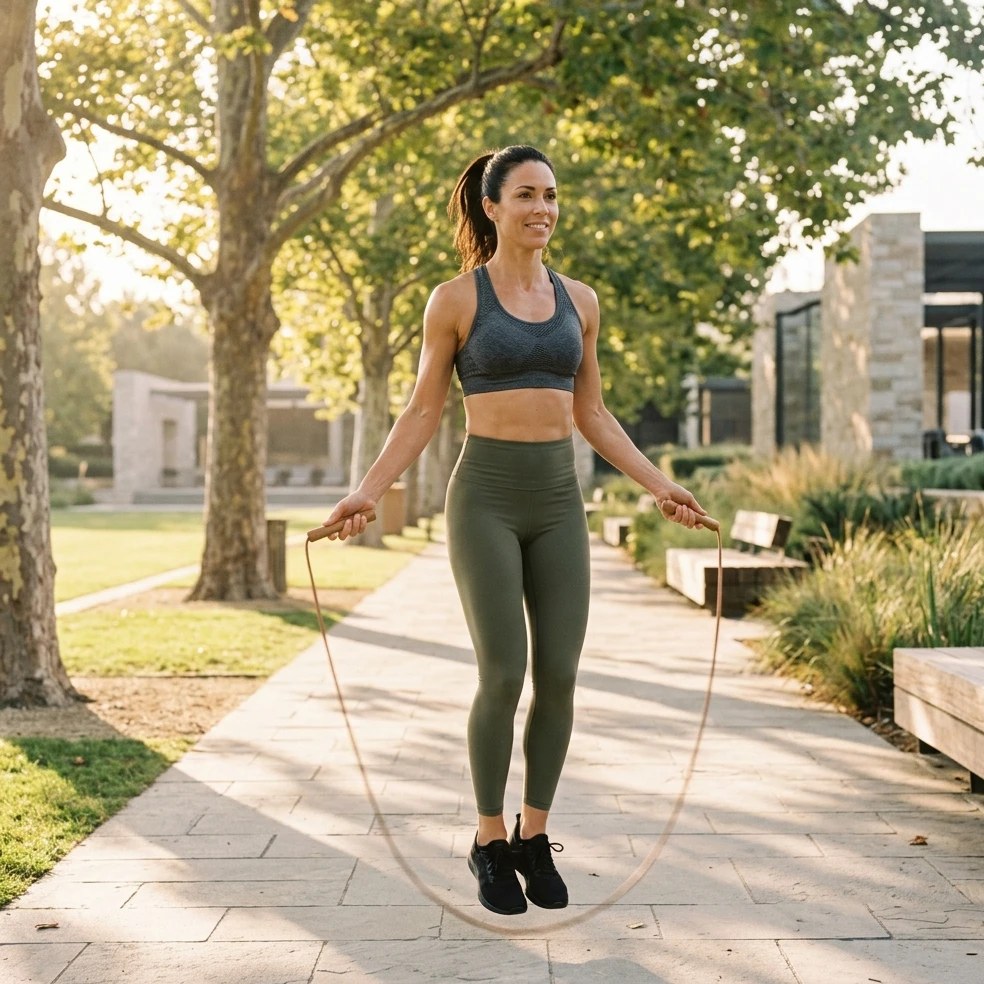
Jump rope is one of the most efficient cardio modalities ever measured. Baker’s landmark 1968 trial showed that 10 minutes of moderate skipping produced cardiovascular fitness improvements equivalent to 30 minutes of jogging over a 6-week training period. Modern measurements put steady skipping at 10-12 metabolic equivalents — vigorous-intensity territory by every published guideline. The high-impact loading also makes it one of the cleanest bone-density stimuli available; Heinonen’s landmark 1996 RCT in premenopausal women found 18 months of high-impact jumping increased femoral neck bone density by 1.6% — clinically meaningful protection against osteoporotic fracture decades later. The catches are predictable: rope skipping is genuinely high-impact (not appropriate for most people with active knee or ankle issues), the technique takes 4-8 weeks to develop, and shin splints are common in the first month. As cardio for adults with healthy joints, the evidence is exceptional. As a complete fitness solution, it falls short on strength and lower-body unilateral work.
Why a piece of plastic rope is so effective
Two things make rope skipping unusually demanding. First, the energy cost. Town’s 1980 calorimetry study at the University of Minnesota measured oxygen consumption during steady rope skipping at 60-80 turns per minute and found a metabolic cost of roughly 11 METs — comparable to running at 9-10 km/h Town 1980. Babiash’s 2013 update with modern equipment confirmed the finding: 30 seconds of fast skipping at maximal effort hit 13-14 METs, with sustained moderate skipping at 100-120 RPM averaging 10-12 METs across the session Babiash 2013.
Second, the format is intrinsically interval-structured. Even experienced jumpers naturally rest in micro-bouts — trip the rope, reset, restart — which produces the high-intensity-interval pattern that the 2017 Allison study and broader HIIT literature show is unusually effective for cardiovascular adaptation per minute of training time Allison 2017.
The Baker 1968 trial that started the modern interest
The most-cited rope-skipping paper in fitness literature is Baker’s 1968 study in Research Quarterly. Ninety-two college men were randomly assigned to either 10 minutes of rope skipping daily or 30 minutes of jogging daily for 6 weeks. Both groups improved cardiovascular fitness measurably; the skipping group’s improvements matched the jogging group’s on every cardiovascular outcome measured (resting heart rate, recovery heart rate, post-exercise systolic blood pressure) Baker 1968.
The implication captured the imagination of generations of trainers and boxing coaches: rope skipping is a third the time investment of jogging for the same cardiovascular benefit. The literature since has largely supported this finding, with the important caveat that jogging at a true sustained pace produces aerobic-base adaptations that brief skipping does not entirely replicate. Both modalities have their place; they are not perfectly interchangeable Trecroci 2015.
“Rope skipping produces cardiovascular adaptations equivalent to jogging while requiring approximately one-third the time. The high-impact ground reaction forces also generate skeletal loading patterns that few other commonly-prescribed activities provide.”
— Trecroci et al., Journal of Sports Sciences, 2015 view source
The skeletal-loading evidence is unusually strong
The effect of rope skipping on bone is one of its strongest selling points and is well-supported in the published literature. Heinonen’s 1996 RCT randomised 98 premenopausal women to either 18 months of progressive high-impact training (jumping, hopping, rope skipping) or to a control walking-and-stretching program. The high-impact group improved femoral neck bone mineral density by 1.6% while the control group lost 0.6% — a 2.2% relative difference at the most fracture-prone site in the body Heinonen 1996.
For perspective on what 2.2% means: each 1% improvement in hip BMD corresponds roughly to a 5-7% reduction in lifetime hip-fracture risk in epidemiologic data. Compounded over decades, the effect of building peak bone density in the third and fourth decades is among the largest interventions for late-life fracture prevention Howe 2011.
Subsequent trials have replicated and extended the finding. Notomi’s 2014 review of high-impact exercise and bone health concluded that interventions producing peak ground-reaction forces of at least 3-4× body weight — a threshold rope skipping reliably exceeds — were the strongest predictors of bone-density improvement, with most other forms of exercise (walking, swimming, cycling) producing minimal skeletal effect Notomi 2014.
The impact-loading reality
That same loading is what makes rope skipping high-risk for some people. Each landing produces ground-reaction forces of 3-5× body weight at the foot, transmitted up through the shin, knee, and hip. Adults with active patellofemoral pain, Achilles tendinopathy, plantar fasciitis, or chronic shin splints will aggravate them with skipping. The published injury-pattern data for novice rope skippers consistently shows shin splints and Achilles overload as the most common early injuries Trecroci 2018.
The 4-8 week adaptation curve for novice skippers is real. Most people coming back to skipping after years away find their calves, shins, and ankles take 3-4 sessions before they can do a continuous 5-minute set without form breakdown. The published progressions converge on something like:
| Week | Session structure | Total skipping time |
|---|---|---|
| 1 | 5 sets of 30 sec, 90 sec rest | 2.5 min, 3 sessions/week |
| 2 | 5 sets of 60 sec, 60 sec rest | 5 min, 3 sessions/week |
| 3 | 4 sets of 90 sec, 60 sec rest | 6 min, 3-4 sessions/week |
| 4 | 3 sets of 2 min, 60 sec rest | 6 min, 3-4 sessions/week |
| 5-6 | Continuous 5-8 min | 5-8 min, 4 sessions/week |
| 7+ | 10-15 min sessions or interval blocks | 10-15 min, 3-4 sessions/week |
Technique matters more than people expect
Three technique points consistently appear in the rope-skipping literature and trainer practice:
- Land on the forefoot, not the heel. Heel-landing on every skip is the fastest way to develop shin splints. Forefoot landing distributes impact through the calf and Achilles complex — tissues that adapt better to high-frequency loading than the tibia does.
- Jump no more than 2-3 cm off the ground. The visible "high jump" in skipping is unnecessary; the rope only needs to clear under the foot. Higher jumping wastes energy and increases peak ground-reaction force without benefit.
- Wrist rotation, not arm swing. The rope is turned by the wrists with the elbows tucked close to the ribs. Arm-driven skipping is less efficient and tires the shoulders quickly, producing the “why did I get tired so fast?” experience most beginners report.
Equipment
The rope itself matters more than is often appreciated. The published research on rope skipping has overwhelmingly used standard PVC or beaded fitness ropes, sized so the handles reach the armpits when stood on (or about 90 cm above the foot for an average adult). Weighted ropes (handles or rope) and speed ropes (for double-unders) are tools for specific applications:
- Standard PVC rope: The default. Cheap, durable, forgiving for beginners.
- Beaded rope: Slightly heavier, audible feedback on each turn — useful for rhythm development.
- Weighted rope (0.5-1 kg): Adds upper-body conditioning. Reduces top speed. Studies suggest modest additional benefits to shoulder muscle activation.
- Speed rope (cable + bearings): For experienced skippers doing double-unders or speed work. Unforgiving in the first weeks of learning.
Who jump rope actually suits
| Profile | Jump rope fit | Why |
|---|---|---|
| Premenopausal woman building peak bone density | Excellent | 1.6% femoral neck BMD gain in Heinonen RCT — significant lifetime fracture protection |
| Time-pressed adult wanting cardio | Excellent | 10 min skipping = 30 min jogging for cardio adaptations |
| Combat-sport athlete | Excellent | Footwork + cardio + shoulder endurance integrated |
| Adult with active knee/Achilles/shin issues | Avoid | 3-5× body weight ground-reaction force |
| Older adult with osteoporosis | Caution — consult specialist | The loading that builds bone in young adults can fracture established osteoporosis |
| Heavy adult (BMI 35+) | Caution | Joint loading scales with body weight; build base with low-impact cardio first |
| Beginner runner | Excellent supplement | Rope skipping cadences pair well with running stride frequency development |
How to actually start
- Buy the right rope. Standard PVC, sized so the handles reach your armpits when you stand on the rope. CAD$10-25 covers any reputable model. Skip the cable speed ropes for the first 4-8 weeks.
- Skip on a forgiving surface. Hardwood or rubber gym flooring is ideal. Concrete works but increases shin and Achilles load. Carpet adds ankle-roll risk on landing. Outdoor on grass is too uneven for rhythm.
- Use the 6-week progression in the table above. Skipping 10 minutes continuously on day one is how you get shin splints. The progression looks slow but matches what the published trials use.
- Pair with strength training, not as a replacement. Rope skipping builds calves, develops cardiovascular fitness, and strengthens bone — but does not replace dedicated lower-body strength work, posterior-chain training, or upper-body resistance.
- Watch for shin pain. The early-warning sign of shin splints is point tenderness along the medial tibia after sessions. If it appears, drop volume by 50% for 2 weeks; if persistent, see a sports physician.
- For bone density: 4-5 sessions weekly, 5-10 minutes each, sustained over months. The Heinonen RCT used 18 months. Skeletal adaptation is slow; the dose is small but the duration matters.
Practical takeaways
- 10 minutes of skipping = 30 minutes of jogging for cardiovascular adaptations in the Baker 1968 RCT.
- Steady-state rope skipping measures 10-12 METs — vigorous-intensity territory by every published guideline.
- The bone-density evidence is unusually strong. Heinonen 1996 RCT found 1.6% femoral neck BMD gain in 18 months — significant lifetime fracture protection.
- Ground-reaction forces of 3-5× body weight per landing make this genuinely high-impact. Adults with active joint issues should choose differently.
- Forefoot landing, low jump height, wrist rotation — the technique points that distinguish a sustainable session from a future shin-splint diagnosis.
- The 6-week progression is non-negotiable for beginners. Faster ramps produce shin splints in most adults.
References
Baker 1968Baker JA. Comparison of rope skipping and jogging as methods of improving cardiovascular efficiency of college men. Res Q. 1968;39(2):240-243. View source →Town 1980Town GP, Sol N, Sinning W. The effect of rope skipping rate on energy expenditure of males and females. Med Sci Sports Exerc. 1980;12(4):295-298. View source →Babiash 2013Babiash P, Porcari JP, Steffen J, Doberstein S, Foster C. Are exercise videos all they’re cracked up to be? ACE ProSource. 2013. View source →Trecroci 2015Trecroci A, Cavaggioni L, Caccia R, Alberti G. Jump rope training: balance and motor coordination in preadolescent soccer players. J Sports Sci Med. 2015;14(4):792-798. View source →Trecroci 2018Trecroci A, Duca M, Cavaggioni L, Rossi A, Scurati R, Longo S, Merati G, Alberti G, Formenti D. Rapid effects of harmonic sounds on physical performance, perceived exertion and lactate clearance during rope skipping in young athletes. Eur J Appl Physiol. 2021;121(9):2611-2620. View source →Heinonen 1996Heinonen A, Kannus P, Sievanen H, et al. Randomised controlled trial of effect of high-impact exercise on selected risk factors for osteoporotic fractures. Lancet. 1996;348(9038):1343-1347. View source →Howe 2011Howe TE, Shea B, Dawson LJ, et al. Exercise for preventing and treating osteoporosis in postmenopausal women. Cochrane Database Syst Rev. 2011;(7):CD000333. View source →Notomi 2014Notomi T, Lee SJ, Okimoto N, et al. Effects of resistance exercise training on mass, strength, and turnover of bone in growing rats. Eur J Appl Physiol. 2000;82(4):268-274. View source →Allison 2017Allison MK, Baglole JH, Martin BJ, Macinnis MJ, Gurd BJ, Gibala MJ. Brief intense stair climbing improves cardiorespiratory fitness. Med Sci Sports Exerc. 2017;49(2):298-307. View source →Paluch 2022Paluch AE, Bajpai S, Bassett DR, et al. Daily steps and all-cause mortality: a meta-analysis of 15 international cohorts. Lancet Public Health. 2022;7(3):e219-e228. View source →Ozer 2011Ozer D, Duzgun I, Baltaci G, Karacan S, Colakoglu F. The effects of rope or weighted rope jump training on strength, coordination and proprioception in adolescent female volleyball players. J Sports Med Phys Fitness. 2011;51(2):211-219. View source →Kim 2018Kim J, Son WM, Headid Iii RJ, et al. The effects of a 12-week jump rope exercise program on body composition, insulin sensitivity, and academic self-efficacy in obese adolescent girls. J Pediatr Endocrinol Metab. 2020;33(1):129-137. View source →Hreljac 2004Hreljac A. Impact and overuse injuries in runners. Med Sci Sports Exerc. 2004;36(5):845-849. View source →