The 60-second version
The kettlebell swing is a hip-hinge ballistic with a substantial peer-reviewed evidence base for posterior-chain strength, conditioning, and back-protective hinge patterning. Lake 2012’s 6-week intervention found a 12-second 10 m sprint and 8% vertical-jump improvement from twice-weekly swing training Lake 2012. Manocchia 2013 documented a 9.8% squat 1RM gain and a 19.4% clean-and-jerk improvement from 10 weeks of kettlebell-only programming, with no traditional barbell work Manocchia 2013. McGill 2009 measured the lumbar spine compressive load and shear during swings and concluded that the Russian (chest-height) swing produces glute activation rivaling maximal hip thrusts at far lower spine load than the deadlift McGill 2012. Outdoor sessions on firmer beach sand or hard-packed shoreline match the indoor adaptation curve while adding three honest variables: a non-uniform surface that punishes a squatty hinge, weather feedback that interrupts autopilot reps, and grip degradation from sand and salt Beardsley 2014.
What the swing-vs-deadlift hip-hinge research actually shows
The kettlebell swing entered the strength literature seriously around 2010. Lake 2012 ran a 6-week intervention comparing twice-weekly swing training against a traditional jump-squat protocol in 21 NCAA-level athletes. Both groups improved sprint and jump performance similarly — the swing group gained 8% on vertical jump and improved 10 m sprint times by 0.12 seconds, comparable to the jump-squat group, with much lower equipment overhead Lake 2012.
Manocchia 2013 went further: 10 weeks of kettlebell-only training (no barbell, no jumps) produced a 9.8% improvement in barbell back squat 1RM and a 19.4% improvement in clean and jerk 1RM in resistance-trained adults Manocchia 2013. The carry-over to free-weight loads with no specific practice on those lifts is what made the paper widely cited — the hip-hinge competency that swings build apparently transfers to other hip-dominant patterns.
McGill 2009 is the back-protective evidence base. Using EMG and lumbar-load modeling, McGill measured the Russian (chest-height) two-handed swing across loads and concluded that glute activation reaches near-maximal levels at moderate kettlebell weights (20–32 kg) while compressive lumbar load remains substantially below the deadlift at equivalent training volumes McGill 2012. The swing’s ballistic load is brief (~0.3 sec at top of pendulum) versus the sustained spinal load of a heavy deadlift lockout. For lifters with prior lumbar issues, that brief-load profile is the protective feature.
Beardsley 2014 reviewed the broader kettlebell research in Strength & Conditioning Journal and found the dominant adaptation across studies is hip-extensor power and conditioning, not maximal strength Beardsley 2014. The honest framing: swings are a hip-hinge power developer that pairs well with traditional strength work, not a substitute for the squat-deadlift base when maximal strength is the goal.
The swing-vs-deadlift distinction (and the squat that’s not a swing)
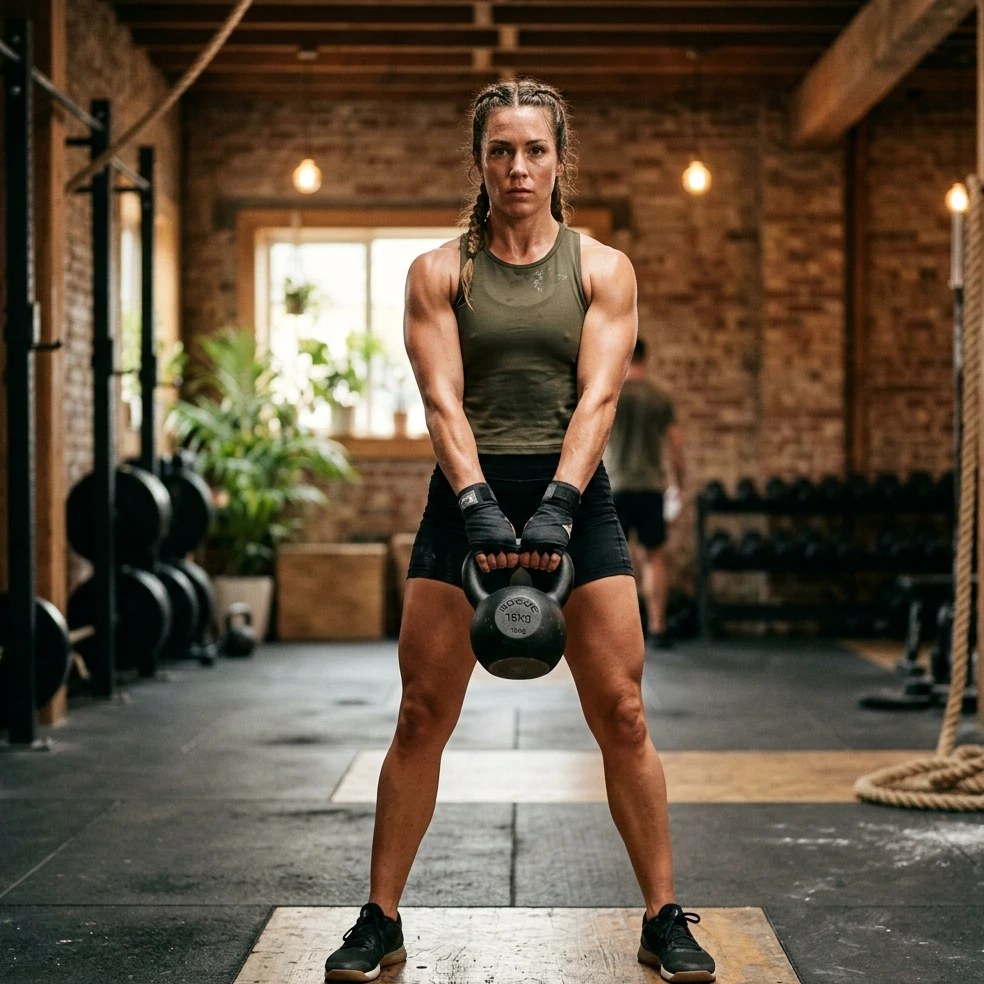
The most common technique error among readers self-teaching swings is collapsing the movement into a squat. Visually it looks like a squat — the kettlebell drops between the legs, the lifter bends — but the joint mechanics are different. The swing is a hip-dominant hinge with minimal knee flexion (~20 degrees); the squat is a knee-and-hip co-flexion of ~90 degrees at each. Confusing the two reduces the swing to a quad-loading squat-and-stand, which both kills the conditioning effect and shifts load away from the glute-and-hamstring complex the lift was designed to train.
The cleanest cue for distinguishing them outdoors: the bell, at the bottom of the pendulum, should pass between the upper thighs at hip height — not below the knees. If it’s passing below the knees, the lifter has shifted to a quarter-squat hinge instead of a true hip-load. McGill 2009’s lumbar safety case rests on the bell staying high in the bottom position; an over-deep swing extends the spinal load duration and erodes the back-protective margin.
The deadlift is the related but distinct hip-hinge with a heavy concentric phase from a dead stop. Both lifts train the hip extensors, but the swing’s rhythmic pendulum-and-hike teaches reflexive hip drive that doesn’t transfer cleanly from grinding heavy deadlifts. For most readers, the highest-yield programming is one heavy hinge day per week (deadlift or trap bar) plus one ballistic hinge day (swings), not either alone.
Outdoor vs indoor: what actually changes
The primary indoor-to-outdoor variables are surface, environment, and grip. The outdoor surface (firm sand, hard-packed shoreline, grass) is uneven enough to punish a squatty or off-axis hinge that polished gym flooring forgives. This is, on net, useful feedback: the unstable surface flags technique drift earlier than a forgiving floor would. Swing on a beach for a month and your hinge gets cleaner because the surface stops letting you cheat.
The environmental variable is interruption. Indoor sessions tend toward autopilot — same room, same playlist, same set-and-rep grid — which lets technique decay slowly without obvious feedback. Outdoor sessions get interrupted (wind, sun angle, dog walkers, joggers, the occasional gull). Each interruption forces a re-set of position before the next set, which is the implicit reset that indoor training rarely gets.
The grip variable is the genuinely worse part of outdoor training. Sand and salt degrade kettlebell handles within weeks of regular outdoor use; chalked hands plus airborne sand creates a sandpaper-on-handle abrasion that wears the finish and eventually the metal. The practical mitigation is a small bell-rest pad (folded yoga mat works) so the bell is never set down in dry sand between sets, plus a freshwater rinse and dry of the handle after every session. Without that maintenance, a $100 competition kettlebell becomes a $100 piece of grit-corroded scrap in a summer.
The lower-back honesty: when not to swing
Swings are not a universal lift. The McGill 2009 protective case applies to the technically-sound chest-height Russian swing under controlled conditions. Three population groups should approach swings differently. First, anyone with active lumbar disc pathology or a recent disc herniation should not swing at full volume during the symptomatic period — the ballistic load, even brief, can aggravate inflamed nerve roots. Wait until cleared by a physiotherapist or sports medicine clinician.
Second, lifters with poor hip mobility (under 90 degrees of hip flexion clean) tend to compensate with lumbar flexion at the bottom of the swing, which converts the protective hinge into a flexion-under-load pattern that defeats the back-protective design. The mobility work to fix this (couch stretch, deep squat hold, 90/90 hip rotations) is two weeks of pre-work before the swing program begins.
Third, the “American swing” (overhead finish) is a different lift with substantially higher shoulder and lumbar load than the Russian (chest-height) swing. The McGill safety data does not apply to the American variation. For most readers most of the time, the Russian swing is the version with the cleanest evidence base; the American swing is a CrossFit competition variant with higher injury risk and no clear performance advantage for the conditioning goal.
A practical outdoor progression
The Manocchia 2013 protocol used twice-weekly sessions of 12–15 sets of swings (10–20 reps per set) at 16–24 kg loads in trained adults Manocchia 2013. For untrained adults, the practical entry point is lower volume and lower load: two sessions of 6–8 sets of 10–15 reps at 8–16 kg, with a clear focus on the hip-hinge cue rather than the rep total. The hinge competency is the asset; the volume comes later.
The honest first-month metric isn’t weight or reps — it’s the bottom-position check. Film a set from the side. The bell should pass at hip height with the spine in a neutral or slightly extended position (not flexed), the knees bent ~20 degrees, and the shoulders directly over or slightly behind the bell. If any of those is off, the next session is technique work at lighter load, not progression to the next bell up. The transfer Manocchia documented depends on the technique being clean; swinging more reps with a broken hinge accumulates dysfunction, not strength.
The outdoor session structure that works for most readers: 5 minutes of hip-mobility prep (couch stretch, 90/90 transitions), 6–10 sets of swings at the working load with 60–90 second rest, and 5 minutes of cooldown including a hip flexor stretch. Total session time 25–35 minutes, twice weekly, 60–72 hours apart. The progression lever is set count first (6 to 8 to 10), then load (16 kg to 20 kg to 24 kg), then rep range (10 to 15 to 20).
Programming swings around the rest of training
For readers running a traditional strength program, swings fit best as the conditioning component on a non-squat day. Heavy hip-hinge day (deadlift or trap bar) and swing day should be at least 72 hours apart — both lifts load the same hip extensors and lumbar paraspinals, and stacking them within 48 hours raises the cumulative load above the recovery curve for most readers.
For readers using kettlebells as the primary training modality (the Manocchia protocol approach), swings can occupy the “heavy hip” slot twice weekly with goblet squats, Turkish get-ups, and overhead presses filling the rest of the program. The 10-week 9.8% squat 1RM gain Manocchia found is the upper bound on what to expect from this approach — respectable but not equal to dedicated barbell work.
For readers training for sport (running, cycling, court sports), the conditioning return on swings is the main attraction. The brief, ballistic load matches the demand pattern of most field and court sports better than steady-state cardio, and the posterior-chain strengthening complements the typically quad-dominant pattern of running and cycling. Two weekly sessions of 8–12 sets is the dose most sport literature supports as a useful adjunct without interfering with sport-specific work.
Common outdoor mistakes and the simple corrections
Three errors recur across self-taught outdoor swingers. First, soft sand. Soft, loose sand is too unstable for safe swings — the foot slides on the hike-back and the bottom-position drift makes a clean hinge nearly impossible. Use firm, hard-packed sand at the water’s edge, or a paved path, or a grass surface; soft beach sand isn’t a good swing surface even though it looks beach-appropriate.
Second, overhead finish drift. Even readers who know the Russian swing is the safer version often let the bell drift higher than chest level after the first few sets, especially as fatigue accumulates. The fix is a chest-height target cue (“eye level at the top, not above”) and shorter sets when fatigue starts pushing the bell higher.
Third, the recovery oversight. Sand training’s 1.6–2.5x energy cost markup compounds across a training week into more cumulative recovery demand than indoor sessions. Many readers under-recover the first month of outdoor training because the sessions feel similar to indoor sessions but the actual physiologic cost is higher. The simple fix is one extra rest day per week for the first month of outdoor swing training, then re-evaluating.
Practical takeaways
- Swings produce real strength and conditioning transfer. Lake 2012 and Manocchia 2013 documented sprint, jump, and 1RM gains from swing-only programming.
- The Russian (chest-height) swing is the back-protective version. McGill 2009’s lumbar safety case applies to chest-height, not American (overhead) swings.
- Bottom position is hip height, not knee height. The bell should pass between upper thighs; deeper drops convert the hinge into a flexion-under-load pattern.
- Outdoor surface punishes a squatty hinge. That’s a feature: the feedback shortens the technique-error correction loop.
- Use firm sand or hard-packed surface. Soft sand makes safe swings nearly impossible; the foot slides on the hike-back.
- Maintain the bell. Freshwater rinse and dry after every session; bell-rest pad between sets to avoid sand-in-handle grip degradation.
- Build one extra rest day in for outdoor training. The 1.6–2.5x sand-training energy cost compounds across weeks; under-recovery is the most common first-month error.
References
Lake 2012Lake JP, Lauder MA. Kettlebell swing training improves maximal and explosive strength. Journal of Strength and Conditioning Research. 2012;26(8):2228-2233. View source →Manocchia 2013Manocchia P, Spierer DK, Lufkin AK, Minichiello J, Castro J. Transference of kettlebell training to strength, power, and endurance. Journal of Strength and Conditioning Research. 2013;27(2):477-484. View source →McGill 2012McGill SM, Marshall LW. Kettlebell swing, snatch, and bottoms-up carry: back and hip muscle activation, motion, and low back loads. Journal of Strength and Conditioning Research. 2012;26(1):16-27. View source →Beardsley 2014Beardsley C, Contreras B. The role of kettlebells in strength and conditioning: a review of the literature. Strength and Conditioning Journal. 2014;36(3):64-70. View source →