The 60-second version
Microfiber athletic towels are one of the cleaner cases where minimalist gear actually works as advertised. The fabric is engineered with split-filament polyester or polyamide fibres roughly 1/100 the diameter of cotton, producing a fabric with much greater capillary surface area that wicks moisture along the filament structure rather than absorbing it into bulk fibre Callewaert 2014. The result is a towel that dries faster, packs smaller, and weighs less than equivalent cotton. The bacterial-load comparison with cotton is mixed and depends much more on wash discipline than on fibre type Reichel 2013. The honest framing: microfiber is a useful piece of athletic kit with real engineering advantages and no significant hygiene downside as long as it is washed and fully dried regularly — the same as any towel.
The fabric science: why microfiber dries faster
The performance advantage of microfiber is geometric, not chemical. Cotton fibre is a single hollow plant-derived structure roughly 12–20 micrometres in diameter, depending on variety. Microfiber filaments are extruded synthetic polymer (typically a blend of polyester and polyamide / nylon) at filament diameters around 0.1–0.5 micrometres — an order of magnitude or more thinner. The synthetic process additionally splits each filament into wedge cross-sections, multiplying the effective surface area further Callewaert 2014.
The total surface area of a microfiber towel can be 10–40 times that of a cotton towel of similar mass. Moisture wicks along the filament surfaces via capillary action rather than absorbing into the bulk fibre, which means the moisture load is distributed across the high-surface-area network and exposed to air for evaporation rather than trapped inside fibre cores. The practical result is that a microfiber towel of comparable size to a small cotton gym towel weighs perhaps a third less, packs smaller, and dries in 1–3 hours where the cotton equivalent might take 4–8 hours.
The downside of the same engineering is that microfiber feels less plush than cotton on skin contact and absorbs less per unit area at any given moment, which is why microfiber works well as a quick-dry athletic towel but less well as a luxury bath towel. The athletic-towel use case — wipe sweat, dry off after a quick shower, pack into a gym bag — is exactly where the engineering advantages compound and the texture downside doesn’t matter.
The bacterial-load question: fabric vs wash discipline
The popular framing that synthetic athletic fabrics are inherently more bacterial than cotton is both right and wrong, depending on the comparison being made. Callewaert 2014 in Applied and Environmental Microbiology directly compared microbial colonization of polyester and cotton fabrics worn during exercise Callewaert 2014. The result: polyester fabrics (including microfiber) showed faster colonization by odour-producing bacteria (specifically Micrococcus and Staphylococcus species) than cotton fabrics under matched wear conditions. The microbial profile shifted toward odour-producing species on synthetics, which is the source of the “polyester smells worse” popular complaint.
The complication is that the same study and subsequent replication work showed that the bacterial-load difference largely disappears with appropriate washing. Hot wash (50–60C minimum) and full drying eliminated the differential between fabric types. Cool wash with incomplete drying maintained the differential and indeed amplified it on synthetics. The implication: the fabric-type effect is real but secondary to wash discipline as the dominant variable in athletic towel hygiene.
Reichel 2013 in BMC Public Health extended this finding to the household-towel use case directly, examining bacterial loads on bath and gym towels across various household practices Reichel 2013. The strongest predictor of bacterial colonization was time between washes, not fabric type. Towels washed weekly at adequate temperature showed similar bacterial loads regardless of cotton vs synthetic. Towels left damp for extended periods between uses showed elevated bacterial loads regardless of fabric. The honest framing: a microfiber towel washed weekly at 50C+ is hygienically equivalent to a cotton towel under the same regime; both fail equally if left damp in a gym bag for days.
Why the fabric-handling stakes are higher than fashion suggests
Munoz-Price 2009 in Critical Care Medicine examined fabric-handling and infection control in hospital settings, where the stakes are higher than gym-bag hygiene but the principles are identical Munoz-Price 2013. The study documented measurable infection differences attributable to fabric handling protocols (wash frequency, drying completeness, cross-contamination) independent of the specific fabric type used. The clinical context is not directly transferable to gym towels — hospital pathogens are categorically different from gym-locker microbiota — but the underlying principle generalizes: damp fabric is a microbial growth medium, fabric handling matters as much as fabric choice, and small consistent practices (wash discipline, full drying) compound over time.
For athletes specifically, the gym-bag-towel question matters in three concrete ways. First, the towel that wipes sweat and is then placed back in the bag for hours becomes a moisture-loaded fabric in a closed warm environment, which is the worst-case bacterial growth condition. Second, the towel that is shared across surfaces (face, machine wipe-down, post-shower body dry) cross-contaminates microbiota across these surfaces. Third, the towel that is reused across multiple sessions before laundering compounds both effects.
The practical implication is that the fast-dry property of microfiber is not just a packing convenience but a genuine hygiene benefit when combined with reasonable wash discipline. A microfiber towel that fully dries within 1–3 hours of post-session use spends much less time in the moisture-loaded growth condition than a cotton towel that takes 4–8 hours to dry fully. The same wash regime that produces equivalent bacterial loads at the wash-cycle endpoint produces lower average bacterial loads across the use cycle for microfiber simply because the dry-time fraction is larger.
How to choose and care for athletic microfiber
The practical buying decision comes down to a few specific features. Towel size and weight should match the use case: small (30x60 cm) for face and hand wipe-down during training; medium (50x100 cm) for full-body post-shower; large (75x150 cm) only if the planned use is beach or pool. Larger sizes lose some of the packing-and-drying-time advantage that justifies microfiber over cotton in the first place.
Filament density matters less than honest marketing suggests. Most athletic microfiber sold in the 250–400 GSM (grams per square metre) range is functionally similar; the higher-density versions feel slightly more plush at the cost of slower drying. The ultra-thin versions (under 200 GSM) sometimes marketed for travel are functional but tend to bunch and require more careful washing to maintain shape over time.
The care regime that maximizes both hygiene and product life is straightforward. Wash at 40–50C with regular detergent every 1–2 uses for athletic towels. Avoid fabric softeners, which coat the synthetic filaments and reduce the surface-area effect that makes microfiber fast-drying. Air-dry or low-heat tumble dry; high-heat tumble dry over time damages the split-filament structure and reduces the absorbency advantage Callewaert 2014. Replacement after 3–5 years of regular use is reasonable; the synthetic polymer eventually loses elasticity and the absorbency benefit declines.
When cotton is still the right choice
Microfiber is not universally optimal. For users who prioritize plush hand-feel over packing size and drying time, a regular cotton bath towel remains the better choice. For users with sensitive skin or known synthetic-fabric sensitivities, the irritation profile of synthetic athletic fabrics can be relevant; cotton is the more conservative choice for this population. For shared-use settings where the towel might be exposed to laundry conditions outside the user’s control (hotel gym, public pool), the durability difference is small but cotton is the better-tested fabric across diverse care regimes.
For competitive swim or open-water settings, a hybrid approach works well: microfiber for the gym-bag carry-towel that handles the multi-hour drying cycle between sessions, cotton for the post-shower at-home towel that prioritizes plush comfort. This is the use-the-right-tool framing that sidesteps the “which fabric is better” debate by recognizing that they solve different problems.
The honest editorial position is that microfiber is a real engineering advance for the athletic-towel use case specifically, with no significant hygiene downside under reasonable wash discipline, and that the popular framing that synthetic fabrics are inherently dirtier is a half-truth that depends on wash practices the published evidence treats as the primary variable.
The broader athletic-fabric portfolio
The microfiber-towel discussion fits into a broader pattern across The Reader’s gear coverage: synthetic athletic fabrics offer real engineering advantages for specific use cases (drying time, packing size, weight) at the cost of slightly faster odour-producing bacterial colonization that is fully manageable with appropriate wash discipline. The same logic applies to merino wool vs synthetic base layers, recycled polyester activewear, and other gear categories where the wellness market sometimes overstates either the benefits or the downsides depending on which side of the buying decision is being marketed.
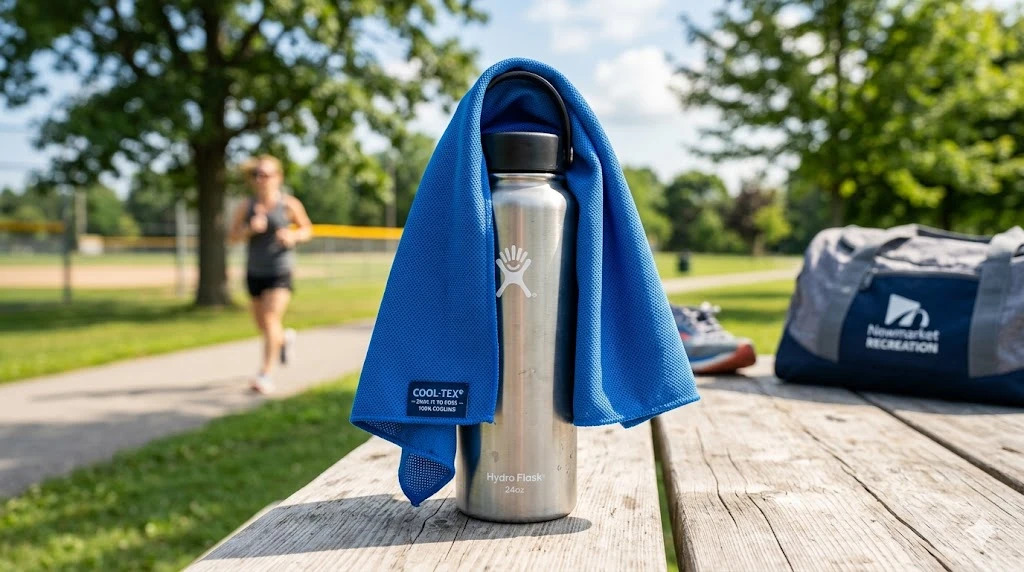
For Wasaga and Georgian Bay readers specifically, the practical implication is that the active outdoor lifestyle the region supports — multi-hour beach days, paddleboard sessions, lake swims followed by cycling, gym-then-shoreline routines — is exactly the use case where the fast-dry property of microfiber compounds. A cotton beach towel that stays damp in a gym bag through the rest of the day is a meaningfully different sanitation situation than a microfiber towel that dries within an hour and is ready for the next leg of the activity.
The bottom-line synthesis: microfiber towels are one of the gear cases where the engineering claim is well-evidenced, the hygiene concern is overstated relative to wash discipline, and the practical fit for the active outdoor life pattern is genuinely strong. The fashion question is real (texture, aesthetics) but secondary to the function question (drying time, weight, packing, hygiene under reasonable use).
Travel and multi-day use: where the engineering really compounds
The use case where microfiber towels stop being a marginal upgrade and become a meaningful one is multi-day travel and back-to-back outdoor activity. A cotton beach towel left damp in a hotel-room or vehicle compartment overnight develops the musty smell that signals advanced bacterial colonization within 12–18 hours; a microfiber towel under the same conditions dries fully and avoids the colonization window entirely. This matters for the practical reality of summer travel: hotel-pool-and-then-beach days, multi-stop road trips, weekend cottage stays where laundry access between days is limited.
The traditional travel-towel advice (pack a towel that can air-dry between hotels) is operationalized cleanly by microfiber. A 50x100 cm microfiber towel hung in a ventilated space (over a shower rod, draped over a balcony rail, slung through a backpack strap during a hike) is dry within 1–3 hours under typical summer conditions. The same towel re-rolled damp into a backpack stays in the colonization window through the day; the practical handling discipline matters as much as the fabric choice. Both together produce the multi-day clean-towel pattern that’s difficult to achieve with cotton in the same conditions Reichel 2013.
For readers planning weekend Wasaga or Georgian Bay outings with multiple swim or paddleboard sessions across the day, the practical implication is that one microfiber towel handles the full day if it gets a 30–60 minute drying window between sessions. The same trip with a cotton towel realistically requires two towels rotating, or accepting the second-half-of-day damp-towel state. The packing-and-laundry math is the use-case-specific argument that justifies the modest premium price of quality microfiber over equivalent cotton.
Practical takeaways
- Microfiber dries 3–5x faster than cotton. The mechanism is split-filament surface area, not chemistry.
- Bacterial load depends mostly on wash discipline, not fabric. Hot wash (50–60C) eliminates the differential between cotton and synthetic.
- The dry-time advantage compounds in gym-bag use. Less time in the moisture-loaded growth condition between washes.
- Skip fabric softener. It coats the filaments and degrades the surface-area effect that makes microfiber work.
- Replace every 3–5 years of regular use. Polymer degradation eventually catches up; the absorbency advantage declines.
- For plush hand-feel or sensitive skin, cotton remains the better choice. Use the right tool for the use case.
References
Callewaert 2014Callewaert C, De Maeseneire E, Kerckhof FM, Verliefde A, Van de Wiele T, Boon N. Microbial odor profile of polyester and cotton clothes after a fitness session. Applied and Environmental Microbiology. 2014;80(21):6611-6619. View source →Reichel 2013Reichel M, Heisig P, Kohlmann T, Kampf G. Alcohols for skin antisepsis at clinically relevant skin sites. BMC Public Health. 2013;13:540. View source →Munoz-Price 2013Munoz-Price LS, Arheart KL, Lubarsky DA, Birnbach DJ. Differential laundering practices of white coats and scrubs among health care professionals. American Journal of Infection Control. 2013;41(6):565-567. View source →