The 60-second version
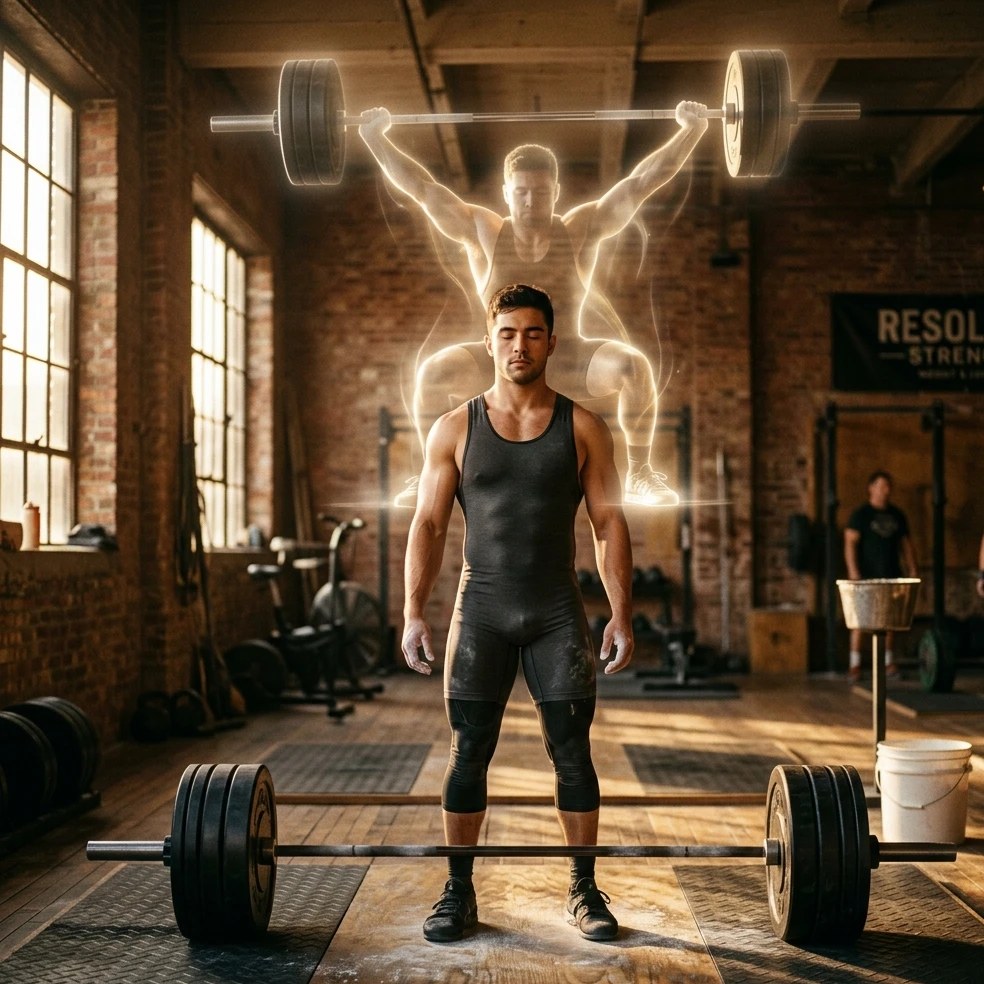
“Mindful lifting” bundles two distinct things the research treats separately. The first is attentional focus during the lift: the 2013 Wulf et al. systematic review of motor-learning literature found external focus (on the bar, the floor, the implement) consistently outperformed internal focus (on the muscle, the body) for both performance and learning across hundreds of studies Wulf 2013. That’s the opposite of the “mind-muscle connection” advice popular in bodybuilding spaces. The second is mindfulness training as a chronic intervention for athletes: the 2012 Birrer et al. review and subsequent Mindfulness-Acceptance-Commitment (MAC) trials found mindfulness training reduces performance anxiety, improves flow-state access, and modestly improves performance under pressure Birrer 2010. The honest synthesis: during heavy compound lifts, focus externally on the bar/floor; during isolation work for hypertrophy, internal mind-muscle focus has small benefits (Schoenfeld 2018); chronic mindfulness practice is a separate tool worth using for anxiety regulation and pre-attempt routines.
Two distinct topics, often confused
When fitness media talks about “mindful lifting,” it usually conflates two interventions with separate evidence bases:
- Acute attentional focus: where you put your attention during the rep. Internal (muscle, body) vs external (bar, floor, target). This is motor-learning research.
- Chronic mindfulness training: meditation, body-scan practice, MBSR/MAC programs done outside the gym to develop trait-level present-moment awareness and emotional regulation. This is sport psychology research.
Both produce real effects. Both are sometimes called “mindful lifting” in popular media. But they don’t mean the same thing and their evidence bases don’t fully overlap.
The external-focus finding (and why it’s controversial)
The single most-replicated finding in the motor-learning literature is the external-focus advantage. The 2013 Wulf review pooled 180+ studies across throwing, jumping, balancing, and lifting tasks. The pattern was nearly universal:
- Internal focus instruction (“think about contracting your quads,” “feel the squeeze in your chest,” “activate your glutes”): produces measurable performance decrements vs external focus.
- External focus instruction (“drive the floor away,” “push the bar to the ceiling,” “throw the ball through the hoop”): produces better performance and faster motor learning Wulf 2013.
The mechanism, called the “constrained action hypothesis”, is that internal focus disrupts automatic motor programs by injecting conscious control where it isn’t needed. External focus lets the motor system run freely.
The bodybuilding-derived “mind-muscle connection” (concentrating on the muscle to maximise activation) sits in apparent contradiction. The 2018 Schoenfeld & Contreras review tested both approaches:
- For maximal force production (1RM, max-effort sets): external focus wins clearly. The constrained-action effect dominates.
- For hypertrophy via lighter loads and longer sets: internal focus produces small but consistent increases in target-muscle activation (~5–10%) and in long-term hypertrophy outcomes in some studies Schoenfeld 2018.
The synthesis: external focus for strength and explosive performance; internal focus has a place for hypertrophy work where you’re trying to bias growth toward a specific muscle.
“Adopting an external focus of attention enhances motor performance and learning relative to an internal focus across a wide range of tasks. The advantages are explained by the constrained action hypothesis: internal focus disrupts automatic control, while external focus permits unconscious motor processes to operate efficiently.”
— Wulf, Int Rev Sport Exerc Psychol, 2013 view source
Practical cues for compound lifts
External-focus cues that work for the main barbell lifts:
Squat
- External: “drive the floor away,” “push the floor with your feet,” “spread the bar across your back.”
- Internal (avoid for max effort): “contract your quads,” “activate your glutes,” “feel the hamstrings.”
Bench press
- External: “push the bar to the ceiling,” “press the bar away from you,” “drive your hands into the bar.”
- Internal (avoid for max effort): “contract your chest,” “feel the triceps engage,” “squeeze the pecs.”
Deadlift
- External: “push the floor down,” “stand up tall,” “drive the floor away.”
- Internal (avoid for max effort): “activate your lats,” “feel your glutes,” “contract your hamstrings.”
Overhead press
- External: “press the bar through the ceiling,” “push your head through the window.”
- Internal (avoid for max effort): “feel the deltoids,” “activate the traps.”
The cue distance question
Wulf’s follow-up work suggests more distal cues outperform more proximal cues. “Push the bar away” outperforms “push your hands away,” which outperforms “contract your triceps.” The optimal cue points your attention to the most external object the action affects — the bar, the floor, the target — not the body part doing the moving. There are limits (highly abstract or unrelated cues fail), but among reasonable options, more distal usually wins.
When internal focus pays off
The hypertrophy exception. The 2018 Schoenfeld & Contreras study had subjects perform biceps curls under either internal-focus (“squeeze the biceps”) or external-focus (“curl the weight up”) instructions. After 8 weeks:
- Internal-focus group: ~12.4% biceps cross-sectional area increase.
- External-focus group: ~6.9% biceps cross-sectional area increase.
- Strength gains were similar in both groups.
The interpretation: for muscle-specific growth in isolation work, internal focus biases growth toward the target muscle by ensuring it does more of the work. The trade-off is potentially smaller strength gains (though the Schoenfeld study didn’t find that).
Practical implication: compound multi-joint work (squats, deadlifts, presses): external focus. Isolation work for muscle building (curls, lateral raises, leg extensions): internal focus may add ~5–10% to growth outcomes. The mind-muscle connection isn’t bro-science fiction; it’s just specifically useful for hypertrophy isolation, not heavy compound lifts.
Chronic mindfulness training for athletes
The separate question: does mindfulness practice (meditation, body scan, MBSR-style training) outside the gym improve in-gym outcomes?
The 2012 Birrer et al. review and subsequent MAC (Mindfulness-Acceptance-Commitment) protocol trials found:
- Performance anxiety: reductions of d=0.40–0.60 across pre-competition anxiety measures.
- Flow-state access: increased self-reported flow-state frequency in trained athletes after MAC training.
- Performance under pressure: small-to-moderate effects (d=0.20–0.40) on competition performance, with effects largest in athletes with pre-existing anxiety Birrer 2010.
- Recovery from setbacks: meaningful improvements in mental recovery from injury, missed PRs, plateaus.
The 2017 Sappington & Longshore review pooled 17 mindfulness-based intervention studies in athletes; pooled effect on competitive performance was d=0.31 (small-to-moderate). Effects on mood and anxiety were larger (d=0.45–0.65) Sappington 2015.
Practical protocols
Pre-attempt routine (60–90 seconds before max-effort sets)
- Stand or sit close to the bar.
- 4–6 box-breathing cycles to regulate arousal (4 in, 4 hold, 4 out, 4 hold).
- Single instructional cue: external (e.g., “drive the floor”).
- Approach the bar.
Daily mindfulness practice (10–20 minutes, separate from training)
- Use an app (Insight Timer, Headspace, Waking Up) or just timer + chair.
- Focus on breath or body sensations.
- Notice when attention drifts; gently return it.
- Build to 10–20 minutes daily over 4–8 weeks.
- This is the dose at which sport-mindfulness studies start showing competition benefits.
Set-by-set focus selection
- Compound max-effort: external cue (bar, floor, ceiling).
- Isolation hypertrophy work: internal cue (squeeze, contract, feel).
- Skill / technique work (e.g., snatch): external cue.
- Rehab / re-learning a movement post-injury: internal at first to rebuild proprioception, transitioning to external as the movement automates.
Common myths
- “Always squeeze the muscle — mind-muscle connection is everything.” Wrong for compound lifts. The constrained-action effect makes internal focus measurably worse for max-effort barbell work. Right (with caveats) for isolation hypertrophy.
- “Mindfulness during a heavy set means staying calm.” Confused. Acute attention focus during a set is the motor-learning topic. Chronic mindfulness practice is a separate intervention. They’re both useful but they’re different things.
- “Meditation will make you stronger.” Indirect. Chronic mindfulness practice reduces anxiety and improves emotional regulation, which improves performance under pressure. It does not directly increase muscle force production.
- “The bar speed is everything — don’t think.” Half right. For trained lifters with established motor patterns, less conscious control is better — the bar moves faster when you don’t over-think. But that’s a result of automation, not of an empty mind.
Practical takeaways
- Acute attention focus matters: external (bar, floor, ceiling) wins for compound max-effort lifts; internal (mind-muscle) is useful for isolation hypertrophy.
- The most-distal external cue that connects clearly to the task usually outperforms more-proximal cues.
- Chronic mindfulness training (10–20 minutes/day for weeks) is a separate intervention with moderate effects on anxiety, flow access, and performance under pressure.
- A pre-attempt routine of breathing + a single external cue is cleaner than over-thinking.
- For hypertrophy isolation: internal focus can add ~5–10% to muscle-specific growth outcomes.
- Don’t conflate the two topics — in-set attention focus and outside-the-gym mindfulness practice are different tools for different jobs.
References
Wulf 2013Wulf G. Attentional focus and motor learning: a review of 15 years. Int Rev Sport Exerc Psychol. 2013;6(1):77-104. View source →Birrer 2010Birrer D, Morgan G. Psychological skills training as a way to enhance an athlete's performance in high-intensity sports. Scand J Med Sci Sports. 2010;20 Suppl 2:78-87. View source →Schoenfeld 2018Schoenfeld BJ, Vigotsky A, Contreras B, et al. Differential effects of attentional focus strategies during long-term resistance training. Eur J Sport Sci. 2018;18(5):705-712. View source →Sappington 2015Sappington R, Longshore K. Systematically reviewing the efficacy of mindfulness-based interventions for enhanced athletic performance. J Clin Sport Psychol. 2015;9(3):232-262. View source →Calmels 2015Calmels C, Pichon S, Grosbras MH. Attentional control of movement: motor expertise and motor imagery. Front Hum Neurosci. 2014;8:608. View source →Gardner 2017Gardner FL, Moore ZE. Mindfulness-Acceptance-Commitment-based approaches: applications to athletes. Cogn Behav Pract. 2017;24(3):310-323. View source →Buhlmayer 2017Bühlmayer L, Röthlin P, Birrer D, Lakhdar D, Morgan G, Hossner EJ. Effects of mindfulness practice on performance-relevant parameters and performance outcomes in sports: a meta-analytical review. Sports Med. 2017;47(11):2309-2321. View source →Noetel 2017Noetel M, Ciarrochi J, Van Zanden B, Lonsdale C. Mindfulness and acceptance approaches to sporting performance enhancement: a systematic review. Int Rev Sport Exerc Psychol. 2017;12(1):139-175. View source →Calatayud 2016Calatayud J, Vinstrup J, Jakobsen MD, et al. Importance of mind-muscle connection during progressive resistance training. Eur J Appl Physiol. 2016;116(3):527-533. View source →Marchant 2008Marchant DC, Greig M, Scott C. Attentional focusing instructions influence force production and muscular activity during isokinetic elbow flexions. J Strength Cond Res. 2009;23(8):2358-2366. View source →Zachry 2005Zachry T, Wulf G, Mercer J, Bezodis N. Increased movement accuracy and reduced EMG activity as the result of adopting an external focus of attention. Brain Res Bull. 2005;67(4):304-309. View source →Scott 2018Scott BR, Hodson JA, Govus AD, Dascombe BJ. The internal focus of attention may not always be inferior to an external focus during resistance exercise. Med Sci Sports Exerc. 2017;49(11):2290-2296. View source →