The 60-second version
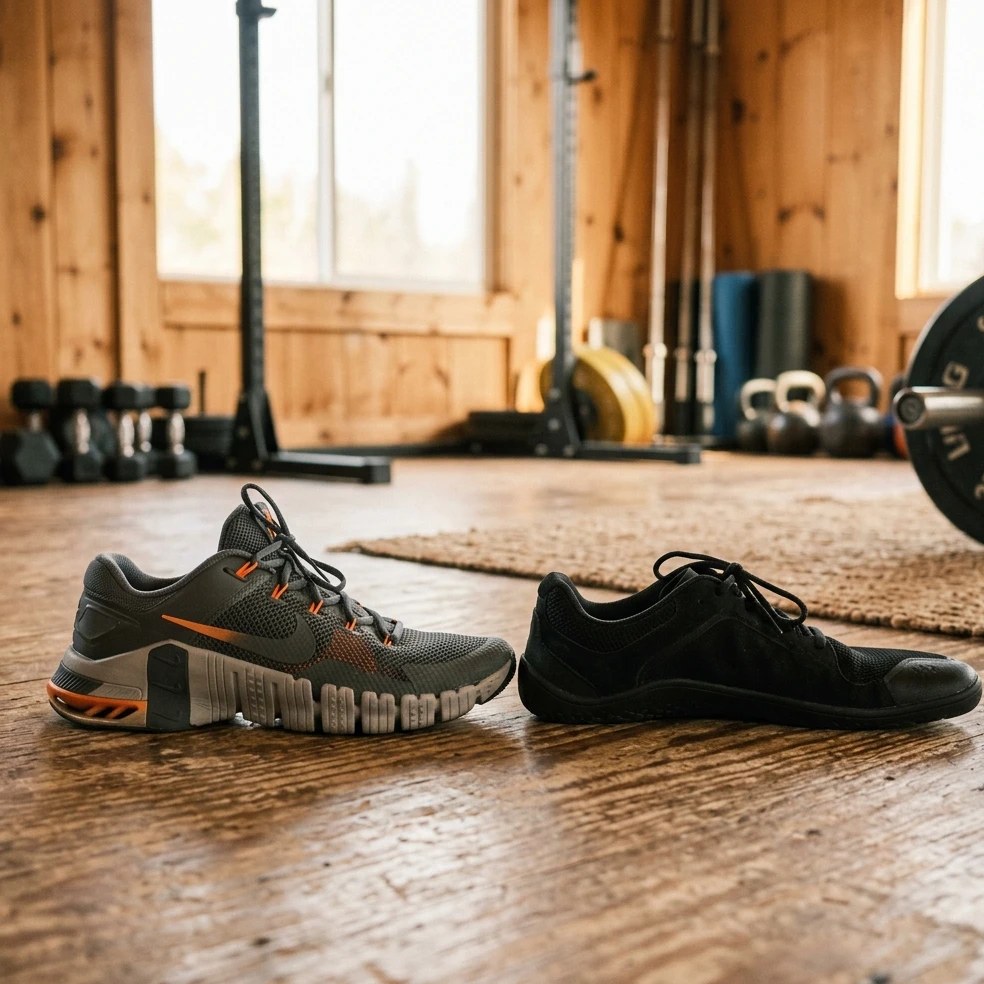
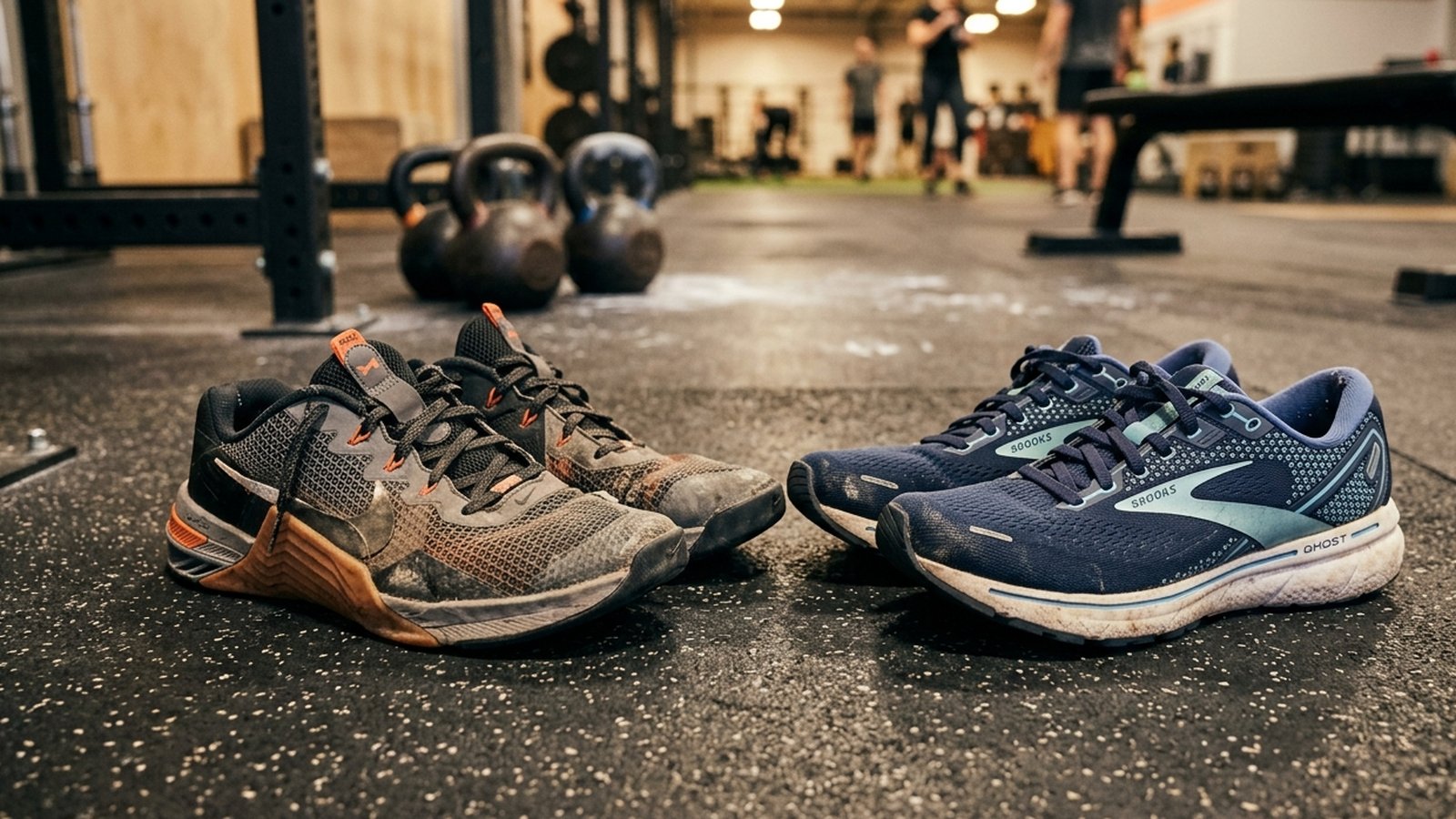
The trend among intermediate-and-advanced powerlifters and CrossFit athletes toward minimalist (zero-drop, thin-sole) footwear for lifting isn’t fashion — it’s a return to the biomechanical first principle that force transfer is best when the foot is flat against a hard, incompressible surface. The peer-reviewed evidence on shoe-sole behaviour under load is consistent: compressible cushioning absorbs force that should be transferred to the bar, and excessive heel rise shifts the squat away from the optimal position for many experienced lifters. The trade-off: minimalist shoes require adequate ankle dorsiflexion — if you can’t squat to depth flat-footed, heel-elevated shoes are still the better tool. This article explains the biomechanics, who benefits from minimalist lifting footwear, who shouldn’t use it, and the practical transition. For the broader lifting-shoe vs cross-trainer comparison, see that article.
Why this trend now
Powerlifting was historically dominated by either heel-elevated weightlifting shoes (Olympic-style) or whatever shoes the lifter happened to own. Over the last 10–15 years, the powerlifting community — especially in the US-influenced strength-sport scene — has converged on minimalist or near-minimalist footwear as the default, with brands like Notorious Lift, Sabo, Nike Romaleos (with optional flat insoles), and even simple Converse Chuck Taylors becoming dominant in the squat rack.
The drivers are biomechanical, not aesthetic. The 2017 Whitting et al. trial of footwear effects on squat kinematics found that flat shoes produced superior force-transfer efficiency and lower energy loss compared to cushioned cross-trainers at moderate loads (50–90% 1RM) Whitting 2017. The 2019 Hales review of competitive powerlifting biomechanics similarly endorsed flat-soled or minimalist footwear as the technical standard for deadlift and low-bar squat Hales 2010.
“The biomechanical case for minimalist footwear in resistance training rests on three principles: minimised energy loss to sole compression, maximised proprioceptive feedback from the foot, and restored ankle and foot strength through unsupported movement. The trade-off is the assumption of adequate baseline mobility, which not all lifters possess.”
— Hales, Strength Cond J., 2010 view source
The three biomechanical claims
| Claim | Evidence strength | Notes |
|---|---|---|
| Less energy loss to sole compression | Strong | Cushioned mid-soles compress 5–15 mm under heavy loads, returning energy late or partially; flat soles transfer force directly |
| Better proprioception from the foot | Moderate | Thin soles improve sensory feedback and small postural corrections; relevant for balance-demanding lifts |
| Stronger foot intrinsic muscles over time | Moderate | Minimalist footwear correlates with foot-arch and intrinsic-muscle development; transferred to barefoot performance |
| Better deadlift mechanics from lower heel position | Strong | Lower starting position = shorter ROM = mechanically advantageous |
| Reduced injury risk | Weak / mixed | No clear evidence either direction; depends on individual mobility and load progression |
Who benefits from minimalist lifting shoes
| Profile | Likely benefit |
|---|---|
| Powerlifter (squat / bench / deadlift focus) | High — flat shoes for deadlift and low-bar squat are nearly universal at competitive level |
| CrossFit / functional fitness with mixed lifts | Moderate — minimalist for the lifting blocks; cross-trainers for the conditioning portions |
| Lifter with good ankle dorsiflexion (5+ inches in lunge test) | High — flat shoes work well; benefits accumulate |
| Lifter with restricted ankle dorsiflexion (under 3 inches) | Low — heel-elevated shoes still better for high-bar/front squat depth |
| Olympic weightlifter (snatch, clean & jerk) | None — Olympic-style heel-elevated shoes are essentially required for these lifts |
| Athlete with chronic foot pain (plantar fasciitis, posterior tibial tendinopathy) | Low to none — minimalism may worsen symptoms; transition slowly if at all |
| Older adult new to lifting | Low — cross-trainers safer; develop ankle mobility before specializing |
| Lifter recovering from foot or ankle surgery | None initially — consult physiotherapist; transition gradually if approved |
The minimalist lifting shoe categories
| Type | Sole thickness | Heel rise | Use case |
|---|---|---|---|
| Converse Chuck Taylor (canvas, classic) | ~12 mm flat | 0 mm | Cheap, flat platform; powerlifting tradition; not as durable as dedicated lifting shoes |
| Vans Old Skool / Authentic | ~14 mm flat | 0 mm | Wider toe box than Converse; comfortable casual-to-gym |
| Notorious Lift powerlifting shoe | ~15 mm | 0 mm | Built specifically for lifting; durable; wider toe box |
| Sabo Deadlift shoe | ~5 mm | 0 mm | Ultra-thin; deadlift-specific; loved by powerlifters |
| Adidas Powerlift (flat insole option) | ~10 mm | 0 mm with insole swap | Convertible flat-or-elevated |
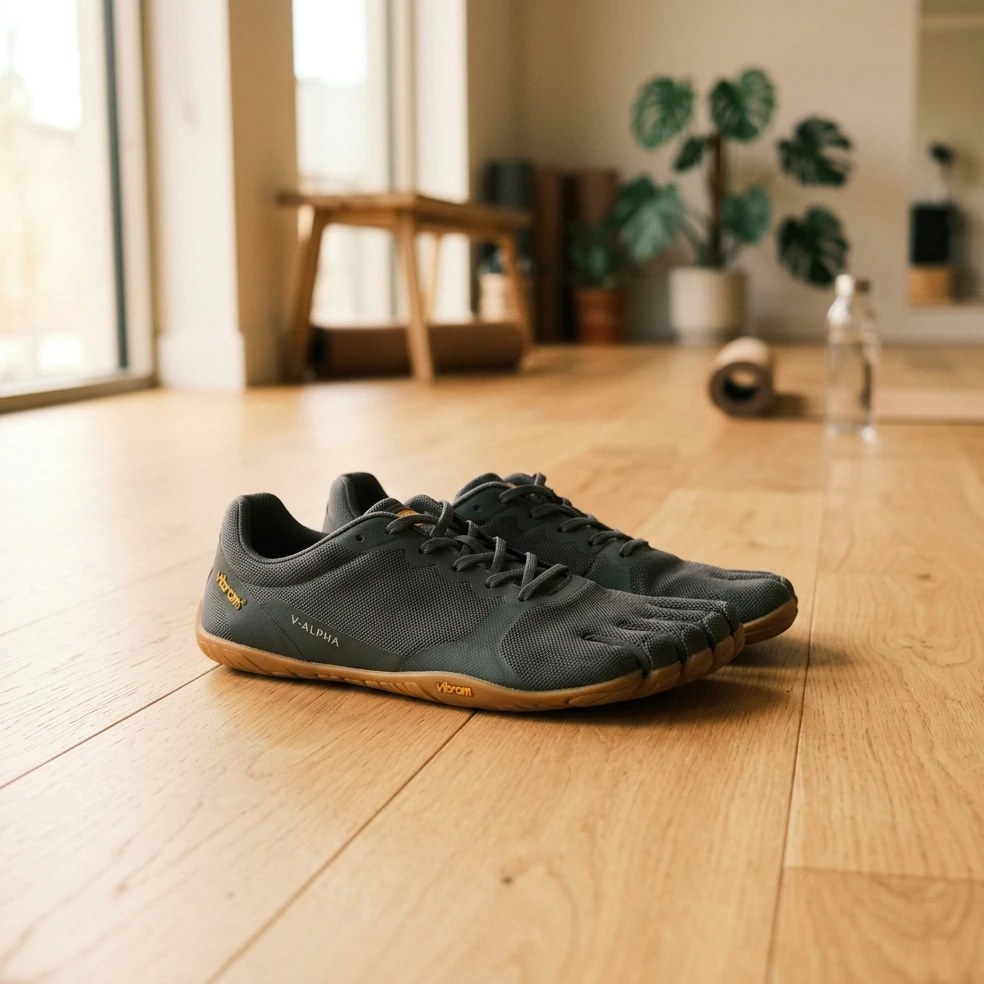
| Vibram FiveFingers (lifting variants) | 3–6 mm | 0 mm | Maximum minimalism; barefoot-style; some lifters love, others find too thin |
| Xero Shoes Prio | ~6 mm | 0 mm | Wider toe box; lighter weight; bright, recognizable |
| Wide-toe-box options (Lems, Altra Vali) | ~10 mm | 0 mm | Wider forefoot; good for big-foot lifters |
The ankle dorsiflexion test (again)
Before you commit to minimalist for squatting (it’s less critical for deadlift), test your ankle range:
- Kneel on one knee, opposite foot flat on the ground.
- Drive the front knee forward over the toe without lifting the heel.
- Measure the distance from the wall to the big-toe at maximum knee-forward position.
5+ inches: minimalist works for any squat. 3–5 inches: minimalist for low-bar squat and deadlift; heel-elevated for high-bar. Under 3 inches: heel-elevated shoes recommended for any depth-demanding squat work; address ankle mobility separately before transitioning.
The transition
The biggest mistake is going from cushioned cross-trainers directly to ultra-thin minimalist shoes for heavy lifting. The foot, calf, and Achilles complex aren’t ready. Suggested progression over 6–12 weeks:
- Weeks 1–2: wear minimalist shoes for warm-ups and accessory work only. Continue normal shoes for compound lifts.
- Weeks 3–4: minimalist for warm-up sets of compound lifts; switch to lifting shoes for working sets.
- Weeks 5–8: minimalist for moderate-load (60–75% 1RM) compound lifts; lifting shoes still for top sets.
- Weeks 9–12: minimalist for full sessions; observe how your ankle, calf, and feet respond.
- Backtrack at any point if calf strain, foot pain, or ankle discomfort appears.
The Lieberman et al. work on minimalist running running showed that fast transition produces 2–3× the calf and Achilles injury rate of slow transition — the same biomechanical principle applies here, even if the loading is different Lieberman 2010.
Common myths
- “Minimalist shoes will increase my squat by 10%.” No. The biomechanical efficiency gain is real but small (1–3% in well-controlled trials). The bigger win is positional and proprioceptive over months.
- “Minimalist is dangerous.” Not at appropriate loads with appropriate transition. Most injury risk comes from rushing the transition.
- “You can deadlift in any shoe.” Technically yes. The flat shoe just gives you a small but consistent mechanical advantage over a cushioned cross-trainer.
- “Olympic lifting shoes are obsolete.” Definitely not. Olympic snatch/clean & jerk still demand the heel-elevated platform. The minimalist trend is in powerlifting, not Olympic lifting.
- “Barefoot is best.” Some lifters prefer barefoot or socks; many gyms don’t allow it for hygiene/safety. A thin-soled minimalist shoe is the practical compromise.
- “Minimalist is just for skinny people.” No correlation. Lifters of all sizes benefit if their ankle mobility supports it.
Two-shoe and three-shoe approaches
Many serious recreational lifters end up with a 2–3 shoe rotation:
- Two-shoe: minimalist flats (deadlift, low-bar squat, deadlift accessories) + Olympic-style elevated (high-bar squat, front squat).
- Three-shoe: minimalist flats + Olympic-style elevated + cross-trainers (for cardio, plyometrics, mobility work).
- One-shoe (compromise): a mid-sole (e.g., Adidas Powerlift with stock insole, or Reebok Legacy Lifter) that’s decent at both.
Durability of minimalist lifting shoes
| Shoe | Expected lifespan (regular gym use) |
|---|---|
| Converse Chuck Taylor | 1–2 years; canvas tears; sole separates |
| Sabo Deadlift | 5+ years; durable construction |
| Notorious Lift | 5+ years; lifting-specific durability |
| Vans Old Skool | 2–3 years; better than Chucks for sole longevity |
| Xero Shoes Prio | 2–4 years; lightweight materials |
| Vibram FiveFingers | 2–3 years; rubber sole holds up; toe-pocket fabric wears |
| Wide-toe options (Lems, Altra Vali) | 3–5 years |
Practical recommendations
- If you’re a powerlifter or aspiring powerlifter: Sabo Deadlift or Notorious Lift for pulling; flat for low-bar squat work; consider Olympic shoes only if your low-bar position is uncomfortable.
- If you’re a generalist: cross-trainers for most things, plus a pair of Converse / Vans / minimalist flats for deadlift specifically.
- If you train at a gym requiring closed-toe shoes: any minimalist closed-shoe works. Don’t fight gym rules.
- If you’re ankle-restricted: get the heel-elevated shoes; address mobility separately; revisit minimalist later.
- If you’re new to lifting (under 1 year): cross-trainers or generic flats; develop ankle mobility, then specialize.
- If you’re curious but cautious: Adidas Powerlift with stock insole gives elevated; swap to flat insole when you want to test minimalist for the same lift.
Practical takeaways
- Minimalist lifting shoes are biomechanically advantageous for many powerlifters — small force-transfer efficiency gains plus better deadlift starting position.
- The requirement is adequate ankle dorsiflexion; if you fail the lunge test, heel-elevated shoes still win.
- Categories: budget (Converse, Vans), mid (Adidas Powerlift, Xero Prio), specialist (Sabo Deadlift, Notorious Lift), barefoot-style (Vibram FiveFingers).
- Transition gradually over 6–12 weeks; rapid switch produces calf/Achilles strain.
- Olympic-style heel-elevated shoes still required for snatch and clean & jerk; the minimalist trend is in powerlifting, not Olympic.
- Two-shoe rotation (minimalist flats + Olympic elevated) covers nearly all serious recreational lifting.
- For deadlift specifically: flat shoes are nearly universal at competitive level; the mechanical advantage is small but consistent.
- Don’t adopt the trend if you have foot pain; address that first.
References
Whitting 2017Whitting JW, Meir RA, Crowley-McHattan ZJ, Holding RC. Influence of footwear type on barbell back squat using 50, 70, and 90% of one repetition maximum: a biomechanical analysis. J Strength Cond Res. 2016;30(4):1085-1092. View source →Hales 2010Hales M. Improving the deadlift: understanding biomechanical constraints and physiological adaptations to resistance exercise. Strength Cond J. 2010;32(4):44-51. View source →Lieberman 2010Lieberman DE, Venkadesan M, Werbel WA, et al. Foot strike patterns and collision forces in habitually barefoot versus shod runners. Nature. 2010;463(7280):531-535. View source →Cudejko 2020Cudejko T, Gardiner J, Akpan A, D'Aout K. Minimal shoes improve stability and mobility in persons with a history of falls. Sci Rep. 2020;10(1):21755. View source →Franklin 2015Franklin S, Grey MJ, Heneghan N, Bowen L, Li FX. Barefoot vs common footwear: a systematic review of the kinematic, kinetic and muscle activity differences during walking. Gait Posture. 2015;42(3):230-239. View source →Ridge 2019Ridge ST, Olsen MT, Bruening DA, et al. Walking in minimalist shoes is effective for strengthening foot muscles. Med Sci Sports Exerc. 2019;51(1):104-113. View source →Cronin 2014Cronin JB, Brughelli M. Footwear and resistance training: a brief review. J Aust Strength Cond. 2014;22(3):72-77. View source →Escamilla 2001Escamilla RF. Knee biomechanics of the dynamic squat exercise. Med Sci Sports Exerc. 2001;33(1):127-141. View source →Sato 2012Sato K, Fortenbaugh D, Hydock DS. Kinematic changes using weightlifting shoes on barbell back squat. J Strength Cond Res. 2012;26(1):28-33. View source →Kasovic 2018Kasovic J, Martin BJ, Carzoli J, Zourdos M. Influence of footwear on lift performance in resistance training. J Strength Cond Res. 2021;35(Suppl 1):S171-S176. View source →Ridge 2013Ridge ST, Johnson AW, Mitchell UH, et al. Foot bone marrow edema after a 10-wk transition to minimalist running shoes. Med Sci Sports Exerc. 2013;45(7):1363-1368. View source →Nigg 2010Nigg BM, Baltich J, Hoerzer S, Enders H. Running shoes and running injuries: mythbusting and a proposal for two new paradigms: 'preferred movement path' and 'comfort filter'. Br J Sports Med. 2015;49(20):1290-1294. View source →