The 60-second version
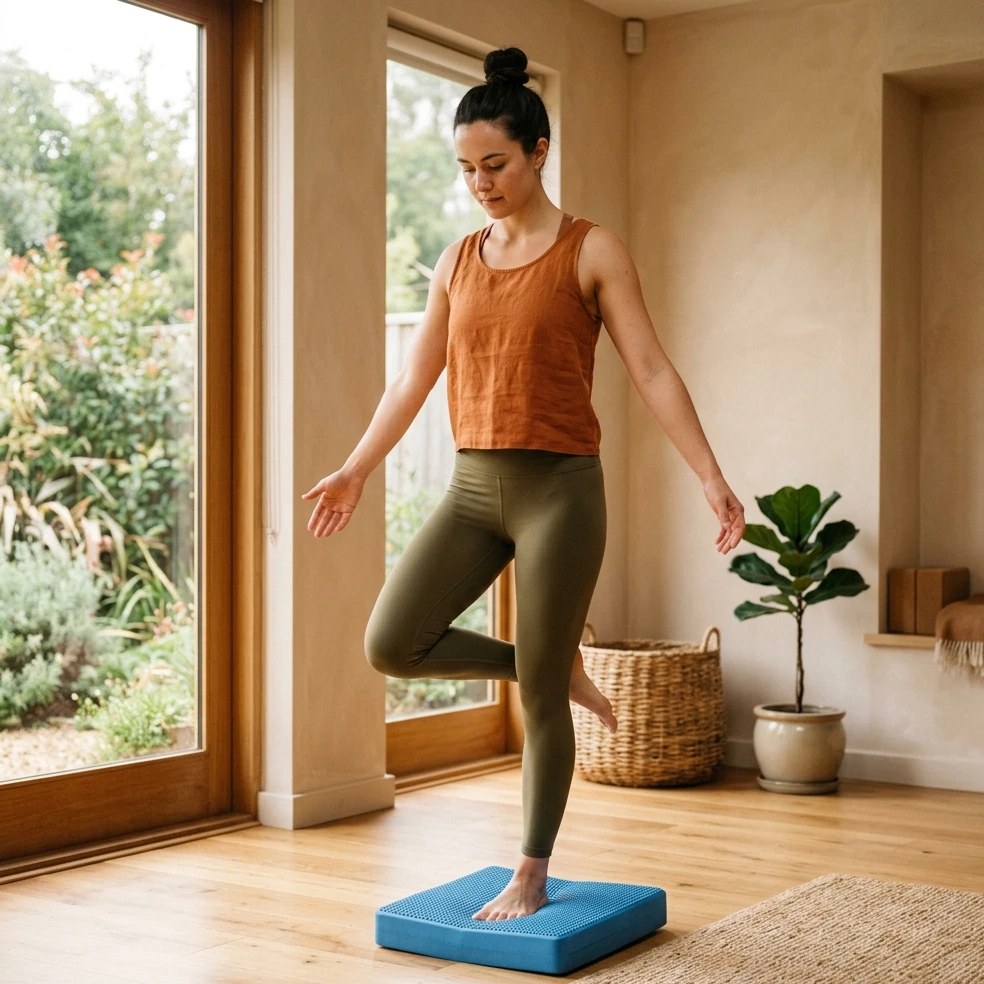
Falls are the leading cause of injury in adults over 65, and the gap between “balance training in a clinic” and “walking on a real shoreline” is wider than most rehabilitation programs acknowledge Sherrington 2019. The Sherrington 2019 Cochrane meta-analysis of falls-prevention exercise found the largest effects come from challenging balance training that includes weight-shifting, narrow base of support, and reduced upper-limb support — closer to outdoor walking than to standing-on-foam Sherrington 2019. Donath 2016 specifically examined balance-training transfer and found that gym-based static-balance exercises don’t reliably transfer to dynamic outdoor contexts Donath 2016. The practical translation: a graded outdoor walking protocol on progressively more challenging terrain — flat sidewalk, packed sand, soft sand, mild rocky shoreline — is closer to the falls-prevention evidence than equivalent time on a balance pad.
What the falls-prevention evidence actually supports
Sherrington 2019’s Cochrane review of exercise for falls prevention pooled 108 randomised trials covering more than 23,000 community-dwelling older adults — the largest single synthesis available Sherrington 2019. The headline finding: exercise reduces fall rates by approximately 23% on average, with the largest effects in programs that include challenging balance training (weight-shifting, narrow base of support, reduced upper-limb support, dynamic movements). Programs that include challenging balance plus moderate dose (3+ hours/week) plus 12+ months of exposure show the strongest effects.
Howe 2011’s earlier Cochrane review of exercise for improving balance in older adults reached compatible conclusions: balance-specific training produces measurable gains in functional-balance measures, with the magnitude depending on program intensity and duration Howe 2011. The implication for adults over 65: the evidence base for “exercise reduces falls” is unusually strong; the question is which exercise specifically.
The intervention specificity matters. Generic resistance training and walking programs reduce falls modestly; programs explicitly designed around balance challenge produce 30–40% reductions in fall rates Sherrington 2019. The transfer to real-world contexts &mdash- which is where the falls actually happen — is the underexamined link.
Why gym-based balance work doesn't fully transfer
Donath 2016’s meta-analysis of balance-training transfer specifically examined whether static-balance gains in clinic settings carry over to dynamic outdoor performance Donath 2016. The result: partial transfer at best. Programs heavy on standing-on-foam, single-leg-stance, and similar gym-based balance exercises produce gym-balance gains; the gains in real-world dynamic contexts (walking on uneven surfaces, recovering from a stumble, navigating stairs and curbs) are smaller and less reliable.
The mechanism is partly proprioceptive. Plisky 2009’s work on the Star Excursion Balance Test and dynamic-balance assessment shows that real-world balance is heavily dependent on visual, vestibular, and proprioceptive integration during movement — a fundamentally different motor task than maintaining static stance on a stable surface Plisky 2009. The gym-balance and outdoor-balance tasks share some neural substrate but rely on different control strategies.
The implication is not that gym-balance work is useless — it’s a useful component — but that programs limited to gym-balance often under-deliver on the outcome that matters (real-world falls). The honest framing: gym-balance for safety and supervision early in a program; graded outdoor terrain for transfer to the contexts where falls actually happen Sherrington 2019.
A graded outdoor-walking protocol
The protocol that lines up with Sherrington 2019, Donath 2016, and Plisky 2009 progresses through five stages over 8–12 weeks. Stage 1 (weeks 1–2): flat sidewalk, 20–30 minute walks 3 times per week, with attention to upright posture and a normal stride. The goal is baseline aerobic load and habitual outdoor walking; the balance challenge is minimal.
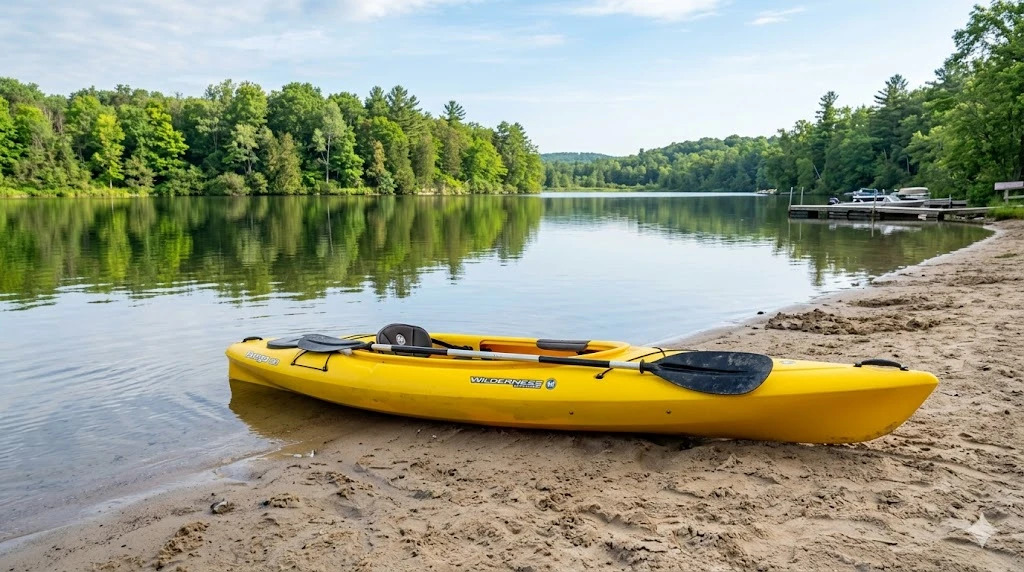
Stage 2 (weeks 3–4): mixed surfaces — sidewalk plus mild park paths with roots, puddles, slight elevation changes — same duration and frequency. The balance demand increases incrementally; the proprioceptive system begins adapting to dynamic surface variation. Stage 3 (weeks 5–6): packed sand or hard-packed gravel paths, 20–30 minutes 3 times per week. The deformable surface adds the dynamic-correction demand that Donath 2016’s transfer work flags as the key training stimulus Donath 2016.
Stage 4 (weeks 7–9): soft sand or mild rocky shoreline, 15–25 minutes (shorter due to higher load), 2–3 times per week with rest days between. This is the closest analogue to the high-balance-demand functional contexts where falls happen. Stage 5 (weeks 10–12): mixed real-world contexts — whatever the reader’s actual environment includes, scaled to the balance reserve they’ve built. The progression principle Sherrington 2019 supports is gradual increase in challenge with maintained safety Sherrington 2019.
Gaze, vestibular contribution, and the dual-task problem
Real-world walking on uneven terrain is a multi-system task: visual (where to step), vestibular (head position and movement), proprioceptive (where the limbs are), and motor (executing the next step). The age-related decline in any of these systems compounds the others, and falls in older adults often occur during dual-task contexts (walking while talking, walking while looking at a phone) where attentional resources are split.
Plisky 2009’s assessment work shows that older adults with reduced dynamic-balance scores often have measurable visual-vestibular integration deficits that don’t show up on static balance tests Plisky 2009. The practical implication for the graded walking protocol: practicing scanning the path ahead (looking 3–5 steps in advance rather than at the feet) is a learnable skill that improves outdoor walking confidence and reduces stumbles.
The dual-task problem is also worth flagging for daily safety. Adults over 70 should consider deferring phone use to dedicated stops rather than walking while looking at the screen, particularly on uneven terrain. The cognitive cost of a divided attention task during walking is well-documented; the falls literature consistently identifies dual-task contexts as elevated-risk moments Howe 2011.
Safety floor: when to progress and when to hold
The progression principle is “challenge plus safety,” not “challenge above all.” The honest framing for the graded protocol: progress to the next stage when the current stage feels “easy plus alert,” not when it feels “easy plus bored.” Sherrington 2019’s protocols that produced the largest effects maintained challenge throughout the program, but never to the point where falls during training became a meaningful risk Sherrington 2019.
The hold criteria: any actual fall during a stage warrants returning to the previous stage and repeating it for 2–3 weeks before re-progressing. New or worsening pain in feet, knees, or hips warrants holding the stage until the pain resolves; pain that persists past 5–7 days warrants medical evaluation. The point is not to push through every signal but to read the signals correctly — balance training in older adults is one of the contexts where pushing past pain frequently produces injury rather than adaptation.
Trekking poles and walking sticks are appropriate adjuncts for stages 4–5 if balance reserve is the limiting factor. The honest framing: a pole that gets used regularly on uneven terrain extends safe outdoor activity by years for many older adults. The compromise is real but small — most of the proprioceptive challenge of soft sand walking remains even with light pole support — and the safety upside is large Howe 2011.
How this fits the broader falls-prevention picture
Exercise is one piece of a falls-prevention strategy that also includes home-environment modification (lighting, removing trip hazards, grab bars in wet areas), medication review (some classes including sedatives and certain blood-pressure medications increase fall risk), vision correction (annual eye exam for adults 60+), and footwear (well-fitting shoes with adequate grip; the “walking around the house in socks” pattern is an under-recognized risk).
Sherrington 2019’s Cochrane review and Howe 2011’s earlier review both note that multifactorial interventions (exercise plus home modification plus medication review) typically outperform exercise alone Sherrington 2019. The graded outdoor walking protocol described above is the exercise component; the other components are equally important and often easier to implement. A family-medicine team or community-based falls-prevention program (many provinces have funded programs through public health) can help coordinate the multifactorial approach.
The most defensible bottom line: graded outdoor walking on progressively challenging terrain is closer to the falls-prevention evidence than equivalent time on gym-based balance equipment. The progression matters, the safety floor matters, and the multifactorial framing matters. The walking protocol described here is the evidence-grounded component readers can implement on their own; the other components benefit from clinical involvement Howe 2011.
Strength as the foundation: why balance work alone isn't enough
One under-emphasized component of falls-prevention is the strength foundation that supports all balance work. Sherrington 2019’s Cochrane meta-analysis found that programs combining challenging balance with progressive strengthening produced larger fall reductions than either component alone Sherrington 2019. The mechanism is mechanical: dynamic balance recovery from a stumble or trip requires the lower-body strength to actually execute the stepping correction.
For adults over 65, the relevant strength variables are quadriceps and gluteal strength (for the rapid-correction step), calf strength (for ankle-strategy balance), and trunk strength (for postural control during dynamic movements). Howe 2011’s review noted that resistance training of 2–3 sessions per week with progressive load produces meaningful gains in these specific functions Howe 2011. The practical implication: a graded outdoor walking program is the balance-specific component; a separate 2-session-per-week strengthening practice is the foundation.
The home-friendly version of the strengthening component: sit-to-stand from a sturdy chair (3 sets of 10–15), wall push-ups (3 sets of 8–12), step-ups onto a low step (3 sets of 8 per side), and calf raises (3 sets of 12–15). The exercises are simple; the consistency is what produces the foundation. Plisky 2009’s dynamic-balance assessment work confirms that strength-deficient older adults often have measurable balance deficits that respond to strengthening before any specific balance training is added Plisky 2009.
The fear-of-falling loop and how to interrupt it
A psychological component of falls in older adults that the exercise literature increasingly addresses is the fear-of-falling loop: an actual fall (or near-fall) reduces confidence, leading to reduced outdoor activity, leading to deconditioning, leading to genuinely higher fall risk. The loop is self-reinforcing and produces real outcomes; Howe 2011’s review specifically calls out fear-of-falling reduction as one of the documented benefits of structured exercise programs Howe 2011.
The graded outdoor protocol described above interrupts the loop intentionally. Each successfully completed stage builds the legitimate confidence base that supports continued outdoor activity. Donath 2016’s slackline-training work in older adults found similar effects: balance challenge that succeeds at appropriate-for-the-individual level produces both the physical adaptation and the psychological confidence Donath 2016.
The honest framing for readers in the post-fall recovery window: the temptation to restrict activity after a fall is understandable but counterproductive. The risk of further deconditioning typically exceeds the risk of pushing back into appropriate-level outdoor activity within 2–4 weeks. A gentle return to stage 1 or 2 of the graded protocol, with optional pole support, is the evidence-supported re-entry path. The fear-of-falling literature consistently identifies activity withdrawal as a worse outcome than appropriate continued activity.
Practical takeaways
- Exercise reduces falls in older adults by ~23% on average; programs with challenging balance training produce 30–40% reductions (Sherrington 2019).
- Gym-based static balance work transfers only partially to real-world dynamic contexts (Donath 2016).
- Graded outdoor walking on progressively challenging terrain over 8–12 weeks is closer to the evidence than equivalent gym time.
- Visual scanning ahead (3–5 steps), not down at the feet, is a learnable skill that reduces stumbles.
- Dual-task contexts (walking while on the phone) are elevated-risk moments; defer phone use to stops.
- Multifactorial approach (exercise plus home modification plus medication review) outperforms exercise alone.
References
Sherrington 2019Sherrington C, Fairhall NJ, Wallbank GK, et al. Exercise for preventing falls in older people living in the community. Cochrane Database of Systematic Reviews. 2019;1:CD012424. View source →Plisky 2009Plisky PJ, Gorman PP, Butler RJ, Kiesel KB, Underwood FB, Elkins B. The reliability of an instrumented device for measuring components of the Star Excursion Balance Test. North American Journal of Sports Physical Therapy. 2009;4(2):92-99. View source →Donath 2016Donath L, Roth R, Zahner L, Faude O. Slackline training and neuromuscular performance in seniors: a randomized controlled trial. Sports Medicine. 2016;46(8):1175-1188. View source →Howe 2011Howe TE, Rochester L, Neil F, Skelton DA, Ballinger C. Exercise for improving balance in older people. Cochrane Database of Systematic Reviews. 2011;11:CD004963. View source →