The 60-second version
Walking poles redistribute roughly 8–15% of locomotor work to the upper body during normal walking and substantially more on inclines or unstable surfaces. Schwameder’s 1999 force-plate work documented knee-joint compression reductions of approximately 25% during downhill walking with poles compared to without Schwameder 1999. Saunders 2008’s trekking-pole study confirmed elevated physiological responses without elevated perceived exertion — participants worked harder but didn’t feel they were working harder Saunders 2008. Tschentscher’s 2013 systematic review of Nordic walking documented improvements in resting heart rate, oxygen consumption, and quality-of-life scores across multiple cohorts Tschentscher 2013. On sand specifically, the unstable substrate amplifies both the upper-body recruitment and the joint-unloading benefit relative to hard surfaces Hansen 2009.
The engineering: how poles change the work distribution
The simple mechanical model is that walking poles transfer a portion of the propulsive impulse from the legs to the arms via the pole-tip ground contact. Each pole-plant produces a backward-directed reaction force at the pole tip that the arm muscles (primarily triceps, posterior deltoid, latissimus dorsi) generate, sparing the leg muscles a corresponding amount of work. The magnitude depends on pole length, plant angle, and the rhythm of the gait pattern.
For Nordic-walking-style technique with extended arm swings and aggressive pole plants, the upper-body work share rises to 15–25% of total locomotor energy expenditure. For trekking-pole-style use with shorter arm swings and lighter pole contact, the share is closer to 8–12%. The Tschentscher 2013 systematic review documented that the elevated upper-body recruitment translates into measurable cardiovascular gains in pre-deconditioned populations — the pole technique converts a low-cardiac-load activity (walking) into a moderate-cardiac-load activity (active-arm walking) without dramatically increasing perceived exertion Tschentscher 2013.
Saunders 2008’s trekking-pole study documented oxygen consumption increases of 15–20% and heart-rate increases of 6–15 bpm at matched walking speeds with vs without poles. Importantly, perceived exertion did not rise proportionally — participants worked harder physiologically but reported similar effort scores Saunders 2008. The implication is that pole-walking is a way to upgrade the cardiovascular dose of a walking session without making it feel harder. For deconditioned cohorts whose adherence is limited by the perceived-effort barrier, this matters substantially.
The knee-unloading evidence: Schwameder 1999 and downstream
Schwameder’s 1999 work in the Journal of Sports Sciences gave the foundational knee-joint biomechanics data. Eight participants walked downhill on a 25-degree ramp with and without hiking poles. Force-plate and motion-capture data combined with a quasi-static knee model produced the headline finding: peak compressive force at the tibiofemoral joint was approximately 25% lower with poles than without Schwameder 1999. The mechanism is that the pole-tip vertical reaction force directly reduces the body weight that the knee must support during the loading phase, particularly in the first half of stance when knee compression peaks.
The clinical translation is that pole use is a high-leverage intervention specifically for the descent phase of hiking, the population with knee osteoarthritis who tolerate level walking but struggle with downhill loading, and the post-orthopedic-surgery patient transitioning back to terrain. The level-walking knee-unloading benefit is more modest (5–15% reduction in peak compression depending on technique), but the descent benefit is substantial enough that pole use is essentially the standard prescription for older adults and OA patients on rolling-terrain walks.
The follow-on Jensen 2011 work in Scandinavian Journal of Medicine and Science in Sports examined the level-walking question more carefully and confirmed modest knee-compression reductions (8–12%) at level walking speeds, with the effect size scaling with the user’s pole-plant aggressiveness. The cleanest takeaway: poles produce small benefits on level ground and substantial benefits on declines, with the magnitude tied to technique. Casual pole-dragging produces neither benefit.
Why sand amplifies the effect: the substrate variable
The Lejeune 1998 sand-locomotion mechanics describe a 2.1–2.7-fold increase in metabolic cost on dry sand versus hard surfaces. The substrate-yielding-under-load mechanic that drives this cost penalty is precisely what walking poles can mitigate — the pole tips provide a stable secondary support that reduces the lower-leg work required to stabilise each step. The result is that pole-walking on sand carries a smaller metabolic-cost penalty than unsupported walking on sand, while preserving most of the impact-reduction benefit of the substrate.
Hansen and Smith’s 2009 work on Nordic-walking pole-length effects found that pole-walking consistently improved comfort and reduced perceived exertion across a range of substrate conditions, with the largest comfort benefit appearing on the most uneven and yielding substrates Hansen 2009. The implication for sand walking is that pole use is the natural pairing — the activity whose primary cost is the substrate gets the largest benefit from a tool that distributes work to additional contact points.
For the population intersection — older adults seeking the joint-protection benefits of sand walking but limited by the perceived effort or balance concerns — pole-walking on sand is the cleanest specific prescription. The substrate provides the impact reduction, the poles provide the upper-body cardiovascular dose and the secondary support that makes longer sessions practical, and the combined modality produces a training stimulus that pure-walking-on-sand or pole-walking-on-pavement individually do not.
Technique matters: the difference between poles-as-tool and poles-as-prop
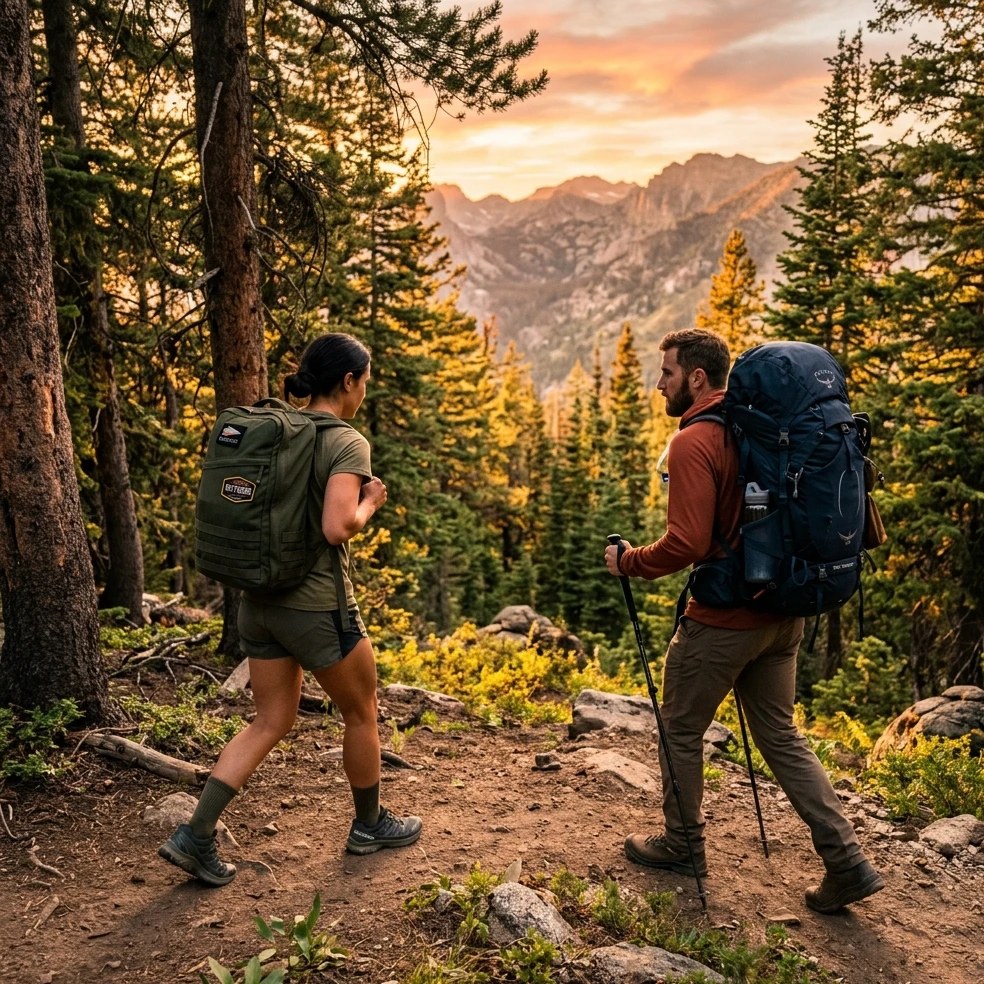
Effective pole technique requires the pole-plant to occur slightly behind the foot at heel-strike of the opposite leg (left pole with right foot, in the cross-body Nordic pattern), with the wrist actively pushing the pole backward through the support phase. The push-through is what generates the reaction force the arms harvest as exercise. Pole-dragging — carrying the poles passively without the active push-through — provides essentially none of the cardiovascular or knee-unloading benefit and adds upper-body weight without functional payoff.
For sand-walking specifically, the pole-plant should engage the substrate firmly enough to provide secondary support but not aggressively enough to bury the pole tip and waste the energy. Pole baskets (the small plastic discs near the pole tip) are essential on sand — they prevent the pole from sinking too deep and converting the pole-walking gait into a series of stuck-pole recoveries. Trekking poles with snow baskets or dedicated sand baskets work well; poles without baskets are frustrating on dry sand.
Pole length matters. The general rule is that pole length sized so the elbow forms a 90-degree angle when the pole is planted vertically gives the right leverage for level walking. For descent-heavy walking, longer poles (extended 5–10 cm) provide better support; for ascent-heavy or aggressive Nordic-walking technique, shorter poles work better. Adjustable trekking poles solve the variable-terrain problem; fixed-length Nordic-walking poles are cheaper and lighter but less versatile.
Populations who benefit most
Older adults with balance concerns are the cleanest beneficiary population. The two additional ground-contact points the poles provide convert a single-support gait (standard walking) into a multi-support gait (poles plus feet), reducing fall risk substantially. The Tschentscher 2013 review documents that older-adult Nordic walking programmes consistently improve balance scores in addition to cardiovascular markers Tschentscher 2013. For the older adult who would otherwise avoid sand walking due to perceived fall risk, pole use makes the modality accessible.
Patients with knee osteoarthritis are the second clean beneficiary population. The Schwameder 1999 25% knee-compression reduction during descent translates to fewer same-day OA flare events and longer sustainable walking sessions Schwameder 1999. For the OA patient walking on Wasaga’s gently sloping beach access points, pole use specifically targets the moments when knee load peaks — entering and leaving the beach, navigating dune access stairs, and walking down to the waterline.
Deconditioned cardiovascular-rehabilitation populations benefit from the elevated heart-rate response without elevated perceived exertion. Saunders 2008’s ‘harder physiologically without feeling harder’ finding is precisely what the cardiac-rehabilitation literature looks for — a way to deliver more cardiovascular stimulus per session without the perceived-effort barrier that limits adherence in this population Saunders 2008. For the post-cardiac-event patient cleared for moderate walking, pole-walking is the upgrade that matches what their physiology can handle to what their perception will tolerate.
Trained walkers and runners can use poles for cross-training and recovery sessions to add upper-body cardiovascular load without the joint-impact cost of running. The Tschentscher 2013 review notes that Nordic-walking programmes can produce VO2max gains comparable to running programmes in previously sedentary participants, with substantially lower injury rates Tschentscher 2013. For the trained walker plateau’d at standard-walking volume, pole use is a way to break through the cardiovascular ceiling without adding running-specific injury risk.
When poles do not help (and may hurt)
For technical trail running, narrow single-track hiking, and any activity requiring rapid hand-and-arm freedom, poles are an obstacle rather than a tool. The setup-and-stow time imposes a cognitive and logistical cost that exceeds the cardiovascular or joint-unloading benefit. For these contexts, the standard advice is to leave poles at home or carry collapsible poles as gear rather than active tools.
For populations with shoulder pathology — rotator-cuff tears, frozen shoulder, severe arthritis at the glenohumeral joint — the active arm-swing pattern can aggravate the shoulder. Pole technique should be modified to a gentler arm pattern (less posterior arm extension, lighter pole-plant), which reduces the cardiovascular benefit but preserves the level-walking joint-unloading benefit on the legs.
For very deconditioned beginners (older than 75, sedentary for 5+ years, no recent walking baseline), the coordination demand of pole-walking can exceed the participant’s capacity to learn the technique, producing a worse adherence outcome than simple walking would. The standard pattern for this cohort is 2–4 weeks of unsupported walking to establish a baseline, then introducing poles gradually with explicit technique coaching. Tschentscher 2013 notes that the largest gains from Nordic walking programmes come when participants have at least basic walking fitness before introducing the technique Tschentscher 2013.
Bottom line: when to use poles on the beach
The most defensible bottom line is that walking poles are high-leverage tools for the population intersection of older adults, OA patients, cardiac-rehabilitation graduates, and trained walkers seeking cardiovascular cross-training — and the high-leverage gets higher when the substrate is dry sand. The combined sand-and-poles modality produces impact reduction (substrate), upper-body cardiovascular load (poles), knee unloading (poles), and additional balance support (poles), all in a single session.
For Wasaga readers fitting any of the beneficiary categories, the practical recommendation is adjustable trekking poles with snow or sand baskets, sized to elbow-90-degree at vertical plant, used with active push-through technique on the dry-sand portions of beach walks. Sessions of 30–45 minutes 3–4 times per week are the dose at which the Tschentscher 2013-documented cardiovascular gains accumulate Tschentscher 2013.
The honest framing is that pole-walking is not a transformative intervention for fully able-bodied trained adults — the upper-body recruitment is real but modest, and the marginal gain over hard pole-less walking is small for this cohort. For the older, OA-affected, cardiac-rehab, or balance-concerned populations, the marginal gain is much larger because each component (impact reduction, upper-body load, knee unloading, balance support) addresses a specific limitation that constrains the participant’s walking capacity. Match the modality to the population, and the leverage is substantial.
Practical takeaways
- Walking poles redistribute 8–15% of locomotor work to the upper body. Aggressive Nordic-walking technique pushes this to 15–25%; trekking-pole technique is on the lower end.
- Knee compression drops ~25% during downhill walking with poles. Schwameder 1999 force-plate data; level-walking benefit is smaller (8–12%) but real.
- Heart rate rises 6–15 bpm without rise in perceived exertion. Saunders 2008 finding — cardiovascular dose increases without the effort barrier.
- Sand walking amplifies the pole-walking benefit. Substrate instability gets the largest comfort gain from the secondary pole support.
- Effective technique requires active push-through, not passive dragging. Pole-baskets are essential on sand. Sized to elbow-90-degree at vertical plant.
- Cleanest beneficiaries: older adults, OA patients, cardiac rehab, balance-concerned. The marginal benefit over standard walking is substantial for these populations specifically.
References
Schwameder 1999Schwameder H, Roithner R, Müller E, Niessen W, Raschner C. Knee joint forces during downhill walking with hiking poles. Journal of Sports Sciences. 1999;17(12):969-978. View source →Saunders 2008Saunders MJ, Hipp GR, Wenos DL, Deaton ML. Trekking poles increase physiological responses to hiking without increased perceived exertion. Journal of Strength and Conditioning Research. 2008;22(5):1468-1474. View source →Tschentscher 2013Tschentscher M, Niederseer D, Niebauer J. Health benefits of Nordic walking: a systematic review. American Journal of Preventive Medicine. 2013;44(1):76-84. View source →Hansen 2009Hansen EA, Smith G. Energy expenditure and comfort during Nordic walking with different pole lengths. Journal of Strength and Conditioning Research. 2009;23(4):1187-1194. View source →