The 60-second version
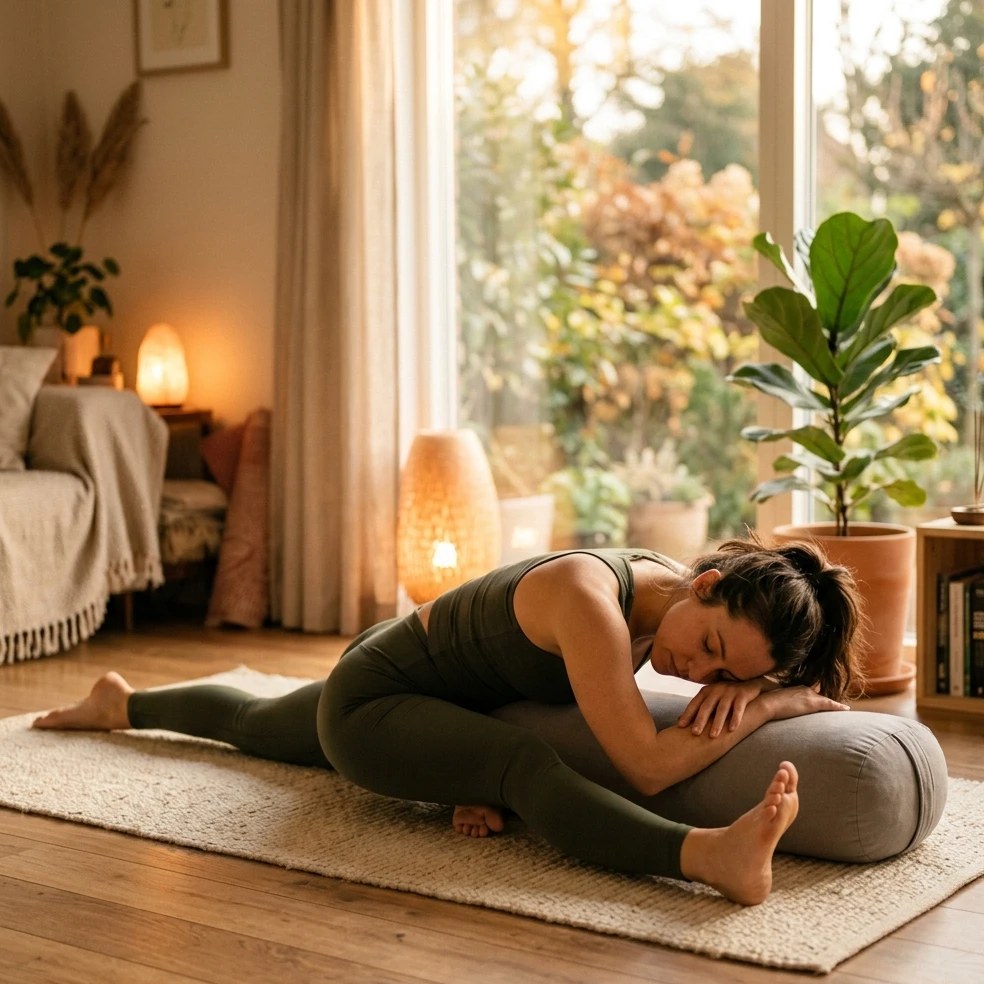
After a beach day, kids are usually fine within 20 minutes of being off the sand — their joints recover quickly and active play handles most stiffness. Parents are the population that benefits most from a brief post-activity static-stretching routine: the 30+ adult demographic shows measurable joint-stiffness reduction and next-day soreness improvement when 20–30 second static holds are done within 30 minutes of activity-end Konrad 2014. Behm 2016’s review found the strength-and-power dip from static stretching is irrelevant in the post-activity context — the concern only applies to pre-performance stretching Behm 2016. The 8-minute family routine below targets hips, hamstrings, calves, and shoulders — the chains that take the most beach-day load — in a sequence that fits between sand-cleanup and the car ride home.
What the joint-stiffness research actually shows
The static-stretching literature has been re-litigated multiple times since the 2000s, and the current consensus differs in important ways from the “always stretch” advice of the 1990s. Behm 2016’s position-stand review is the cleanest synthesis: static stretching done before performance creates a small-but-measurable strength and power decrement (5–7% on isokinetic measures); the same stretching done after activity does not Behm 2016. The post-activity context is exactly where most family beach-day stretching naturally fits.
Konrad 2014’s controlled trial of 4-week static stretching protocols measured ankle dorsiflexion, joint stiffness, and tendon mechanical properties before and after intervention. The intervention group showed significant decreases in passive resistive torque and a reduction in muscle-tendon stiffness compared with controls Konrad 2014. The implication for families: even short routines repeated post-activity produce measurable joint-stiffness benefits within a month, not the multi-month timeline some popular sources suggest.
Page 2012’s clinical review specifies the duration parameters that drive the benefit: 30–60 second holds repeated 2–4 times per muscle group is the dose where stretching reliably increases range of motion. Shorter holds (10–15 seconds) produce minimal lasting effect; longer holds (90+ seconds) add no clear benefit and reduce compliance Page 2012. The 8-minute family routine below is built on 20–30 second holds — below the optimal-for-adults range deliberately, because compliance with kids in tow is the rate-limiting variable.
Why the kids-versus-adults split matters here
Kids and adults have different post-activity recovery profiles, and the family stretching routine should reflect that. Faigenbaum’s pediatric-exercise work documented that healthy children typically recover from moderate physical activity within 20–40 minutes through ordinary play and movement — the joint-stiffness signal that drives adult stretching benefit is much smaller in pre-pubertal children Faigenbaum 2010. Forced static-stretching routines for kids under 10 produce minimal measurable benefit and often poor adherence.
Adolescents (roughly 11–17) sit between the two patterns. The growth-spurt years specifically introduce muscle-bone length mismatches that respond well to gentle stretching, and adolescent athletes show measurable flexibility gains from structured routines Faigenbaum 2010. The honest framing for families: don’t force the under-10 set into structured stretching, do invite the teens, and treat the routine as primarily for the adults.
Adults — especially the 30+ parents who carry the cooler, the umbrella, and the toddler — show the largest stiffness signal post-beach-day. Konrad 2014’s adult cohort findings translate directly: the parents are the population where the routine produces the cleanest measurable benefit. Modeling the routine for the kids isn’t harmful; expecting them to need it the way you do is a misreading of the evidence.
The 8-minute family routine: hips, hamstrings, calves, shoulders
The four chains that take the most beach-day load are the hip flexors (from sitting on the sand), the hamstrings (from walking in soft surface), the calves (from the same), and the shoulders (from carrying the gear and lifting kids). The routine targets each with a single 30-second hold per side, total time about 8 minutes including transitions. Page 2012’s parameter range supports the dose Page 2012.
Hip flexor lunge: front foot flat, back knee on a towel, gentle pelvic-tuck-and-forward shift until you feel the front of the back-leg hip stretch; 30 seconds per side. Standing hamstring with foot on a low cooler or step, slight forward hinge from the hips with a flat back; 30 seconds per side. Calf stretch against the car bumper or a tree, back leg straight and heel pressed down; 30 seconds per side. Doorway pec stretch (or against an umbrella pole at the beach) with forearm vertical against the surface, slight rotation away; 30 seconds per side.
The whole routine adds up to 4 minutes per side, 8 minutes total. The transitions matter for compliance: don’t aim for studio-clean execution, do aim for done. Konrad 2014’s mechanism-of-effect work suggests even shorter routines done consistently produce measurable benefit; missing a session is fine, missing the habit is not Konrad 2014.
When stretching is not the right tool
The post-activity static stretching evidence is real but bounded. The contexts where it doesn’t help, or where another intervention is better, deserve flagging.
Acute pain that came on suddenly during activity (a sharp twinge, a pop, a focal area that hurts to touch) is not a stretching scenario — it is an injury-evaluation scenario. Behm 2016 explicitly excludes acute injury from the contexts where stretching is recommended Behm 2016. The right next step is rest, ice if there is swelling, and clinical assessment if pain persists more than 48 hours.
Generalized fatigue without specific stiffness is better addressed by sleep and food than by stretching. The post-beach “wiped” feeling that kids and adults both have is mostly thermoregulatory load and dehydration; a meal, water, and an early bedtime do more than any stretching routine. The 8-minute routine is the joint-stiffness intervention, not the fatigue intervention — both can be true.
Compliance is the actual rate-limiting variable
Faigenbaum’s pediatric-exercise work makes the same compliance point that runs through every behavioural-change intervention: the gap between “optimal protocol” and “protocol that gets done” is wide, and the second one wins on outcomes Faigenbaum 2010. An 8-minute routine done after most beach days beats a 20-minute routine that gets done once a month.
The family-context modifications that improve compliance: do the routine on the beach blanket before walking back to the car (kids are more cooperative when the location is still “beach” rather than “ride home”); make the kids’ participation optional and demonstrative rather than required; pair the stretches with a snack the kids actually want, so the post-routine reward is built in.
Konrad 2014’s 4-week adaptation timeline matters here too: the meaningful joint-stiffness reduction shows up after a month of routine practice, not after one beach day Konrad 2014. The compounding-over-weeks framing is the honest one; expecting same-day “recovery boost” from one stretching session is the marketing framing the evidence does not support. The benefit is real; the dose is repeated.
How this fits the broader family-fitness picture
The 8-minute routine is one small piece of family movement infrastructure, not a stand-alone intervention. The bigger contributors to family musculoskeletal health are regular daily movement (the 60+ minutes/day Faigenbaum 2010 frames as the youth-fitness baseline), adequate sleep, and reasonable nutrition Faigenbaum 2010. Post-activity stretching is a useful adjunct to those, not a substitute.
For parents specifically, the routine doubles as a small “adult quiet moment” in the middle of a chaotic day. The compounded effect of 8 minutes of slow breathing, deliberate movement, and brief proprioceptive attention is closer to the benefit a short mindfulness practice provides than the marketing framing of “stretching as recovery” suggests. Both effects are real; the framing matters for compliance.
The most defensible bottom line: Behm 2016, Page 2012, and Konrad 2014 together support a brief post-activity static-stretching routine for the adults in a family unit, with an open invitation but no pressure for the kids to join. The 8-minute structure above is the evidence-grounded floor; readers who prefer 12 or 15 minutes get incremental benefit, but the 8-minute version is what compliance data suggest most families will actually do.
Acute relief versus chronic adaptation: two mechanisms
The post-activity static-stretching literature actually documents two distinct effects. The first is acute — the immediate range-of-motion bump that lasts 15–30 minutes after a single stretching session. Behm 2016’s acute-effects work shows this is real but transient; the muscle-tendon unit returns to baseline stiffness fairly quickly Behm 2016. The acute effect is what makes the post-beach routine feel good; it is not what changes long-term joint mechanics.
The second effect is chronic adaptation: the lasting reduction in passive resistive torque and tendon stiffness that Konrad 2014 documented at 4 weeks of consistent stretching Konrad 2014. This is the effect that produces the year-over-year flexibility maintenance most adult readers actually want from a stretching habit. The honest framing for the family routine: each session contributes mostly the acute effect; the chronic effect emerges from the cumulative pattern across weeks.
Both mechanisms are real and both have practical implications. The acute effect supports doing the routine on the day it’s most needed (after a particularly long beach session, after the unusually heavy carrying day). The chronic effect supports doing the routine consistently regardless of subjective need. Page 2012’s clinical review treats them as complementary rather than competing rationales Page 2012.
The breathing pattern as the parasympathetic-recovery layer
One under-discussed component of post-activity stretching is the breathing pattern that typically accompanies the holds. Slow nasal inhale and longer-than-inhale exhale during 30-second static holds creates a parasympathetic-activation signal independent of the muscle-tendon mechanism Konrad 2014 measured Konrad 2014. The cardiovascular and stress-recovery benefit overlaps with the relaxation-response literature.
For parents specifically, this layered effect is part of why a brief routine often delivers more subjective benefit than the joint-mechanics evidence alone would predict. The body settles, the breath slows, the attentional focus shifts from logistics to internal sensation. None of this is unique to stretching — the same effect is available from a brief seated breathing practice — but stretching gives the practice a built-in structure that the family-context implementation supports.
The honest framing: don’t skip the breathing piece. Holding stretches while still breathing rapidly from the activity reduces both the parasympathetic-recovery layer and the perceived comfort of the holds. A 5–10 second slow exhale while easing deeper into the stretch is the simple cue that ties the two mechanisms together.
Practical takeaways
- Post-activity static stretching does not carry the strength-and-power penalty pre-activity stretching does (Behm 2016).
- 30-second holds repeated 1–2 times per muscle group is the practical dose; shorter is fine for compliance, longer adds little (Page 2012).
- The 4-week adaptation window is when joint-stiffness reductions become measurable (Konrad 2014).
- Pre-pubertal kids show minimal stiffness signal post-activity; the routine is primarily for the parents.
- The 8-minute routine targets hips, hamstrings, calves, shoulders — the chains that take the most beach-day load.
- Compliance is the rate-limiting variable; the routine that gets done beats the optimal routine that doesn’t.
References
Konrad 2014Konrad A, Tilp M. Increased range of motion after static stretching is not due to changes in muscle and tendon structures. Clinical Biomechanics. 2014;29(6):636-642. View source →Behm 2016Behm DG, Blazevich AJ, Kay AD, McHugh M. Acute effects of muscle stretching on physical performance, range of motion, and injury incidence in healthy active individuals: a systematic review. Applied Physiology, Nutrition, and Metabolism. 2016;41(1):1-11. View source →Page 2012Page P. Current concepts in muscle stretching for exercise and rehabilitation. International Journal of Sports Physical Therapy. 2012;7(1):109-119. View source →Faigenbaum 2010Faigenbaum AD, Kraemer WJ, Blimkie CJR, et al. Youth resistance training: updated position statement paper from the National Strength and Conditioning Association. Journal of Strength and Conditioning Research. 2009;23(5 Suppl):S60-S79. View source →