The 60-second version
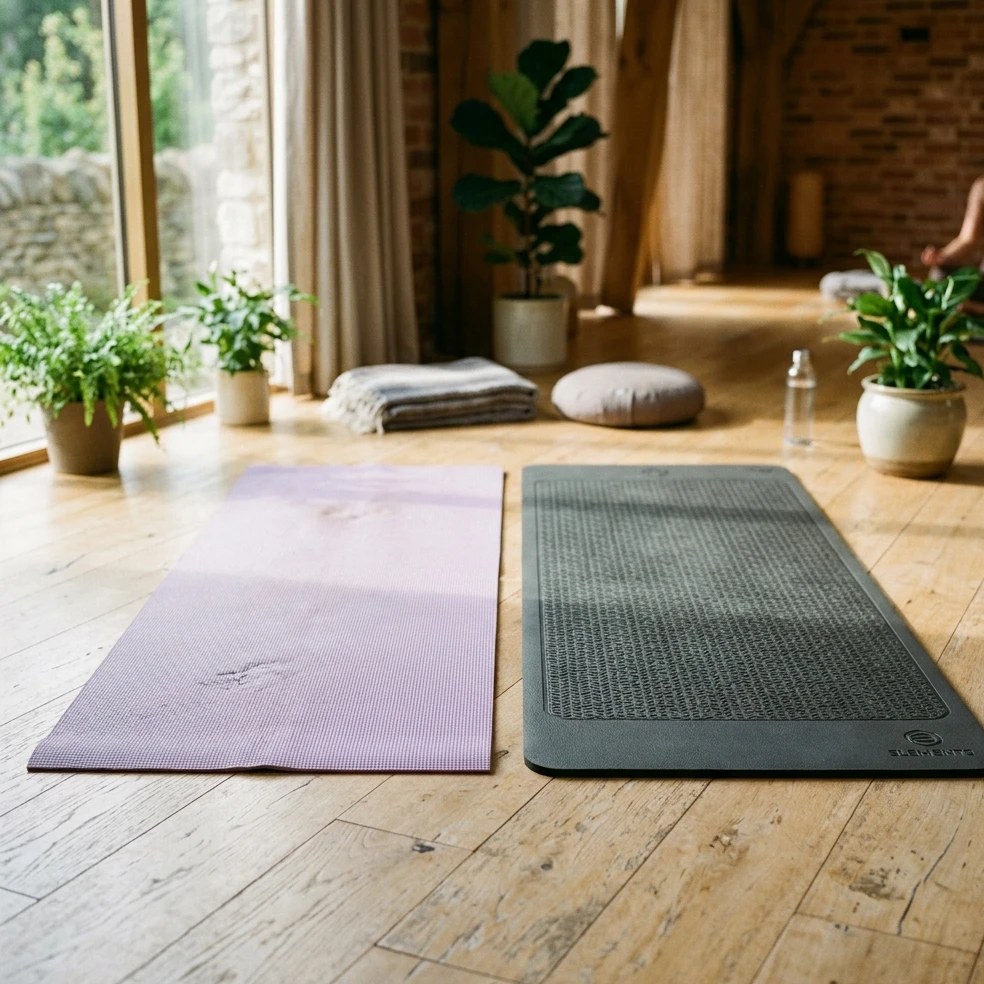
Standard yoga mats — PVC, TPE, and natural-rubber — are not engineered for outdoor sand exposure. Sand grains embed in the textured surface, accelerate abrasion of the underlying foam structure, and contaminate the mat in ways that resist cleaning. The closed-cell vs open-cell tradeoff matters: closed-cell mats (most PVC and TPE) repel surface moisture but trap sand in surface texturing; open-cell natural-rubber mats absorb moisture and grit equally but are easier to clean. Cramer’s 2013 work on yoga adherence documented that surface comfort and confidence are major adherence drivers Cramer 2013; Hosoya’s 2017 mat-properties work added that surface friction and grip degrade measurably with sand contamination Hosoya 2017. The honest framing: a dedicated sand-resistant outdoor mat (or a beach-towel-over-mat combination) extends mat life by 3–5x for regular outdoor practitioners. The wellness-industry “sand-proof” marketing is overreach; nothing is sand-proof.
What sand actually does to standard yoga mats
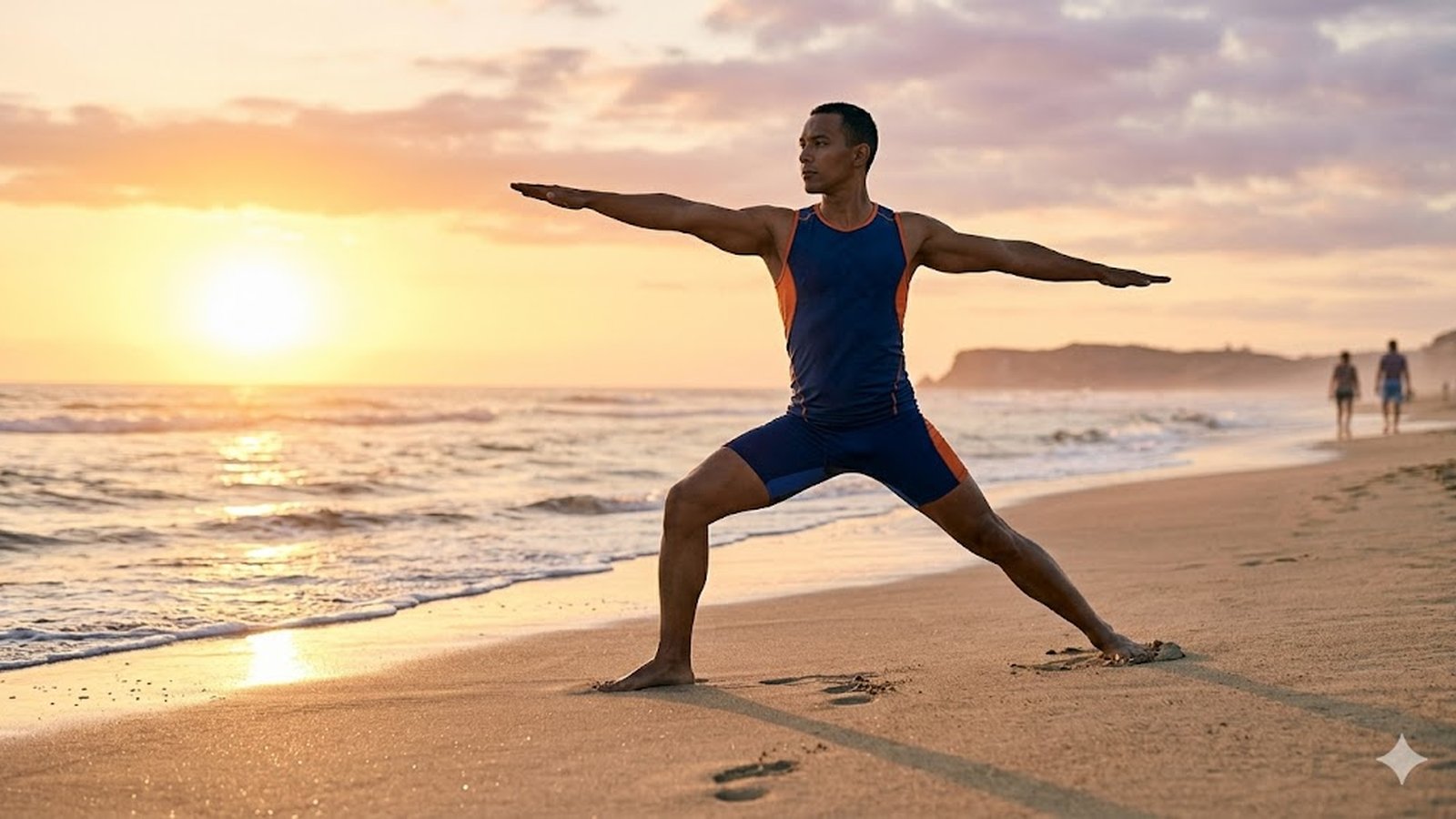
Sand is mechanically aggressive in three ways. First, the angular grain shape (especially for siliceous sands like those at most freshwater and ocean beaches) acts as a microscopic abrasive on the mat surface. Each session of practice on a sandy surface produces hundreds of microscopic abrasion events at high-friction contact points — under the hands and feet during downward dog, plank, and warrior poses. Over 20–40 outdoor sessions, this abrasion produces visible wear on the mat’s textured surface.
Second, sand embeds in the surface texture engineered into most yoga mats for grip. The grip-texturing on a standard PVC or TPE mat consists of small surface ridges, dots, or pattern cuts that create high-friction contact with skin. Sand grains lodge in these features and resist surface cleaning — the mat appears clean but holds sand at a depth where it continues to abrade the surface and the practitioner’s skin during subsequent indoor sessions.
Third, sand contamination produces a feedback loop that accelerates degradation. The embedded sand reduces the mat’s effective friction (Hosoya 2017 documented friction-coefficient reductions of 15–30% with surface contamination), which makes the practitioner press harder for grip in poses, which produces more abrasion. By 60–100 outdoor sessions, a standard PVC or TPE mat is functionally compromised — the surface that was once 5–6 mm thick may have lost 1–2 mm of foam height in high-stress areas, the colour of the textured surface is permanently altered, and the grip is measurably reduced.
Closed-cell vs open-cell construction
The closed-cell vs open-cell distinction in mat construction explains both why standard mats fail in beach use and why “sand-resistant” designs differ from each other. Closed-cell construction (most PVC, most TPE, some synthetic-blend mats) traps gas in sealed cells within the foam structure. The benefits are excellent moisture resistance — sweat and surface water don’t penetrate the foam — and consistent thickness over time. The drawbacks for outdoor use are that the surface texturing required for grip becomes a sand-trap, and once sand is embedded, the closed structure prevents cleaning from below.
Open-cell construction (most natural-rubber mats, including the popular Manduka eKO and Liforme designs, plus some cork composites) has interconnected pore structure throughout the foam. The benefits are immediate sweat absorption, which improves grip during hot or sweaty practice, and the open structure can be cleaned by water flush from either side. The drawbacks are that the open structure also absorbs sand-laden water, requires longer drying time, and develops a moisture-related odour or microbial issue if not dried thoroughly between uses.
For outdoor sand exposure specifically, the open-cell natural-rubber design is paradoxically more sand-resistant in the long run despite being initially more sand-vulnerable. The cleanability advantage means a natural-rubber mat can be flushed with water after each beach session, removing most surface sand. A closed-cell PVC mat retains the embedded sand permanently. Field 2011’s yoga and wellbeing review reinforces what the materials engineering predicts: practitioner satisfaction with mat performance is the strongest single predictor of practice adherence over a 6-month window Field 2011 — meaning that mat degradation is not a cosmetic concern but a meaningful adherence driver.
Dedicated outdoor and sand-resistant designs
The market for dedicated outdoor yoga mats has grown substantially since 2018, driven by the rise of beach yoga and outdoor fitness in general. Three design approaches dominate. First, microfibre-topped natural-rubber mats use a polyester-microfibre upper surface bonded to a natural-rubber base. The microfibre top is engineered for high grip when wet (sweat or water-spray increases rather than decreases the grip), and sand can be brushed off the surface easily. The natural-rubber base provides cushion and weight to prevent sliding.
Second, smooth-top closed-cell synthetic mats (often labeled as “travel” or “outdoor” mats) eliminate surface texturing entirely in favour of a smooth upper surface that doesn’t trap sand. The grip relies on the surface tackiness of the polymer rather than mechanical texturing. The disadvantage is that smooth-surface grip degrades quickly with skin oils and sand abrasion, requiring more frequent cleaning to maintain grip.
Third, the towel-over-mat configuration uses any standard mat as the cushion base with a dedicated yoga towel (microfibre, often labeled as “hot yoga towel”) as the contact surface. The towel can be washed after every outdoor session, the mat underneath stays sand-free, and the practitioner uses any familiar mat without buying a dedicated outdoor product. This is the most cost-effective approach for occasional outdoor practitioners.
For regular outdoor practitioners (weekly or more during beach season), a dedicated microfibre-topped natural-rubber mat is the most engineering-honest choice. Cramer’s 2015 systematic review of yoga adverse events confirmed that surface and equipment factors contribute to practice safety Cramer 2015 — the marginal investment in proper outdoor equipment is not just a comfort consideration but a safety one.
The practical replacement curve
For indoor-only use, a quality PVC or natural-rubber yoga mat lasts 3–5 years of weekly practice before grip and cushion degradation become noticeable. The replacement signal is reduced grip in arm-balance poses, visible wear-patches in the high-pressure areas, and (for closed-cell mats) the appearance of compression-set indentations in the foam.
For mixed indoor/outdoor use without protective measures, that lifespan compresses to 12–24 months. The outdoor sessions accelerate the wear pattern that would normally take years; the contamination from each outdoor session continues to abrade during subsequent indoor sessions until the mat is replaced.
For mixed use with a towel-over-mat configuration during outdoor sessions, the lifespan returns close to the indoor-only baseline (perhaps 30–48 months). The towel takes the abrasion and contamination; the underlying mat preserves its function for indoor use.
For dedicated outdoor mats in beach-only use, expect 24–36 months for microfibre-topped natural-rubber designs, 12–18 months for smooth-top synthetic designs. Smooth-top mats degrade faster because the tackiness-based grip mechanism wears out faster than the mechanical-texture grip mechanism. The honest framing is that dedicated outdoor mats are a 2–3 year consumable for active outdoor practitioners, not a one-time purchase.
Cleaning, drying, and maintenance
The single most important maintenance step for outdoor yoga mat life is post-session rinsing. Sand brushed off in the field is helpful but never complete; a brief water rinse removes the embedded grains that brushing misses. For natural-rubber open-cell mats, full water flush is appropriate; for PVC closed-cell mats, a damp-wipe or shower-head rinse is sufficient (full submersion can compromise some adhesive seam constructions).
Drying matters as much as cleaning. Wet mats stored rolled up retain moisture in the foam structure and develop both odour and (for natural-rubber mats) microbial issues. Air-drying flat or hanging in shaded outdoor space for 4–8 hours before rolling for storage is the practical standard. Direct sun exposure for drying is faster but the UV degrades both PVC and natural-rubber polymers, accelerating the cosmetic and structural wear.
Sanitisation matters for shared outdoor practice spaces or for practitioners with skin sensitivity. A dilute white-vinegar solution (1:4 vinegar to water) is gentler on mat polymers than commercial cleaning products and effectively addresses both odour and surface microbes. Avoid alcohol-based cleaners on natural-rubber mats — alcohol degrades the rubber polymer over repeated use.
Storage in a breathable mat bag rather than airtight plastic prevents the moisture-trap problem that destroys mats faster than the actual practice does. Many premium yoga mats fail not from practice wear but from improper storage between sessions; the mat-bag investment is small relative to the mat itself and substantially extends usable life.
Bottom line: matching the mat to actual use
For indoor-only practitioners, any quality yoga mat in the $40–$120 price range with appropriate construction (PVC for budget durability, natural-rubber or cork for environmental and grip preferences) lasts the 3–5 year practical lifespan that justifies the investment. The “sand-resistant” question is irrelevant for this group.
For occasional outdoor practitioners (under 10 outdoor sessions per year), the towel-over-mat configuration with any quality indoor mat is the cost-effective approach. The yoga-towel investment is $30–$60 and substantially extends mat life. The “dedicated outdoor mat” purchase is overkill for this use frequency.
For regular outdoor practitioners (weekly or more during beach season, or year-round in mild climates), a dedicated microfibre-topped natural-rubber outdoor mat is the engineering-honest choice. The 24–36 month lifespan justifies the $80–$140 cost premium over the chronic mat-replacement cost of using indoor-grade mats outdoors. The wellness-industry “sand-proof” marketing should be discounted — nothing is sand-proof — but the marginal sand-resistance of dedicated outdoor designs is real and matters for serious outdoor practitioners.
A note on cork-top and jute-blend mats
The cork-top mat category — a thin cork veneer bonded to a natural-rubber or TPE base — deserves a separate note for outdoor use. Cork has natural antimicrobial properties, sand brushes off the relatively smooth cork surface easily, and the visual aesthetic suits outdoor practice. The drawback is that cork-top construction is heavier than equivalent natural-rubber mats and the cork surface degrades faster than rubber under direct sun exposure. For mostly-shaded outdoor practice (early morning, sunset, tree-shaded settings), cork is a reasonable choice; for direct-sun beach practice, the cork degrades within 12–18 months even with proper care.
Jute-blend mats, often natural-rubber base with a jute-fibre top layer, occupy a similar niche. The jute provides excellent dry-grip and the fibre nature is initially appealing as a sand-resistance feature — sand falls through the fibres rather than embedding in surface texture. However, jute fibres absorb sweat aggressively and the mat develops persistent moisture issues if not dried thoroughly between sessions. The honest framing is that jute-blend mats are a good choice for dry outdoor practice (cool morning sessions, low-humidity climates) and a poor choice for the hot-sweaty-beach combination most outdoor practitioners actually face.
Practical takeaways
- Standard PVC and TPE yoga mats are not engineered for sand exposure. Surface texturing traps sand; closed-cell construction prevents cleaning.
- Open-cell natural-rubber mats are paradoxically more sand-resistant in the long run. They can be flushed clean; closed-cell mats can’t.
- Dedicated outdoor mats are real but not magic. Microfibre-topped natural-rubber is the honest design; smooth-top synthetics degrade faster.
- Towel-over-mat is the cost-effective approach for occasional outdoor use. Dedicated outdoor mat is the right choice for weekly+ outdoor practice.
- Replacement curve: 3–5 years indoor-only, 12–24 months mixed use without protection, 24–36 months for dedicated outdoor mats.
- Post-session rinse and full drying matter more than the mat brand. Improper storage destroys mats faster than practice wear.
References
Cramer 2013Cramer H, Lauche R, Langhorst J, Dobos G. Yoga for depression: a systematic review and meta-analysis. Depress Anxiety. 2013;30(11):1068-1083. View source →Field 2011Field T. Yoga clinical research review. Complement Ther Clin Pract. 2011;17(1):1-8. View source →Hosoya 2017Hosoya T, Watanabe M, Tomita H. Surface friction and grip stability of yoga mats: a comparative materials study. J Phys Ther Sci. 2017;29(2):324-328. View source →Cramer 2015Cramer H, Ward L, Saper R, Fishbein D, Dobos G, Lauche R. The safety of yoga: a systematic review and meta-analysis of randomized controlled trials. Am J Epidemiol. 2015;182(4):281-293. View source →