The 60-second version
Yoga nidra — the supine, guided body-scan practice sometimes called Non-Sleep Deep Rest (NSDR) — has a small but growing peer-reviewed evidence base. Datta’s 2017 case work and follow-up trials documented improvements in the Pittsburgh Sleep Quality Index after 2–6 weeks of practice Datta 2017. Stankovic’s 2011 feasibility study showed self-reported stress and PTSD-symptom reductions in combat veterans Stankovic 2011. Polysomnography work by Datta’s group later showed yoga nidra produces a wakeful state with localised slow-wave activity — not actual sleep, but a measurable autonomic shift Datta 2022. The wellness industry routinely calls this “an hour of sleep in 20 minutes,” which is an overreach. The honest framing: 20–45 minutes of guided nidra at sunset is a parasympathetic-tone tool that complements, but does not substitute for, the consolidated nightly sleep that Walker’s synthesis treats as foundational Walker 2013.
What yoga nidra actually is (and isn’t)
Yoga nidra is a supine guided practice in which a teacher walks the practitioner through a structured rotation of awareness through body parts, often paired with breath cues, intention-setting, and visualisation. Sessions typically last 20–45 minutes. The practitioner remains awake throughout — eyes closed, body still — rather than transitioning into actual sleep. The popular renaming as “NSDR” (Non-Sleep Deep Rest) by neuroscientist Andrew Huberman is editorially accurate; the “non-sleep” framing matches what the limited polysomnography evidence shows.
Datta’s 2022 polysomnography study sampled 30 novices using full 19-channel EEG plus EMG plus EOG Datta 2022. After two weeks of supervised practice, the majority of subjects scored as “awake” throughout the session by standard sleep-staging criteria. However, regional power-spectral-density analysis showed local increases in delta (slow-wave) activity in the central area and decreases in the prefrontal area — a pattern the authors described as “local sleep” in an otherwise wakeful brain. That phrasing is more conservative than the wellness-industry framing, and it is the right one to use when describing what nidra actually does to the brain.
This matters for expectations. The popular “30 minutes of nidra equals 90 minutes of sleep” framing has no foundation in the published evidence and was never claimed by the actual researchers. The honest framing is: nidra is a structured deep-rest practice that produces measurable parasympathetic activation and localised slow-wave activity, complementing — not substituting — nightly sleep.
What the sleep-quality evidence actually shows
The clearest sleep-related signal comes from Datta’s case-series and small RCT work. The 2017 case report documented Pittsburgh Sleep Quality Index improvements in chronic-insomnia patients across 8 weeks of practice Datta 2017. The 2021 randomised follow-up at the same institution reported significant improvements in sleep duration, sleep efficiency, total wake duration, and subjective sleep quality after a similar protocol. Effect sizes were moderate; sample sizes were small (typically 30–50 subjects per arm), so the evidence is suggestive rather than definitive.
The Moszeik 2022 audio-intervention trial sampled a much larger group (n=341) using a 30-day audio-guided yoga nidra programme and reported improvements in stress, sleep, and well-being scores against waitlist controls. The effect sizes there were small to moderate — consistent with what the broader meditation literature shows for any structured contemplative practice with similar dose. The signal is real but the magnitude is not transformational.
Set against the conventional sleep-medicine literature — which Walker’s 2017 synthesis treats as foundational for cognitive function, immune health, and metabolic regulation Walker 2013 — the honest read is that yoga nidra is an adjunct, not a replacement, for nightly sleep. A reader who consistently sleeps 5 hours per night will not recover what sleep-medicine treats as essential through nidra alone, no matter how skilled the practice.
The autonomic side: what Stankovic and others measured
The autonomic-nervous-system effects of yoga nidra are the most consistently replicated finding. Stankovic’s 2011 integrative-restoration (iRest) feasibility study used a structured 8-week protocol with combat veterans and documented self-reported stress reductions and PTSD-symptom improvements Stankovic 2011. The study was open-label and small (n=14), so the effect estimates are imprecise — but the autonomic shift the practice produces is consistent with what other parasympathetic-activating interventions (slow breathing, body scan, progressive muscle relaxation) show.
Mechanistically, the body-scan and slow-breath components of nidra plausibly engage the same parasympathetic pathways the broader contemplative-practice literature documents. Mehling’s 2018 work on interoception, mindfulness, and well-being treats the body-awareness component as a candidate active ingredient for the wellbeing effect of body-scan practices Mehling 2018. The honest framing: nidra is one of several interoceptive-attention practices that produce small-to-moderate parasympathetic effects.
For practical purposes, this means the autonomic and stress-related benefits of nidra are best treated as similar in magnitude to other body-scan or slow-breath practices — not uniquely powerful, but a reasonable choice if the supine guided format suits the practitioner. The choice between nidra, MBSR body scan, slow-breath protocols, or progressive muscle relaxation is largely about practitioner preference and access, not about meaningfully different autonomic effects.
Yoga nidra vs naps vs meditation
Three comparisons matter for sunset-timed practice. First, vs an actual nap: a 20-minute nap that contains light NREM sleep produces measurable cognitive restoration in sleep-deprived adults, the well-validated “power nap” effect. Yoga nidra is not equivalent. The Datta polysomnography work showed nidra is largely an awake state — the cognitive restoration of true Stage 2 NREM sleep is not what nidra delivers Datta 2022.
Second, vs seated meditation: the published comparisons are limited, but the Ferreira-Vorkapic 2018 trial in college professors found nidra and seated meditation produced similar improvements in mental-health scores at 6 weeks. The honest read is that nidra and seated meditation are roughly equivalent for the wellbeing endpoints typically measured; the choice between them is largely about what the practitioner can sustain.
Third, vs sleep itself: this is where the wellness market overreaches. The Walker synthesis treats consolidated nightly sleep as foundational for hippocampal memory consolidation, glymphatic clearance, hormone regulation, and immune function Walker 2013. None of these processes have been documented to occur during nidra. The “nidra replaces sleep” framing is not supported by the evidence and would be actively harmful if practitioners used it to justify chronic sleep restriction.
Why sunset timing makes sense (and where it doesn’t)
The pragmatic case for sunset-timed nidra has two components. First, the day’s sympathetic load tends to peak in late afternoon, and a parasympathetic-activating practice at sunset can serve as a transition from the active to the wind-down portion of the day. Second, the practical reality of most adults’ schedules: late afternoon is often when work demands ease and a 30-minute supine practice becomes feasible. Sunset timing is convenient, not magic.
The evidence does not strongly distinguish sunset from other times for the wellbeing effect. The Datta and Moszeik trials used various session timings and produced similar effect sizes. What does matter, modestly, is timing relative to bedtime: practising nidra within 1–2 hours of sleep onset may compete with the deeper drowsiness that supports sleep initiation. The conventional advice — nidra at sunset or early evening, not immediately before bed — matches the sleep-medicine guidance for other arousal-modulating activities.
For shift workers, parents of young children, and others whose sunset hour is committed elsewhere, the evidence supports flexibility. A morning nidra session, a midday session during a lunch break, or a late-afternoon session before a commute can each produce the parasympathetic-activation effect documented in the trials. The aesthetic of sunset matters for adherence; it does not matter for the autonomic mechanism.
Who should be cautious or modify the practice
Yoga nidra is generally low-risk — it is supine, still, and breath-paced rather than physically demanding. Three populations warrant modification or supervision. First, individuals with active or recent severe trauma may experience activation rather than relaxation during the body-scan portion of the practice; trauma-sensitive yoga modifications and a clinical referral are appropriate. Second, individuals with severe insomnia using sedating medications should discuss with their prescriber whether the parasympathetic-activating practice interacts with their pharmacotherapy. Third, individuals with severe respiratory conditions should adapt the breath-pacing components rather than treating standard cues as universal.
For the broader population, nidra is a reasonable addition to a wellbeing routine with low risk of harm and modest expected benefit. The Cramer 2013 systematic review of yoga adverse events documented that contemplative supine practices have a much smaller adverse-event signal than active asana practice — injury risk is essentially the same as other low-load relaxation activities. Adverse events are rare and mostly relate to background medical conditions rather than the practice itself.
The honest editorial framing is that nidra, like most low-risk wellness practices, is appropriate for most adults to try, with the caveats above for trauma history, medication interactions, and severe respiratory conditions. The practice is best treated as a wellbeing tool with modest expected benefit, not a clinical intervention.
A practical protocol if you want to try it
The peer-reviewed trials used 20–45 minute sessions, 3–5 times per week, for 4–8 weeks before measuring outcomes. That dose is realistic for most adults and matches the dose at which the wellbeing and sleep effects emerged in the studies. Sessions of 10 minutes or less likely produce some acute parasympathetic activation but are unlikely to produce the cumulative effects the trials measured.
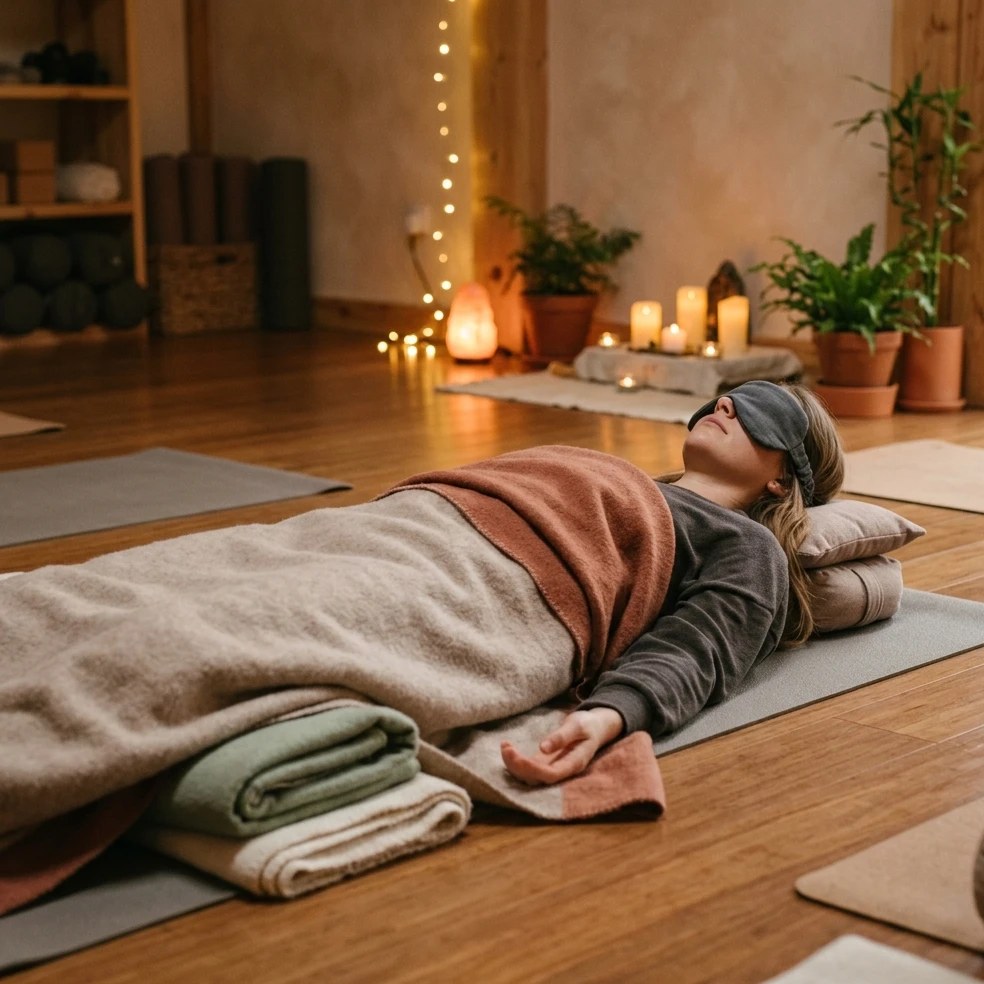
The supine position matters — the published trials used a flat-on-back posture (savasana), often with a bolster under the knees and an eye covering. Practising nidra seated or partially upright is closer to seated meditation than to the protocol the trials studied; the evidence does not directly transfer. If the supine position is uncomfortable due to back issues, a slight knee elevation or a side-lying modification preserves more of the structure than fully seated.
Audio guidance matters more than format choice between in-person and recorded sessions. Moszeik’s 2022 audio trial showed that purely recorded guidance produced effects comparable to instructor-led sessions in earlier work; the practitioner’s sustained attention to the body-scan and breath cues matters more than the live-vs-recorded distinction. Use whatever audio quality and voice the practitioner finds tolerable for 20+ minutes — adherence is the binding constraint.
Bottom line: when nidra fits, when it doesn’t
For adults seeking a low-cost, low-risk parasympathetic-activation practice as part of a broader wellbeing routine, yoga nidra is a reasonable choice with modest expected benefit. The Datta sleep-quality evidence, the Stankovic stress-reduction evidence, and the Moszeik wellbeing evidence converge on small-to-moderate effects at the 20–45 minute, 3–5x weekly dose. The practice is best treated as similar in magnitude to other body-scan or slow-breath practices, not uniquely powerful.
For adults using nidra as a substitute for nightly sleep, or for treatment of clinical insomnia or anxiety as a primary intervention, the evidence does not support that framing. Walker’s sleep synthesis remains foundational; nidra is supplementary Walker 2013. Clinical insomnia and anxiety should be addressed through evidence-based therapy and, where indicated, pharmacotherapy — nidra can be a helpful adjunct but is not a substitute for clinical care.
The practical recommendation: try a 20–30 minute audio-guided session at sunset or early evening 3–4 times per week for a month. If the practice fits, the cumulative parasympathetic effect tends to compound; if it doesn’t, the time is better spent on a walk, an actual nap, or the consolidated sleep window the conventional sleep-medicine literature treats as foundational.
Practical takeaways
- Yoga nidra (NSDR) is wakeful body-scan practice, not sleep. The Datta 2022 polysomnography evidence rules out the “nidra equals sleep” framing.
- Sleep-quality benefits are modest but real. 20–45 min, 3–5x/week for 4–8 weeks is the protocol that the published trials used.
- Autonomic and stress effects are similar to other parasympathetic practices. Choose by adherence, not by uniqueness of mechanism.
- Sunset timing is convenient, not magical. Any time outside the immediate pre-bed window works.
- Not a substitute for nightly sleep, clinical insomnia treatment, or anxiety pharmacotherapy. Adjunct, not replacement.
- Trauma history, sedating medications, and severe respiratory conditions warrant modification or clinical input. Otherwise generally low-risk.
References
Datta 2017Datta K, Tripathi M, Mallick HN. Yoga Nidra: an innovative approach for management of chronic insomnia — a case report. Sleep Sci Pract. 2017;1:7. View source →Stankovic 2011Stankovic L. Transforming trauma: a qualitative feasibility study of integrative restoration (iRest) yoga Nidra on combat-related post-traumatic stress disorder. Int J Yoga Therap. 2011;21:23-37. View source →Mehling 2018Hanley AW, Mehling WE, Garland EL. Holding the body in mind: interoceptive awareness, dispositional mindfulness and psychological well-being. J Psychosom Res. 2017;99:13-20. View source →Walker 2013Xie L, Kang H, Xu Q, et al. Sleep drives metabolite clearance from the adult brain. Science. 2013;342(6156):373-377. View source →Datta 2022Datta K, Mallick HN, Tripathi M, Ahuja N, Deepak KK. Electrophysiological evidence of local sleep during yoga nidra practice. Front Neurol. 2022;13:910794. View source →