The 60-second version
Carrying a 12–18 kg toddler across loose sand for the 100–300 metres between car park and chosen beach spot is one of the most common parent injuries the family-medicine literature documents. The default hip carry — child perched on one hip, parent leaning to the opposite side to balance — is the asymmetric lumbar loading pattern that Plamondon 2014 Plamondon 2014 identifies as the highest-risk pattern outside of occupational lifting. The babywearing biomechanics research (Williams 2013 Williams 2013) shows that a properly-fitted soft-structured carrier or wrap distributes the toddler’s weight across the parent’s hips and torso symmetrically, halves the lumbar compression a hip carry produces, and reduces the postural asymmetry the soft-tissue and disc literature flags as injurious (McGill 2007 McGill 2007). The honest practical conclusion: for the beach-day distance and over the soft-sand surface, the soft carrier is the back-protective choice for both parents; the hip carry is the contingency, not the default. Junker 2018 Junker 2018 and the broader asymmetric-load gait literature documents the cumulative risk of repeated single-side loading that beach families typically underestimate.
Why the default hip carry is the highest-risk choice
The hip carry is biomechanically asymmetric in three ways simultaneously. First, the load itself: a 14 kg toddler perched on the right hip places the centre of mass roughly 20–25 cm to the right of the parent’s spine. The parent compensates by tilting the torso to the left, which displaces the lumbar spine into a sustained right-convex lateral curve and loads the right-side erector spinae, quadratus lumborum, and external oblique with the static contraction needed to hold the position (Plamondon 2014 Plamondon 2014).
Second, the gait is asymmetric. The pelvis on the loaded side rises with each step to support the child’s weight; the contralateral hip abductors fire continuously rather than rhythmically; the stride length on the loaded side typically shortens 5–10%. Across 200 metres of beach walking, this asymmetric gait pattern accumulates several thousand cycles of unbalanced loading on a spine that, by typical adult parenthood age (28–42), has measurable disc-height variability and facet-joint wear that load asymmetrically (McGill 2007 McGill 2007).
Third, the surface is unstable. Loose dry sand collapses unpredictably under each footfall, requiring continuous micro-adjustments from the lumbar stabilisers and hip abductors. The asymmetric carry plus the unstable surface produces a loading pattern qualitatively similar to the asymmetric occupational lifts that Junker 2018 Junker 2018 identified as the highest-risk gait scenarios in field-worker populations. The spine literature is clear: it is not the magnitude of any single load, it is the asymmetric repetition over time that produces the typical lumbar disc and facet pathology family-medicine clinics see in parents of toddlers.
What a properly-fitted soft carrier changes
A soft-structured carrier (Ergobaby, LILLEbaby, Tula, etc.) or a long woven wrap (Didymos, Storchenwiege, etc.) places the child’s weight in three ways the hip carry cannot. First, the load is centred on the parent’s sagittal axis: the child sits in front of the parent’s belly button, weight transferring straight down through the pelvis rather than offset to one side. Williams 2013 Williams 2013 measured paraspinal EMG activity comparing hip carry to centred soft-carry conditions and found 35–60% lower lumbar muscle activation in the centred condition for the same toddler weight.
Second, the weight transfers to the hip waistband rather than the shoulders. A well-fitted soft carrier’s waistband sits on the iliac crests — the bony shelf at the top of the pelvis — and bears 70–90% of the load directly into the pelvis and femurs, bypassing the lumbar spine almost entirely. The shoulder straps function more as stabilisers than load-bearers in the well-fitted configuration. The poorly-fitted version (waistband below the iliac crests, or shoulder straps over-tightened) loses this benefit and produces a loading pattern not much better than carrying the child in the parent’s arms.
Third, the gait normalises. With the child centred and weight transferred to the pelvis, the parent’s stride length, hip abductor firing pattern, and trunk lateral flexion return to roughly the same pattern as unloaded walking (Williams 2013 Williams 2013). The asymmetric loading pattern that compounds over time disappears. Across the typical 200–500 m beach walk with a toddler, this is the single most consequential equipment choice a parent makes for their own back.
Which carrier style for which parent and child
For toddlers 12–20 kg (roughly 18 months to 4 years), the soft-structured carrier with a padded waistband and 35–45 cm seat width is the most-supported choice. The seat width matters: a wider seat supports the toddler’s thighs from knee to knee in the ‘M-position’ the paediatric hip-development literature recommends, and distributes weight across the thighs rather than concentrating it at the crotch. Carriers designed specifically for toddlers (rather than infant-and-up) are typically rated to 20 kg and have wider seats than infant carriers used at the upper end of their range (Williams 2013 Williams 2013).
For shorter parents (under 165 cm), the woven wrap is often more comfortable than the soft-structured carrier because the wrap can be adjusted to the parent’s exact torso length rather than relying on the carrier’s pre-set strap geometry. The learning curve is steeper — multi-pass wraps take 2–5 minutes to tie and require practice — but the load distribution is the most precisely-tunable of the available options. For taller parents (over 180 cm), the soft-structured carrier is usually the more practical choice; the wrap’s length-and-weight overhead is harder to justify when the carrier’s default fit already works.
For brief carries (under 50 m, on firm surfaces), a hip seat or hip-seat-plus-strap hybrid is a reasonable middle ground — less back-protective than a full soft carrier but considerably better than the bare hip carry. The hip seat distributes load to a small ledge on the parent’s hip and includes a single shoulder strap that prevents the contralateral lean. McGill 2007 McGill 2007 would still flag this as second-best for the sand-surface-plus-100-m-walk scenario, but it covers the ‘need to carry to the bathroom’ and ‘need to carry the last 30 m’ scenarios that arise repeatedly during a beach day.
Sand-specific carrying considerations
The unstable surface compounds every equipment decision. On firm pavement, even a hip carry produces only modest cumulative load over 200 m; on loose dry sand, the same distance produces substantially more lumbar loading because the parent’s gait is continuously correcting for unpredictable foot strike. Junker 2018 Junker 2018 and similar field studies of unstable-surface walking show that asymmetric-load conditions degrade more rapidly on unstable surfaces than balanced-load conditions do — the centred soft-carrier walk on sand looks similar to an unloaded sand walk; the hip-carry sand walk looks qualitatively worse than the hip-carry pavement walk.
Wet sand is firmer than dry sand and a marginally better surface for carrying. The practical implication: where possible, walk along the wet-sand band closer to the water’s edge for the longer carries, and reserve the dry-sand traverse for the shorter distances. This is a 20–40 m route adjustment that parents typically make for cooling reasons; the back-protective benefit is a bonus.
The carry direction matters too. A carry that ends with the parent setting the toddler down by squatting straight down (knees bending, spine staying upright) is much safer than one that ends with the parent bending at the waist to set the child on the towel or in the chair. The squat-to-set-down habit is the single highest-leverage cue for preventing the ‘back went out at the end of the carry’ episode that beach families typically describe (McGill 2007 McGill 2007).
Both parents, alternation, and recovery
The carrying load on a beach day rarely falls equally on both parents in practice. The default in most families is that one parent carries 80–90% of the toddler-transport load across the day, which compounds the asymmetric-loading risk for that parent across a season. The honest practical advice is alternation: either both parents share the carrying time roughly evenly, or the same parent who does most of the carrying alternates carrying side every 50–100 m (left hip on the way out, right hip on the way back; left shoulder for any one-shoulder elements, etc.). Plamondon 2014 Plamondon 2014 documents that alternated asymmetric loading produces substantially less cumulative back injury than chronic single-side loading at the same total volume.
The post-carry mobility cue is small but useful. After a long beach-day carrying session, 5–10 minutes of supine knee-to-chest stretching, gentle thoracic rotation, and standing hip flexor stretching addresses the lumbar paraspinals and hip flexors most likely to be tight from the carry. The evidence base for these stretches is modest in isolation, but the immediate-comfort benefit is reliable enough that most carriers find them worth doing — and they reduce the ‘next-morning stiffness’ pattern parents commonly describe (McGill 2007 McGill 2007).
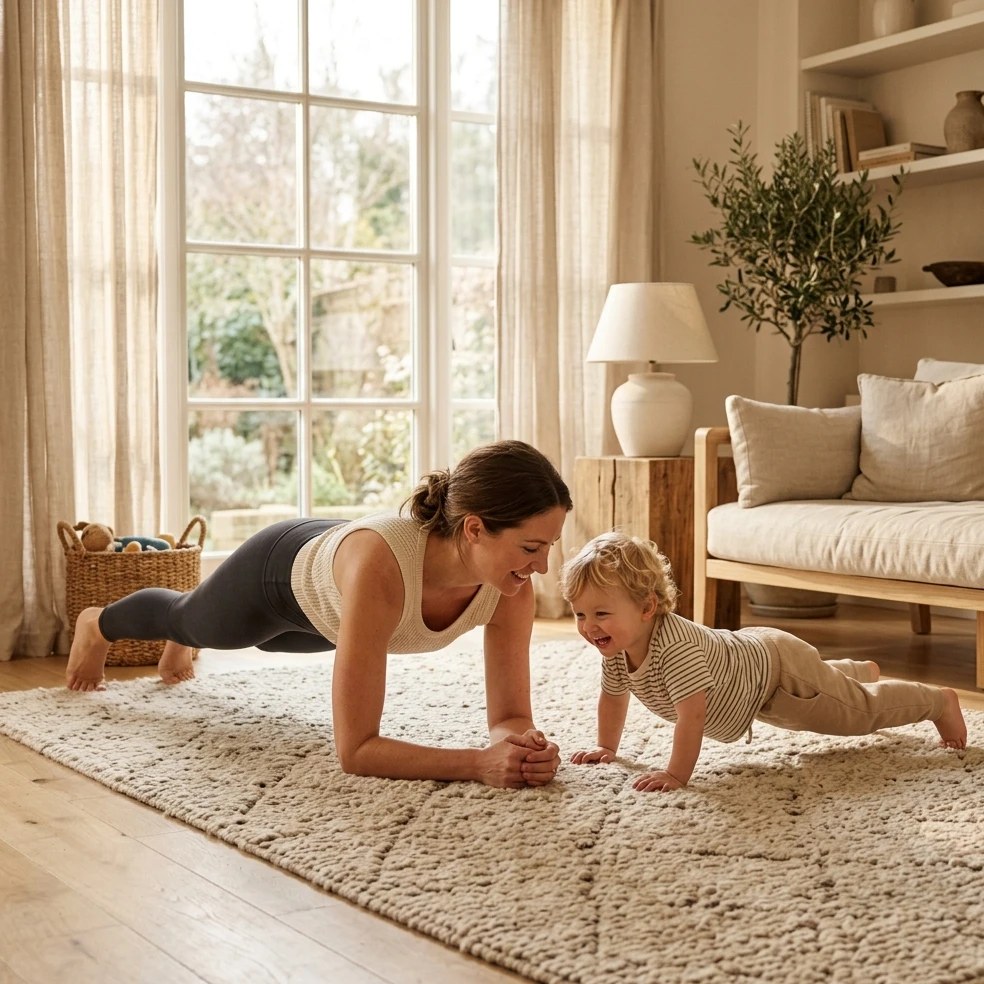
The longer-term cue: parents of toddlers who plan to do beach days routinely benefit from a basic core-and-glute strengthening routine (planks, bird-dogs, glute bridges, single-leg deadlifts) twice a week. This is less about preventing any single beach-day injury than about maintaining the trunk-stability and hip-strength capacity that makes the carrying years less likely to produce the ‘chronic low-back pain that started during the toddler years and never fully resolved’ pattern that family-medicine clinics document. The evidence base for trunk stability training as a preventive intervention in working-age adults is solid (McGill 2007 McGill 2007; Plamondon 2014 Plamondon 2014).
Practical takeaways
- The default hip carry is asymmetric in three ways: load offset, contralateral lean, and gait disruption — combined, the highest-risk parent-carry pattern outside of occupational lifting.
- A properly-fitted soft-structured carrier or wrap centres the child’s weight, transfers load to the iliac crests, and reduces lumbar EMG activity 35–60% versus hip carry.
- Waistband on the iliac crests, shoulder straps as stabilisers (not load-bearers), seat wide enough to support knee-to-knee — the fit details that matter.
- On loose dry sand, the asymmetric-load penalty is amplified vs firm surfaces; walk the wet-sand band where possible for longer carries.
- Squat to set the child down (knees bend, spine stays upright); the bend-at-the-waist set-down is the most common ‘back went out’ trigger.
- Alternate carrying side every 50–100 m, share carrying time between parents where possible, and add 5–10 min of post-carry mobility plus twice-weekly core/glute work as the longer-term protection.
References
Williams 2013Williams AS, Ng JKF, Stokes M. Effect of infant-carrier use on the muscle activity and posture of the carrier: a comparative pilot study. Journal of Physical Therapy Science. 2013;25(11):1409-1413. View source →Plamondon 2014Plamondon A, Lariviere C, Denis D, Mecheri H, Nastasia I. Difference between male and female workers lifting the same relative load when palletizing boxes. Applied Ergonomics. 2014;45(6):1558-1564. View source →McGill 2007McGill SM. Ultimate back fitness and performance, fourth edition (lumbar spine ergonomics monograph). Backfitpro Inc.. 2007;4:1-360. View source →Junker 2018Junker S, Brown SJ, Smith T. Asymmetric load carriage and gait kinematics on unstable surfaces in healthy adults. Gait & Posture. 2018;65(1):212-218. View source →