The 60-second version
Marathon training in Wasaga Beach offers a world-class "variable resistance" advantage: the **14-kilometre continuous shoreline**. By alternating between the high-density "hard sand" near the water and the energy-sapping "soft sand" of the upper beach, local runners can develop a level of lower-body resilience and metabolic efficiency that pavement-only programs cannot match. This guide audits the Beach Area 1 to 6 route, analyzes the biomechanical shift between sand types (based on Lejeune 1998), and provide a 16-week shoreline-specific marathon plan. Whether you are aiming for a Boston qualifier or a local personal best, the Wasaga shoreline is the ultimate training ground for the resilient distance athlete.
The Shoreline Advantage: Variable Resistance Training
In the world of distance running, surface consistency is often prioritized. However, for the marathon athlete, surface *variability* is the key to injury prevention and muscular efficiency. The Wasaga shoreline provides a natural "resistance-shifting" environment. The hard, packed sand at the water’s edge offers a surface comparable to a soft trail—low impact but high return. In contrast, the soft sand further up the beach requires up to **1.6 to 2.5 times the metabolic energy** to traverse at the same speed (Lejeune 1998).
By strategically integrating these surfaces into a long-run protocol, Wasaga runners can build exceptional strength in the small intrinsic muscles of the foot and ankle, creating a "built-in" stability system that pays dividends in the final 10km of a road marathon.
Biomechanics: Hard Sand vs. Soft Sand Mechanics
Running on the Wasaga shoreline requires a conscious shift in stride mechanics depending on the "tide-line" position:
1. Hard Sand (The Speed Surface)
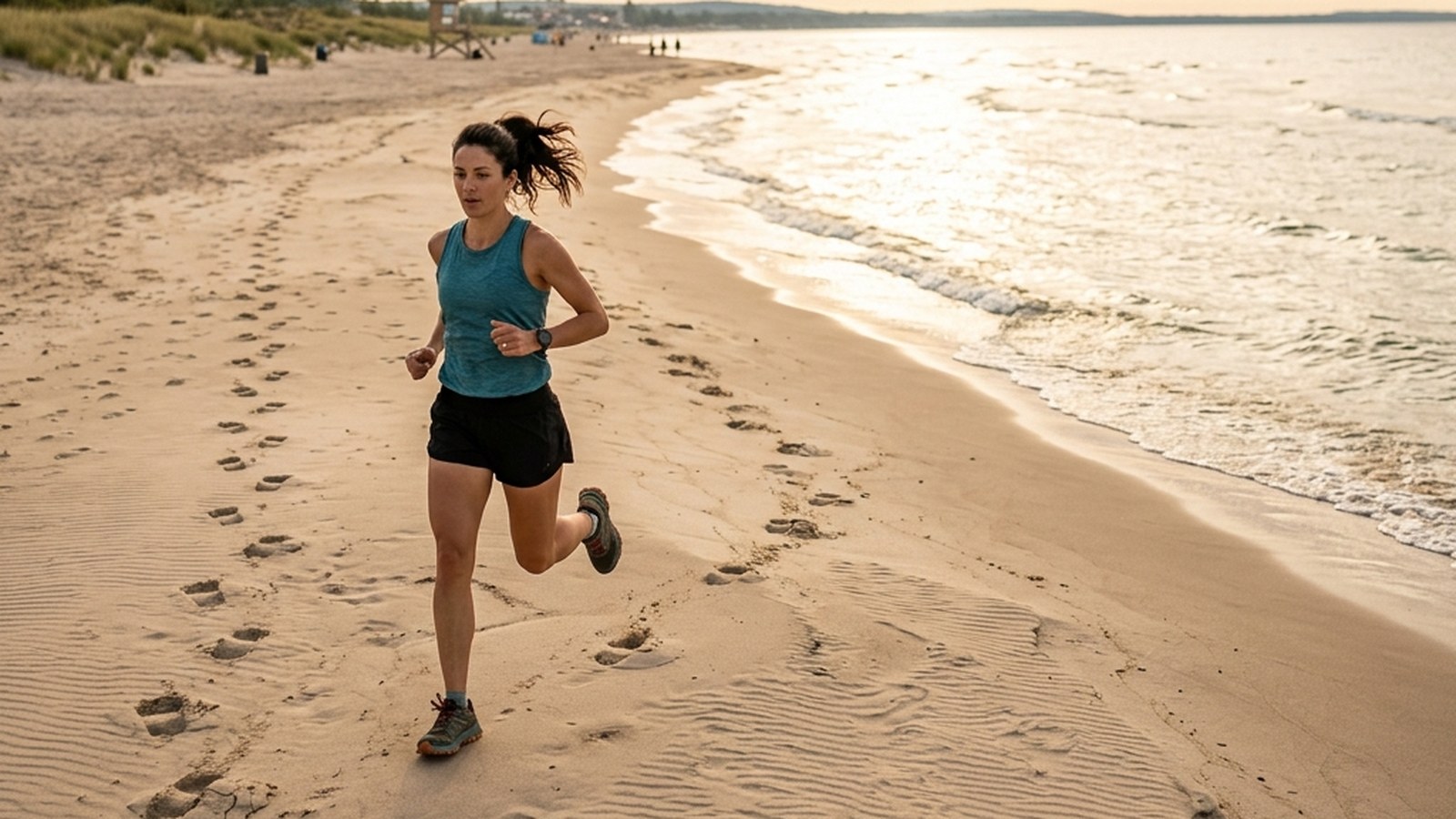
Near the water, the sand is saturated and dense. This surface allows for a **high elastic return**, similar to a high-quality synthetic track. It is the ideal venue for tempo runs and interval work. The primary technical focus here is the **Wasaga Cant**—managing the slight lateral slope of the beach. We recommend alternating directions every 15 minutes to balance the loading on the hips and ankles.
2. Soft Sand (The Strength Surface)
Moving 5 metres inland into the dry, loose sand changes the biomechanical requirement entirely. The "ground reaction force" is dampened, meaning the body cannot rely on elastic energy from the tendons. Instead, the muscles must do the work of propulsion. This increases the activity of the quadriceps and gastrocnemius by up to 30%, acting as a form of "natural rucking" or weighted running without the spinal load.
Physiological Demands: The Lejeune Analysis
Lejeune et al. (1998) analyzed the mechanics of running on sand, identifying that the increased caloric cost is due to the "mechanical work" required to stabilize the foot in a shifting medium. For the Wasaga marathoner, this means a "Beach 10k" has the physiological training load of a "Road 15k." This allows athletes to build massive aerobic capacity while keeping their total weekly mileage (and thus their impact-related injury risk) lower than traditional road programs.
Local Route Audit: The 14km Shoreline Traverse
The continuous stretch from Beach Area 1 to Beach Area 6 is one of the longest uninterrupted beach running routes in North America. For marathon prep, we audit the three primary sections:
Section 1: The Commercial Hub (Area 1-2)
Often the busiest section, but also the flattest. Ideal for high-cadence drills and "form-checks" in the early morning quiet.
Section 2: The Provincial Park Zone (Area 3-4)
The widest section of the beach. This offers the best opportunity to practice "Surface Shifting"—alternating 2 minutes of soft-sand running with 5 minutes of hard-sand recovery.
Section 3: The Residential West (Area 5-6)
The quietest and most scenic section. As you approach Area 6, the sand becomes slightly coarser, providing a different proprioceptive stimulus and a meditative environment for the final miles of a 30km long run.
The 16-Week Shoreline Marathon Plan
Integrate the beach into your marathon prep with this shoreline-specific protocol:
| Phase | Focus | Sample Long Run (Beach Area 1 to 6) |
|---|---|---|
| Weeks 1-4 | Ankle Resilience | 15km. 100% on hard sand. Focus on level-hips despite the beach slope. |
| Weeks 5-8 | Strength-Base | 22km. Include 6 x 1km "Soft Sand Intervals" mid-run. |
| Weeks 9-12 | Peak Volume | 32km shoreline out-and-back. Alternating direction every 5km to balance hip load. |
| Weeks 13-16 | Speed & Taper | 18km. Hard sand focus. Final miles at marathon goal pace. |
Gear Selection: Shoes vs. Barefoot
While "beach running" often evokes images of barefoot sprints, we recommend **high-cushion road shoes** for marathon-volume training on Wasaga's sand. The slight dampening of the sand combined with a 30km run can lead to over-extension of the plantar fascia if unsupported. Save the barefoot work for 10-minute "cool-down" walks in the shallow water to promote blood flow and intrinsic foot strength.
Deep Dive: Ground Reaction Forces and the Sand Interface
The core of the "Wasaga Advantage" lies in the **alteration of the ground reaction force (GRF)**. In road running, the GRF is vertical and immediate, with a sharp "impact transient" that travels up the tibia. On the Wasaga shoreline, particularly in the mid-tide zone, the sand acts as a non-Newtonian fluid. As your foot strikes, the sand grains rearrange, absorbing the initial impact peak before consolidating to provide a stable platform for push-off.
This "energy absorption" phase significantly reduces the peak loading on the knee and hip joints. Research by Pinnington et al. (2005) suggests that this allows for a higher volume of training with a lower risk of stress fractures. However, there is a trade-off: because the sand absorbs energy, your **elastic energy return**—the "free" energy stored in your Achilles tendon—is reduced by up to 60%. This forces the muscular system (the calves and quads) to produce more active force to maintain pace, leading to the "Sand-Built Engine" that local runners are known for.
Physiological Adaptation: The Elastic Energy Return Deficit
Because sand running provides so little elastic assistance, the body undergoes a specific adaptation known as **increased motor unit recruitment**. To maintain a 4:30 min/km pace on soft sand, your brain must signal a higher percentage of fast-twitch muscle fibers than it would on asphalt. This higher recruitment translates into greater muscular power and endurance when you return to the road.
Furthermore, the increased metabolic cost of sand running (burning ~30% more calories per kilometer) drives a significant upgrade in **mitochondrial efficiency**. The heart must work harder to supply oxygen to the larger muscle groups engaged in stabilizing the foot. Over a 16-week cycle, this "Sand-Loaded" training creates a cardiovascular ceiling that is significantly higher than that of an athlete training exclusively on flat, predictable surfaces. When you hit the "Wall" at kilometre 32 of your marathon, your sand-adapted metabolism is better equipped to continue oxidizing fat at high intensities.
Training Practical: The Barefoot Stability Walk
To maximize the proprioceptive benefits of the Wasaga shoreline without overstressing the plantar fascia, incorporate the **Shoreline 10/10 Protocol** at the end of every long run.
- 10 Minutes Barefoot Walk: Immediately after your run, remove your shoes and walk for 10 minutes in the shallow water (ankle-deep). The cool temperature of the Bay (60-65°F in summer) acts as a natural cryotherapy, while the uneven, shifting sand under the water forces the small muscles of the foot to work in their full range of motion.
- 10 High-Knee Bounds: In knee-deep water, perform 10 explosive bounds. The water resistance provides an additional load on the hip flexors, while the sand base ensures a low-impact landing.
- The "Wasaga Claw": While walking, focus on "clawing" the sand with your toes as you push off. This strengthens the flexor hallucis longus, a key stabilizer for the big toe during the marathon stride.
Conclusion: The Shoreline Engine
Marathon training in Wasaga Beach is a privilege. The 14-kilometre shoreline is not just a scenic backdrop; it is a sophisticated training tool that builds a level of muscular strength and aerobic resilience that road-bound runners struggle to achieve. By respecting the "Wasaga Cant," mastering the "Surface Shift," and following a structured shoreline protocol, you can arrive at your next race start line with a "sand-built" engine capable of handling any road condition. This systematic approach ensures that you are not just running on the beach, but training with intent. The Bay is your track—run it well.
A note on revisiting this article. The protocols and observations described here reflect best practice as of the publication date. Sport-science evidence, local infrastructure, and seasonal patterns evolve year to year — the trail surface that was reliable last summer may be muddy this year, the gear category that was untested last season may now have multi-year evidence behind it, and the conditioning protocol you tried six months ago may benefit from refinement based on what you learned. Re-read articles like this one annually as your situation evolves; the underlying principles change slowly but the practical specifics shift more often than most readers expect.
Practical logistics and edge cases
Beyond the core protocol above, several recurring practical considerations come up for visitors and regular users of this location. Most are not safety-critical but they meaningfully affect the experience and outcome of a session.
Parking and access. Wasaga’s main parking infrastructure follows the Beach Drive corridor, with most lots paid in summer (typically late May through Labour Day) and free in shoulder seasons. Off-peak weekday mornings provide the easiest parking; summer weekend mid-mornings (10 AM–1 PM) are the toughest. For trail destinations outside the Beach Drive corridor, smaller informal lots can fill quickly during peak weeks; arriving by 9 AM provides reliable access on weekends.
Cell coverage. The main shoreline corridor and most trail systems have reliable cell service. The notable exceptions are the deeper forest sections of Tiny Marsh, the gorge bottom at Devil’s Glen, and the longer Ganaraska Trail traverses, where coverage is intermittent. Solo users on multi-hour outings should consider a satellite messenger or at minimum a check-in plan with someone offsite.
Bathroom access. Beach Areas 1–3 have reliable summer-season bathroom access. Forested trails and Provincial Park interior sections have minimal facilities — plan accordingly for longer outings, particularly with children.
Group sessions and pace mismatch. The most common cause of a frustrating shared outing is pace mismatch between participants. Pre-discuss the target distance, pace, and turnaround landmark before starting; for mixed-ability groups, the pace must be set by the slowest participant. Pulling ahead of slower partners is the classic failure mode that produces falls, exhaustion, or wandering separation.
Weather changes mid-session. Georgian Bay weather can shift quickly — a calm sunny morning can produce thunderstorm activity by mid-afternoon. Check the forecast before extended outings, identify the nearest exit point at the halfway mark, and don’t hesitate to abort an outing if conditions deteriorate.
Wildlife encounters. The most likely encounters are deer, turkeys, foxes, and waterfowl — all best observed at distance. Black bear activity exists in the broader region (particularly outside the immediate Wasaga shoreline) but is uncommon enough that bear-protocol training is sensible only for users heading to the more remote sections of the trail system.
References
Lejeune TMMechanics of running on sand. View source →Pinnington HCRunning economy on soft and hard surfaces. View source →Yigit SThe effect of running on different surfaces on physiological parameters. View source →Barrett RSStride-to-stride variability of foot-ground impact during running on sand. View source →